
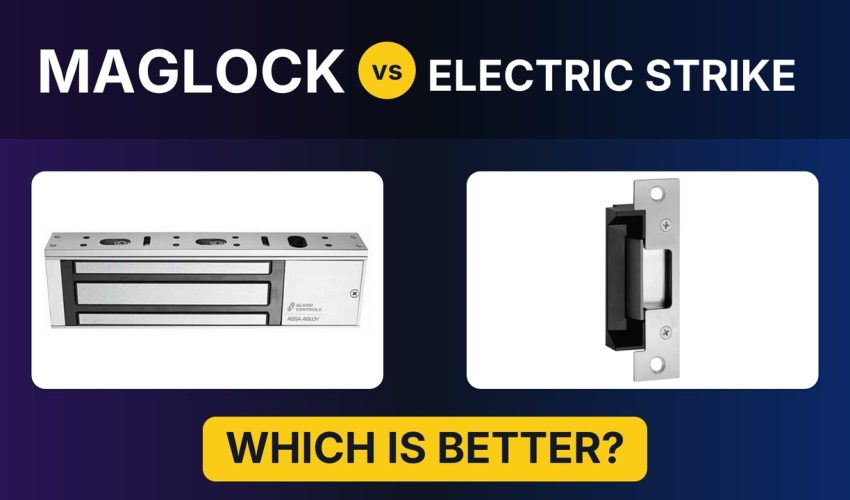
A maglock and an electric strike both let a card reader open a door. They do it in completely different ways. A maglock holds the door shut with a magnet. An electric strike is a gate in the door frame that lets a normal latch through. That one difference decides what happens when the power fails, how people get out in an emergency, and which doors each lock suits.
We made a full video guide with animated cutaways and real product photos. Watch it first if you prefer to see the parts move. The written guide below covers the same ground for quick reference.
The short answer
- Maglock: an electromagnet on the frame holds a steel plate on the door. Power on, it holds. Power off, it lets go. It is always fail-safe, and it needs its own release devices so people can exit.
- Electric strike: it replaces the strike plate in the frame. The door keeps its latch and its lever or push bar. The strike only decides whether the latch can pass. It comes in fail-safe and fail-secure versions.
- Neither is automatically better. The door, the exit requirements and the local code decide.
How a maglock works
A maglock, short for electromagnetic lock, has two parts. The magnet body bolts under the frame header on the secure side of the door. Inside it is a coil of copper wire around a steel core. The armature plate, a flat piece of steel, bolts to the door directly opposite.
When current flows through the coil it creates a magnetic field that pulls the plate tight against the magnet. There is no bolt and no latch. The door is held by magnetic force alone. Cut the power and the field collapses, so the door is free. Think of a scrapyard crane: current on, it lifts the car. Current off, the car drops.
Two things catch people out. First, alignment. The plate has to sit flat on the magnet, and a small gap or a twisted door cuts the holding force sharply. Second, the rating. Maglocks are commonly sold in classes such as 600 lb and 1,200 lb. That figure comes from a straight pull in a lab. On your door, the frame, brackets, fasteners and alignment decide how the lock really performs.
How an electric strike works
Start with an ordinary door. A spring latch sticks out of the door edge and sits in a hole in a metal strike plate on the frame. Turning the handle pulls the latch back.
An electric strike replaces that plain plate. One side of its opening is a moving piece called the keeper. Behind the keeper, a solenoid moves a locking pin. When the controller grants access, the pin releases the keeper. Pull the door and the latch simply pushes the keeper aside.
This is the part most people get wrong: an electric strike does not retract the latch. The latch stays extended the whole time. The strike opens a gate and lets it through. From the inside nothing changes. The lever or push bar still pulls the latch back mechanically, with no electricity involved.
Fail-safe vs fail-secure
These two terms describe what the lock does on the secure side of the door when power is removed.
- Fail-safe: power removed, the lock releases.
- Fail-secure: power removed, the lock stays locked.
They do not describe whether people can get out. That is a separate question, answered by the exit hardware. A fail-secure strike keeps the outside locked in a power failure while the lever inside still opens the door. Fail-secure does not mean anyone is trapped.
| Lock | Power on | Power off | Exit from inside |
|---|---|---|---|
| Maglock | Locked | Unlocked | Through release devices while powered |
| Fail-secure electric strike | Locked until a valid card | Stays locked from outside | Lever or push bar, always |
| Fail-safe electric strike | Locked from outside | Unlocked | Lever or push bar, always |
A backup battery changes the picture for a maglock. It keeps the door locked through an outage, which is good for security. The fire alarm release still has to cut power to the lock whether the building is on mains or battery. Backup power must never override life safety.
Getting out: emergency exit and fire doors
A maglock has no handle and no latch, so the way out has to be built into the system. Depending on the code that applies, that can mean a request-to-exit sensor or push button at the door, a manual release, a fire alarm connection that drops the lock, and release on any loss of power.
In Ontario, the Building Code allows maglocks on exit doors only under specific conditions. In summary, the building needs a fire alarm system. The lock has to release immediately on alarm, on loss of power, and when a manual pull station beside the door is operated. The door carries a sign reading EMERGENCY EXIT UNLOCKED BY FIRE ALARM, and the lock is reset by hand after a release. Maglocks are also restricted on some exits, including those where panic-type hardware is required and exits serving schools. Other provinces and countries write this differently, and your local building department has the final word. Our access control and Ontario Fire Code checklist goes deeper on what property managers need to keep on file.
Fire-rated doors add one more rule. A fire door has to latch shut on its own during a fire, which is called positive latching. A maglock has no latch, so it cannot provide that alone. Strikes on fire doors generally need to be fail-secure and listed for that use, and cutting a rated frame beyond what its listing allows can void the rating.
Maglock vs electric strike at a glance
| Feature | Maglock | Electric strike |
|---|---|---|
| Locking principle | Electromagnetic holding force | Keeper that holds a mechanical latch |
| Where it mounts | Frame header and top of door | In the frame, opposite the latch |
| On loss of power | Unlocks | Depends on the model: fail-safe or fail-secure |
| Mechanical latch | Not part of the lock | Needs a compatible latch on the door |
| Free exit | Needs a compliant release arrangement | Usually by the lever or exit device |
| Fire-rated doors | Needs separate positive latching and approval | Listed, generally fail-secure hardware |
| Power draw | Continuous | Fail-secure draws only when unlocking |
| Maintenance | Magnet face, armature, alignment | Keeper, latch, door alignment |
Which lock for which door
Glass storefront entrance
Narrow aluminum frames often carry a hook bolt instead of a spring latch, so there is nothing for a strike to release. A maglock can be the practical route here. It needs the proper release devices and local approval, and it will not hold the door in a power failure unless it is backed up.
Office entrance with a mortise lock
The latch is already there, so an electric strike is a natural fit. The door stays secure in an outage and people leave with the lever. Check the latch type, the frame depth and that the strike keeps the deadlatch pin pressed in.
Warehouse staff door
Steel door, steel frame, heavy use. If the door must stay locked when power fails, a fail-secure strike with a solid exit device is a common choice. Watch for door sag and pressure on the latch, because a strike under load may not release. Our door access troubleshooting guide covers that fault in detail.
Fire-rated corridor door
The latch matters most. Use hardware listed for fire doors and make sure the door latches every time. Any change has to respect the labels on the door and frame.
Double doors
Pairs are a special case. A centre post, vertical rods or exit bars on both leaves change what will fit. The answer may be electrified exit devices, a strike for the active leaf, or a double maglock where the code permits it.
For a wider look at strikes, maglocks, electrified locks and exit devices, see our commercial door hardware guide.
Wiring and power basics
In most commercial systems the card reader does not power the lock. A separate power supply does, switched by a relay in the controller. A lock that needs power to stay locked, like a maglock, is usually wired through the normally closed contact. A lock that needs power to unlock, like a fail-secure strike, usually goes through the normally open contact. The right choice depends on the equipment and the release logic the code requires.
Most hardware runs on 12 or 24 volts DC, and many devices accept only one of the two. A maglock draws current all day. A fail-secure strike draws current only when it unlocks, sometimes with a brief inrush surge. Size the power supply, the relay contacts and the cable for that load. Long runs lose voltage, so check the wire gauge for access control and run the numbers in our voltage drop calculator.
Cost: compare the job, not the part
A maglock is often quick to mount. It can also need brackets, an exit sensor, a release button, a pull station, signage, a fire alarm connection, testing and paperwork. A strike may need the frame cut and the right latch, but it often reuses the exit hardware already on the door. So the cheaper component can turn into the more expensive job. The controller, power supply, cabling and labour belong in both columns.
Ten questions to answer before you choose
- Is the door part of a required exit route?
- Is it fire-rated?
- What latch or exit device is already on it?
- Does the frame suit a strike, or the header suit a magnet?
- What should happen when power fails?
- Must it stay locked against entry in an outage?
- What type of door is it: glass, aluminum, steel or wood?
- Is the hardware compatible with that door?
- What monitoring do you need, such as door position or lock status?
- What does your local authority permit?
Some patterns do show up. If the door already has a good latch, must stay locked in an outage, or is fire-rated, look at an electric strike or other latching hardware first. If the door has no usable latch or frame and the code allows a maglock with the proper releases, the maglock may be the practical route. Treat these as starting points, not rules.
Common mistakes
- Treating an electric strike and an electric bolt as the same thing. A bolt drives a pin into the door or frame. It is a different product.
- Assuming every electric strike is fail-secure. Both versions exist, and some models can be switched in the field.
- Thinking fail-secure means no escape. Exit depends on the mechanical hardware.
- Putting a maglock on every glass door. It depends on the door, the exit route and the code.
- Ignoring the fire rating or the need for a latch.
- Assuming the card reader powers the lock.
- Forgetting how battery backup and emergency release interact.
- Choosing on holding force alone.
Frequently asked questions
Is a maglock more secure than an electric strike?
Not automatically. A maglock has no moving parts to wear and holds the door directly, but it needs power every second and depends on alignment. A strike relies on a mechanical latch and can stay locked without power, but a sagging door or worn latch weakens it. A well installed lock of either kind beats a poorly installed one.
Does a maglock unlock when the power goes out?
Yes. A standard maglock is fail-safe by nature. It stays locked through an outage only if a backup battery keeps feeding it, and the emergency releases still have to work on battery.
Can I use an electric strike on a glass door?
Sometimes. Framed aluminum doors can take a strike made for narrow frames if the door has a latch rather than a hook bolt. Frameless glass doors usually have no place for one.
Do I need a permit for a maglock in Ontario?
Often, yes. Because a maglock ties into the fire alarm and affects an exit, many municipalities ask for a permit and a declaration that the installation meets the Building Code. Check with your local building department before any work starts.
Need a door looked at?
Cablify installs door access control and security cameras for commercial buildings across Toronto and the GTA, including Mississauga, Brampton and Vaughan. We will look at the door, the frame and the exit route, then tell you which lock fits. Site assessments are free. Call 647-846-1925. If you are still choosing cards, fobs or mobile credentials, our access control credentials guide is the next read.
This guide is general education, not code or engineering advice. Door hardware, fire safety and exit requirements depend on your building and your jurisdiction. Always follow the manufacturer’s instructions and confirm with your local authority before installation.