
Kitchener · Waterloo · Cambridge
Network Cabling in Kitchener-Waterloo for Commercial Spaces
Cablify installs structured copper and fiber cabling for offices, warehouses, plants, network upgrades and commercial renovations across the Kitchener-Waterloo region. Copper drops, fiber backbones, racks and patch panels, access point cabling, testing and labeling, handled by one contractor.
- Cat6 & Cat6A
- Fiber optic cabling
- Racks & patch panels
- Access point cabling
- Testing & troubleshooting
Free on-site site survey before we quote. Mon to Sat, 8:00 to 20:00.
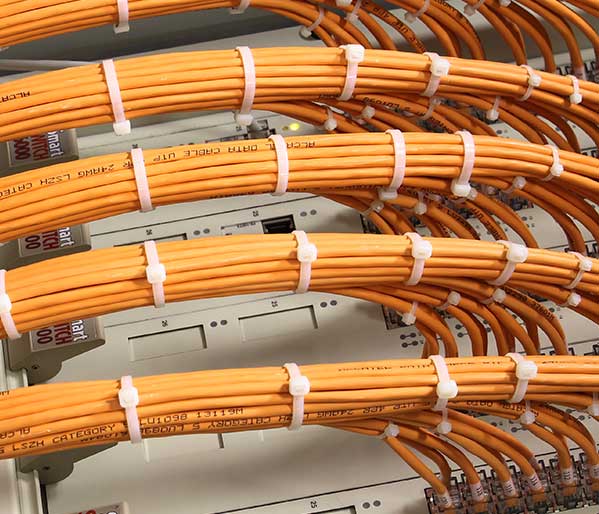
Copper and fiber
Cat5e through Cat6A, plus fiber installation, termination and fusion splicing by the same company.
Tested and labeled
Drops are tested with certification equipment. Test reports can be provided for your records or your landlord.
Panduit certified installers
Manufacturer-certified installation practices. See our Panduit certification.
Free on-site survey
We look at the space before we price it, then put the scope and the cost in writing for approval.
Local coverage
Structured cabling for Kitchener and Waterloo businesses
Most of the cabling work in Kitchener-Waterloo falls into a handful of patterns. A company signs a lease on a floor that was cabled fifteen years ago and needs the whole thing replaced. A growing team runs out of ports and needs twenty more drops before the new hires start. A warehouse adds a mezzanine and now needs coverage where there was never a data run. A tech firm moves buildings over a weekend and everything has to be live Monday morning.
Cablify handles those jobs. We install Cat6 and Cat6A drops, run fiber backbones between floors and buildings, build and terminate racks, cable ceiling-mounted wireless access points, and connect MDF and IDF rooms so the network has somewhere organized to land. On renovations and new construction we work to the drawings and around the other trades, running cable in the rough-in stage and coming back to terminate once the walls and ceilings are closed.
Cablify is based in the Greater Toronto Area and works across Southwestern Ontario, including Kitchener, Waterloo, Cambridge and Guelph. There is no Cablify office in Kitchener. What there is instead is a crew with over 50 years of combined industry experience, arriving with the right test equipment, the right terminations and enough cable to finish the job on the day it was scheduled.
Typical Kitchener-Waterloo projects
- Office build-outs and tenant improvements
- Adding drops to an existing floor
- Replacing aging Cat5e infrastructure
- Warehouse and mezzanine coverage
- Fiber between floors or buildings
- MDF and IDF room cabling
- Wireless access point cabling
- Office moves and equipment relocations
- Rack cleanups and re-terminations
What we install
Commercial cabling services
Every service below is delivered by Cablify crews. Follow the links for full detail on any one of them.
Structured network cabling
Complete cabling systems: horizontal runs from the telecom room to work-area outlets, patch panels, faceplates, jacks, cable management and labeling. Built to a standard layout so ports can be traced, moved and added later without pulling the rack apart.
Cat6 and Cat6A cabling
Cat6 for standard gigabit office and warehouse networks, Cat6A where 10 Gigabit to the desk, dense PoE loads or longer high-bandwidth runs are involved. We will tell you honestly which one your project actually needs rather than defaulting to the more expensive cable.
Fiber optic cabling
Multimode and single-mode fiber for backbones between floors, buildings and distribution rooms. Installation, termination, fusion splicing and testing are all done in-house, including emergency repairs on damaged fiber runs.
Racks, cabinets and patch panels
Wall-mount and floor-standing racks, cabinets, patch panels, horizontal and vertical cable management, and proper dressing of the bundles. A rack that is built well the first time saves hours every time somebody needs to trace a port.
Server room and telecom room cabling
MDF and IDF build-outs, backbone links between rooms, cabinet layout, patching and cable management. Includes tidying up rooms that grew organically over the years and no longer have a usable pathway for the next cable.
Wi-Fi access point cabling
Data drops to ceiling and wall-mounted wireless access points, including the mounting locations, PoE considerations and the runs back to the switch. Where AP placement is not already decided, a wireless site survey can be arranged first.
Testing and troubleshooting
Certification testing on new copper installs, OTDR testing on fiber, and fault finding on existing runs that fail, drop or never worked properly. Useful when you have inherited an undocumented network and need to know what actually works.
Cable removal and cleanup
Removal of abandoned cable above ceilings and under floors, which is often required by code during a renovation, plus rack cleanups, re-dressing and re-labeling. Frequently the first job on a floor before any new cable can be pulled.
Pathways: conduit and cable tray
Conduit, cable tray, J-hooks and sleeves where cable cannot simply be draped over a ceiling grid. Exposed ceilings, warehouse structures, fire-rated walls and outdoor runs between buildings all need a proper pathway installed first.
Choosing cable
Cat6, Cat6A or fiber
There is no single right answer. The cable that suits a 40-person office is not the cable that suits a distribution centre with 300 metres between the office and the far wall. Here is how the three compare in practice.
| Cat6 | Cat6A | Fiber optic | |
|---|---|---|---|
| Typical use | Standard office and warehouse drops, phones, cameras, access points. | 10 Gigabit to the desk, dense PoE devices, high-bandwidth floors. | Backbone between floors, buildings and distribution rooms. |
| Bandwidth | 1 Gigabit across the full run. 10 Gigabit only over shorter distances. | 10 Gigabit across the full run. | 10 Gigabit and well beyond, depending on fiber type and optics. |
| Distance | 100 m at 1 Gigabit. Roughly 37 to 55 m at 10 Gigabit, depending on conditions. | 100 m at 10 Gigabit. | Hundreds of metres on multimode. Kilometres on single-mode. |
| Interference | Fine in normal commercial environments. Keep separation from power. | Better isolated. Shielded versions available for electrically noisy sites. | Immune to electrical interference. Suits plants and long outdoor runs. |
| Install considerations | Smallest diameter, easiest to route in tight pathways. | Thicker and stiffer, larger bend radius, needs more pathway space. | Needs transceivers or media converters at both ends. Does not carry PoE. |
| Suits | Most offices, retail units and light industrial floors. | Tech and engineering firms, labs, high-density Wi-Fi, buildings you intend to keep. | Multi-building sites, long warehouse runs, floor-to-floor links. |
| Upgrade path | Switch upgrades get you a long way before the cable is the limit. | Headroom for the next network refresh without recabling. | Usually upgraded by changing the optics, not the fiber. |
Table scrolls sideways on narrow screens.
Where it goes in
Commercial environments we cable
Each building type brings its own constraints. Knowing them before the quote is what keeps a project on schedule.
Offices
Drops to desks, meeting rooms, printers and access points, usually run above a T-bar ceiling to a floor-level IDF. The variables are furniture layout, whether power and data share a pathway, and how much the tenant expects to reconfigure the space later.
Warehouses and distribution
Long runs, high ceilings and lift access. Distances often exceed what copper will carry, so fiber goes to a remote switch and copper covers the last stretch to scanners, access points and cameras. Cable tray and conduit usually come first.
Manufacturing and industrial
Electrically noisy, physically hard on cable. Pathways need protection from forklifts and vibration, separation from motor and power runs matters, and fiber is often the sensible choice between the plant floor and the office side of the building.
Multi-floor commercial buildings
A main distribution room feeding an IDF on each floor, with a fiber backbone in the riser and copper horizontally from there. Riser routes, sleeve locations and firestopping are usually the parts that need coordinating with the building.
New commercial construction
Cable pulled during rough-in while the walls are open, terminated and tested after ceilings close. Work is sequenced against the drawings and the other trades, and the pathway has to be in before drywall goes up.
Renovations and tenant improvements
Almost always includes removing abandoned cable before anything new goes in. Existing runs need to be identified and either reused or cut back, and much of the work happens around a live business or outside of its hours.
Our work
Recent commercial installations
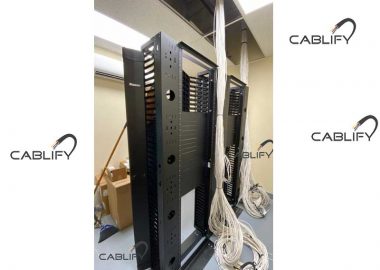
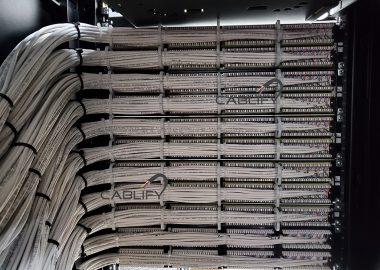
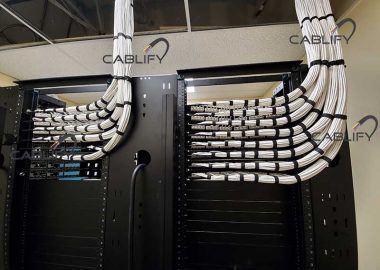
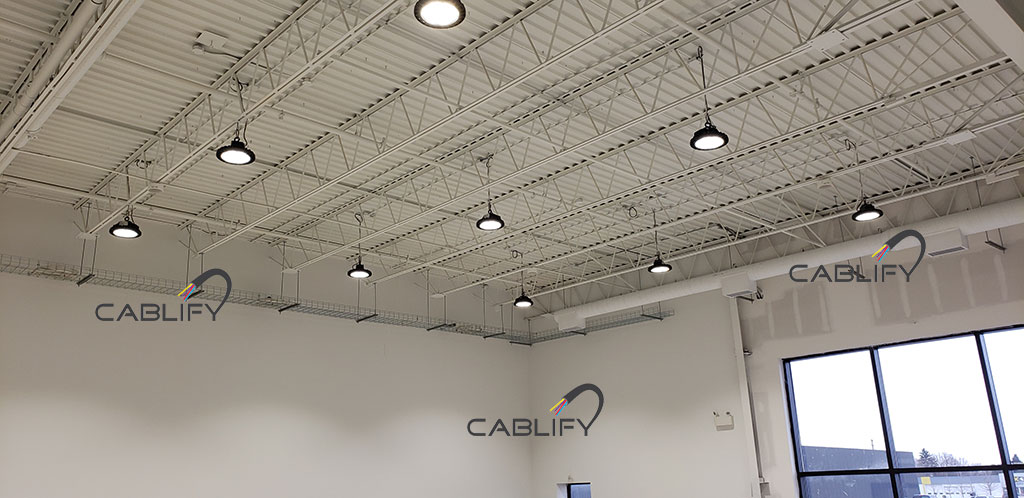
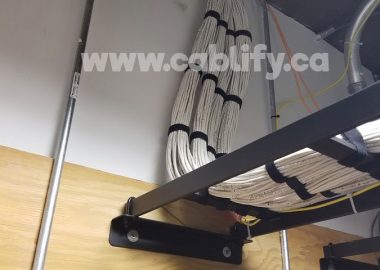
Photographs from Cablify projects. See the full cabling gallery.
Coverage
Where we work in the region
Kitchener and Waterloo are the focus of this page, and Cambridge sits inside the same service run. We also cover the surrounding Southwestern Ontario corridor, and travel there regularly enough that a site visit is rarely a problem.
If your project is outside the list, call and ask. Multi-site work across several cities is common and often easier to schedule as one project.
- Kitchener
- Waterloo
- Cambridge
- Guelph
- Brantford
- London
- Hamilton & Burlington
- Milton & Halton
- St. Catharines & Niagara
- Mississauga & GTA
Questions we get asked
Commercial cabling FAQ
How much does commercial network cabling cost in Kitchener-Waterloo?
Cabling is quoted per project, because the cost is driven by things a price list cannot capture: drop count, cable type, distance from the telecom room, whether a pathway already exists, ceiling height and access, and whether the work happens during business hours or after them. A dozen drops in an open office with an accessible ceiling is a very different job from the same count in a warehouse with a 30-foot ceiling and no tray. We survey the site free of charge, then quote the work in writing.
Do you install Cat6 and Cat6A cabling?
Yes, both, along with Cat5e where it suits the application. Cat6 covers most commercial requirements and supports gigabit across a full 100 metre run. Cat6A is the choice when you need 10 Gigabit at distance, are running dense PoE loads, or want the cabling to outlast two or three network refreshes. Cat6A is thicker and needs more pathway space, so it does affect the install. We will tell you which one your project actually calls for.
Can you add network drops to an existing office?
Yes, and it is one of the most common jobs we do. Adding drops to an occupied space is mostly a question of access and scheduling: where the existing pathway runs, whether the ceiling can be opened, whether there is a free port on the patch panel or a new panel is needed, and when we can work without disrupting the office. Small additions get scheduled the same way as larger projects, and there is no minimum drop count.
Do you install fiber optic cabling?
Yes. We install multimode and single-mode fiber, terminate it, fusion splice and test it. Fiber is typically used for backbone links between floors, between buildings on the same property, or from an office to a remote area of a warehouse where copper cannot reach. Fusion splicing and OTDR testing are done in-house rather than subcontracted, and we also handle emergency repairs on fiber that has been cut or damaged.
Can you run cabling for Wi-Fi access points?
Yes. Access point cabling is a standard part of most installs: a drop to each AP location, run back to the switch that will power it over PoE. The main things worth settling before the install are how many access points you need and where they should physically sit, since moving one afterwards means pulling a new cable. If placement is not decided, a wireless site survey can be done first to work out coverage and count.
Can you clean up or reorganize an existing network rack?
Yes. Rack cleanups usually involve re-dressing the bundles, replacing damaged patch cords, re-terminating anything that fails, re-labeling both ends and often adding proper cable management that was never installed. In many cases we also remove abandoned cable at the same time. If the rack has grown organically over ten years, it is generally faster to strip and rebuild it properly than to keep working around it.
Do you work on office renovations and new commercial construction?
Yes. On new construction we install pathway and pull cable during rough-in while walls are open, then return to terminate and test once ceilings and drywall are closed. On renovations there is usually an extra step first, which is identifying and removing abandoned cable. Either way the work has to be sequenced against the other trades, so the earlier we see the drawings, the fewer surprises there are for everyone.
Can you test or troubleshoot existing network cabling?
Yes. Common symptoms are ports that negotiate at a lower speed than they should, links that drop intermittently, or drops that never worked from the day the office was occupied. We test the run, identify whether the fault is the cable, a termination, a patch cord or the pathway, and repair or re-terminate as required. On fiber, OTDR testing locates the fault along the run rather than requiring you to guess.
Should our business install Cat6, Cat6A or fiber?
For most offices in Kitchener-Waterloo, Cat6 is the sensible default and will not be the bottleneck for years. Cat6A makes sense when 10 Gigabit to the desk is a real requirement, when PoE loads are high, or when you own the building and want to cable it once. Fiber is for distance and for links between buildings or floors, not for individual desks. Most projects end up using a combination: fiber for the backbone, copper for the horizontal runs.
Which areas around Kitchener-Waterloo do you serve?
Kitchener, Waterloo and Cambridge are covered as one service area, along with Guelph, Brantford and London. We also work across the Greater Toronto Area and the Hamilton, Burlington, Milton and Niagara corridors. Cablify is based in the GTA rather than in Kitchener, so scheduling a site survey is worth doing a little in advance, particularly for smaller jobs where we will try to group work in the region.
Planning a cabling project in Kitchener-Waterloo?
Send us the details and we will arrange a free on-site survey, then quote the work in writing.
Mon to Sat, 8:00 to 20:00 · info@cablify.ca
Request a cabling quote
We usually reply the same business day.
Related services
If your project is more specific