
Patch panel installation for offices, server rooms and warehouses.
We supply, mount and terminate Cat6, Cat6A and fiber patch panels, then test every port, label it and dress the rack so anyone can trace a cable in seconds. New installs, added drops and cleanups of racks that got out of hand.
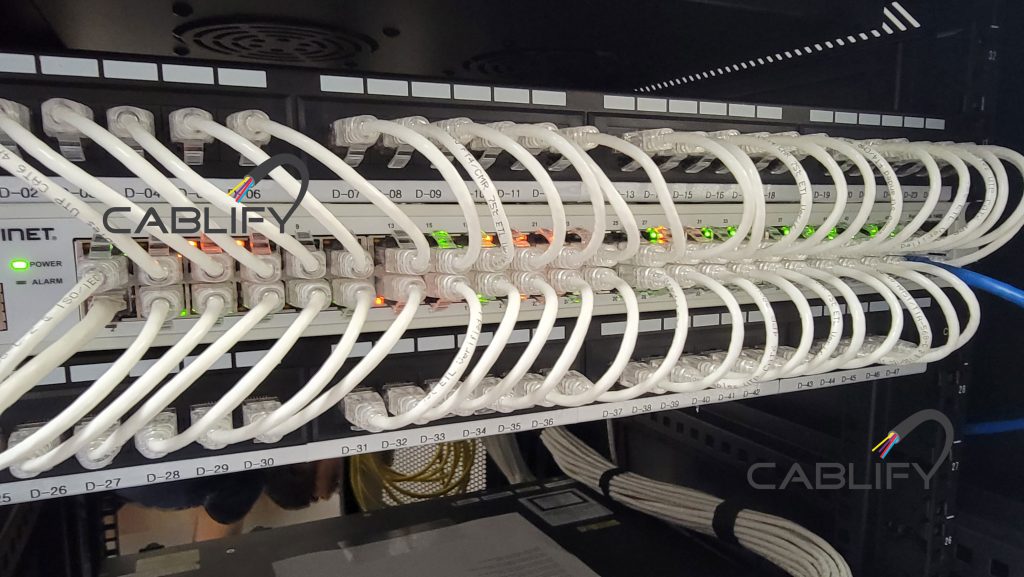
Patch panel work we do
New patch panel installs
Rack-mounted 24 and 48 port panels for a new office or server room, sized for the drops you have today plus spare ports for growth.
Adding drops to an existing panel
New cable runs terminated on spare ports, or a new panel added to the rack, labelled in the same scheme as the ports already there.
Re-termination and repairs
Damaged or failing panels replaced and ports that fail testing re-punched. Where the cable behind them tests clean, it stays.
Rack cleanup
Tangled patch cords replaced with the right lengths, cable managers added and every port labelled. More on our rack cable management page.
Fiber patch panels
Rack-mount fiber enclosures with LC or MPO cassettes for backbones and building-to-building links, spliced or field terminated.
Wall-mount panels for small sites
6 and 12 port panels on a wall bracket for small offices, retail units and camera closets that do not need a full rack.
How we terminate and dress a panel
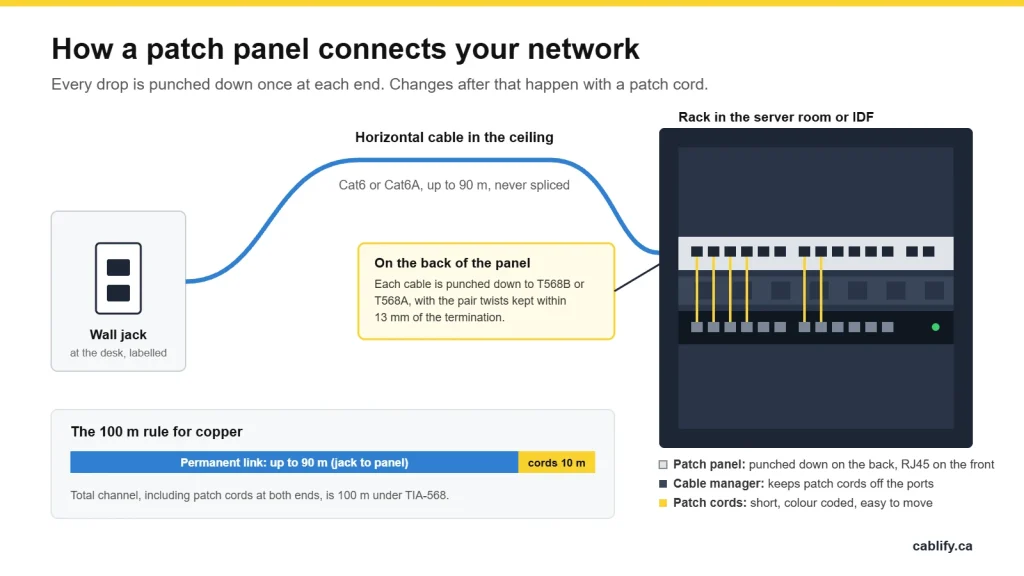
A patch panel is where every cable run in the building ends. It stays fixed. The switch is what changes. Done properly, every move after that happens with a patch cord in a minute, and nobody has to open the back of the rack again.
- Cables are dressed to the back of the panel in neat bundles, with a service loop so a port can be re-terminated later without pulling new cable
- Each run is punched down to T568B, or to T568A if that is what the building already uses, with the pair twists kept within 13 mm of the termination. Our T568A vs T568B guide explains the difference
- Rear support bars and hook-and-loop ties carry the weight of the cable, not the terminations. Tight zip ties can deform the cable and hurt performance
- A horizontal cable manager sits between the panel and the switch, so short patch cords run straight across instead of hanging over the ports
Tested, labelled and documented
A panel that has not been tested is a guess. Every port we terminate is certified with a cable analyzer against the Cat6 or Cat6A standard before we leave, and the results are yours.
- A certification report for every link, pass or fail
- Port labels on the panel that match the labels on the wall plates
- A port schedule showing which panel port feeds which room and desk
- A rack schedule showing what is mounted where
- Failed ports re-terminated and retested before handover
On systems built with Hubbell connecting hardware, we can also register a 25-year Hubbell Mission Critical warranty against your building. It covers the components, the performance of the finished links and the installation itself.
Racks that got out of hand
Many of the patch panel calls we get are not about new panels. They are about racks where nobody can tell which cord goes where, ports that stopped working, and a switch that cannot be swapped without taking the office down.
We trace and document what is there, re-terminate the ports that fail testing, replace tangled cords with the right lengths and colours, and add cable management so it stays organized. Where the existing cable is sound, we keep it.
If the rack itself needs replacing or moving, see our rack and cabinet installation page, and our server rack size chart for how much space a panel layout needs.

Choosing the right patch panel
The panel has to match the cable. A Cat6 panel on Cat6A cable limits the whole link to Cat6.
| Panel | What it supports | Use it for |
|---|---|---|
| Cat5e | 1 Gbps to 100 m | Matching an existing Cat5e system only. Not recommended for new work |
| Cat6 | 1 Gbps to 100 m, 10 Gbps to about 55 m | Most offices, retail units and camera systems |
| Cat6A | 10 Gbps to 100 m | Server rooms, high-speed access point uplinks and long-life installs |
| Shielded Cat6A | 10 Gbps to 100 m with better noise immunity | Plants and warehouses with heavy motors or lighting. Must be bonded to ground |
| Fiber (LC or MPO) | 10G and up, over long distances | Backbones between floors and between buildings |
Flat panels are the default. Angled panels route cords straight into vertical managers and can remove the need for a horizontal cable manager. Keystone panels take individual jacks, so one panel can mix Cat6, Cat6A, fiber and coax. Size panels for the drops you have plus room to grow: a 24 port panel holding 20 drops leaves almost nothing spare. Our comparison of Cat5e to Cat8 cable speeds covers the numbers behind the table.
Panel brands we install: Hubbell, Panduit, CommScope, Leviton, Belden, Siemon and Ortronics.
Where we install patch panels
We install and terminate patch panels across Toronto, Mississauga, Brampton, Vaughan, Markham and the rest of the GTA. For the full cabling scope in each area, see network cabling in Toronto, Mississauga, Brampton, Vaughan and Markham and Richmond Hill.
Patch panel questions
What does a patch panel do?
It is the fixed end point for every cable run in the building. Each run is punched down on the back of the panel once, and the front has RJ45 ports. Short patch cords connect those ports to the switch, so moves and changes are made with a cord instead of by re-terminating cable.
Do I need a patch panel, or can the cables go straight into the switch?
Plugging solid in-wall cable straight into a switch works on day one and causes problems after. Solid cable is not made to be flexed and re-plugged, it cannot be tested or labelled properly, and every switch replacement turns into a rewire. A patch panel avoids all of that for a small part of the job cost.
Should I choose a Cat6 or Cat6A patch panel?
Match the panel to the cable. For a new office, Cat6 covers most needs. Choose Cat6A for server rooms, 10 Gbps links longer than about 55 m, and installs you expect to keep for 15 years or more.
How many patch panel ports do I need?
Count every drop, add spare ports for growth, and round up to the next panel size. 24 and 48 port panels are the most common. We work it out from your floor plan and the rack space you have.
Can you fix or re-terminate an existing patch panel?
Yes. We test the existing ports, re-terminate the ones that fail and replace panels that are damaged. If the cable behind them tests clean, it stays in place.
Do you install fiber patch panels?
Yes. Rack-mount fiber enclosures with LC or MPO cassettes for backbones and links between buildings, spliced or field terminated and loss tested before handover.
Is every port tested?
Yes. Every copper port is certified against its category standard and every fiber strand is loss tested. You get the results along with the port schedule at handover.
Related services
Patch panels are one part of a cabling system. See our pages on structured cabling, server room cabling, office cabling, Cat6 cabling and Cat6A cabling.
Get a patch panel quote
Tell us how many drops and what the rack looks like, or send a photo. We will come back with an itemized price, and a site visit if the job needs one. Call 1-647-846-1925.