
Cablify installs and tests network cabling for businesses in Guelph, Ontario: Cat6 and Cat6A drops, fibre backbones, network racks, Wi-Fi, security cameras and access control. We work in manufacturing plants, food facilities, warehouses, offices and the limestone buildings downtown. The site assessment is free.
Book a free site assessmentCall 647-846-1925
- 18 yearsin business
- Licensedlow voltage contractor
- Our own techniciansemployed and background-checked
- Fluke testedevery cable labelled and tested
- Hubbell Certifiedcan register Hubbell 25-year warranties
Data cabling by building type in Guelph
Advanced manufacturing and agri-food are two of Guelph’s largest sectors, and the University of Guelph runs a research park on Stone Road. Add the new industrial buildings in the south end and a downtown built largely from local limestone, and the cabling has to suit very different buildings. Below is what we install in each one and what we plan around.
Manufacturing plants
Northwest Industrial Park (Woodlawn Road West, Massey Road, Arrow Road), York-Watson Industrial Park and the Hanlon Creek Business Park
Plant floors are hard on network cable. Variable frequency drives, welders and large motors put electrical noise into nearby runs, and forklifts, vibration, oil and coolant cause physical damage. We plan industrial areas along the lines of TIA-1005-A: assess the conditions in each zone, then choose cable, connectors and pathway to match.
In practice that means keeping data runs away from power feeds, using shielded or industrial-rated cable near drives, putting cable in conduit or tray wherever it is exposed at low level, and fitting sealed connectors at machines.
Typical plant work
- Drops to PLCs, HMIs, machine controls and production terminals
- Industrial switches in panels and enclosures on the floor
- Fibre from the office network room out to the plant floor
- Wi-Fi for scanners, tablets and mobile carts
- Cameras over production lines, shipping, exits and parking
Food processing and agri-food
Processing and packaging plants in Guelph’s industrial parks and in Puslinch
Washdown areas, coolers and freezers are where ordinary office cabling fails first. High-pressure, high-temperature cleaning drives water and sanitizer into standard jacks and boxes, and PVC cable jackets stiffen and crack when they are flexed in the cold.
In wet zones we use stainless or IP-rated enclosures, sealed fittings and connectors rated for washdown (IP67 or IP69K), and we route conduit so water drains out instead of collecting. Where conduit passes from a freezer or cooler into a warm room, we seal it so moist air cannot travel through and condense or freeze inside. Switches and patch panels stay outside the wet zone wherever the layout allows.
Typical food plant work
- Network drops for line controllers, scales and label printers
- Cameras in sealed housings for processing, packing and shipping areas
- Wi-Fi coverage inside coolers and freezers for handheld scanners
- Access control on production, ingredient storage and shipping doors
Warehouses and distribution
Hanlon Creek Business Park and Southgate Drive off the Hanlon Expressway, and the Brock Road and McLean Road industrial area in Aberfoyle near the 401
Newer units in the Hanlon Creek Business Park often have 20 feet or more of clear height, and some distribution buildings along Brock Road in Aberfoyle go past 30 feet. That means lift work, careful access point placement and cable runs that can pass the 90 metre limit for copper.
We place access points so scanners keep a signal down every aisle once the racking is full, add a telecom enclosure fed by fibre when the far end of the building is out of copper range, and aim cameras at docks, yards and the spots where losses actually happen. We have installed CCTV in warehouses over 500,000 sq ft.
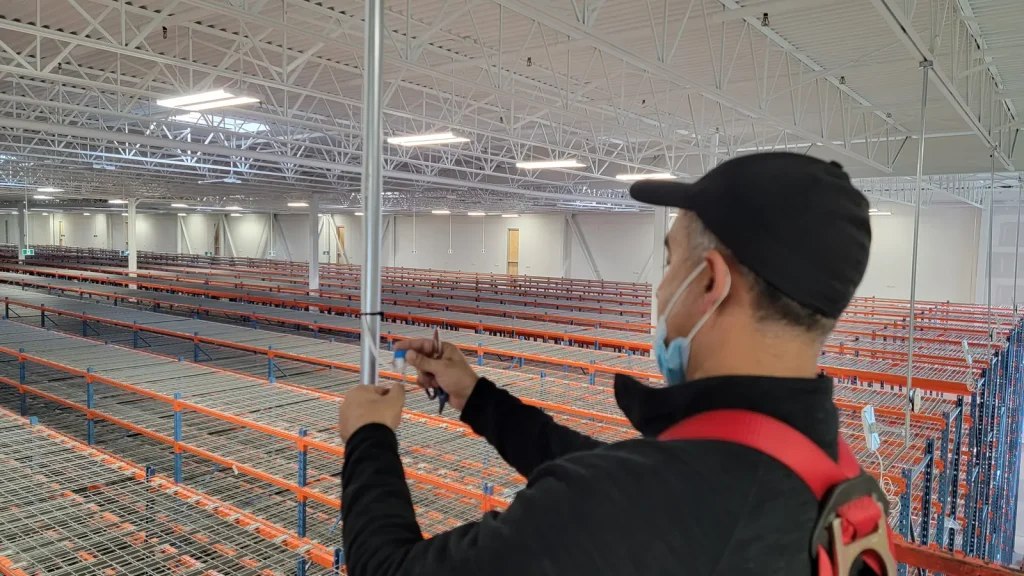
Typical warehouse work
- Warehouse data cabling for offices, shipping desks and docks
- Wi-Fi surveys and access point cabling above racking
- Cameras for docks, trailer yards, parking and entrances
- Telecom enclosures and fibre to the far end of large buildings
- Access control for offices, man doors and gates
Offices, labs and research tenants
University of Guelph Research Park (Stone Road and Research Lane), the Stone Road corridor and downtown offices
Office jobs are usually tenant build-outs and refreshes: new drops for a changed layout, Cat6A to access points, a tidy network room and meeting rooms wired for video. Many suites have a ceiling that doubles as a return-air plenum, and cable in that space has to be FT6 rated under the Canadian Electrical Code unless it runs in conduit.
Lab and research tenants often need separate cabling for instruments, monitoring equipment or a second network. We label and patch those apart from the office network so nobody unplugs the wrong thing.
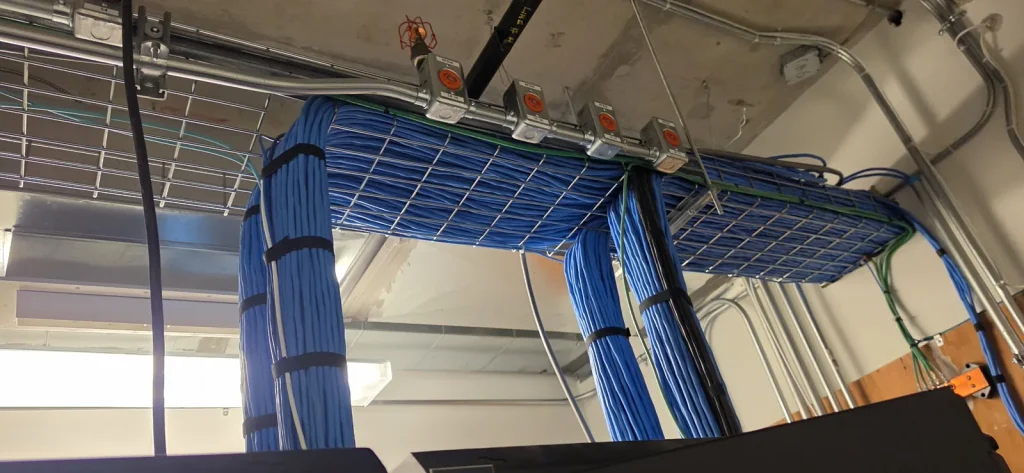
Typical office work
- Cat6 and Cat6A drops, patch panels and faceplates
- Network room builds and clean-ups
- Meeting room AV and video conferencing
- VoIP phone cabling and setup
Heritage and limestone buildings downtown
Wyndham Street, St. George’s Square, and Macdonell, Douglas and Carden streets
Much of downtown Guelph was built from local limestone. That means thick masonry walls, plaster ceilings and often no drop ceiling to hide cable in. Many of these buildings are designated under the Ontario Heritage Act, and changes that affect a building’s heritage attributes can need a heritage permit from the City.
We plan the route before anything is drilled. Basements, existing chases and service openings come first, then painted surface raceway where there is no hidden path. Stone also blocks Wi-Fi far more than drywall does, so these buildings usually need more access points placed room by room, not one or two in a hallway.
Typical heritage building work
- Drops routed through basements, chases and surface raceway
- Wall-mount racks where there is no room for a network closet
- Access point layouts planned around stone walls
- Cameras and door readers placed to avoid cutting into stonework
Sites with more than one building
Plants with a separate warehouse, offices across a yard, guard houses and outbuildings
When a second building needs the network, we link it with fibre pulled through underground conduit or rated for direct burial. Fibre does not conduct electricity, so it is not exposed to the ground potential differences and lightning surges that can damage copper run between buildings. We terminate it with fusion splicing and test it before handover.
If trenching under a parking lot or a road is not practical, a point-to-point wireless link can carry the network across instead. Our guide to fibre cable types explains which cable suits which run.
Low voltage services we install in Guelph
Most Guelph projects combine several of these. Planning them together means one site visit, one layout and one contact for the job.
| Service | What it covers |
|---|---|
| Structured and data cabling | Cat5e, Cat6 and Cat6A drops, patch panels and faceplates, labelled and Fluke tested. |
| Fibre optic installation | Single-mode and multimode backbones between floors, rooms and buildings, with splicing and test results. |
| Racks, cabinets and network rooms | Wall-mount and floor racks, cable managers and clean-ups of crowded rooms. For sizing, see our rack unit chart. |
| Wi-Fi and access points | Cabling, mounting and placement. We are an authorized Ubiquiti reseller and a Cisco Meraki partner. |
| Security cameras | IP camera systems inside and outside plants, warehouses, offices and retail. |
| Access control | Card, fob and mobile credentials for entrances, interior doors and gates. |
| Audio visual | Meeting room displays, video conferencing and training room audio. |
| Phones and unified communications | Cabling and setup for VoIP phone systems. |
| Office moves and cable removal | Disconnecting and reconnecting IT when you move, and removing abandoned cable when a lease requires it. |
| Testing existing cabling | Fluke testing, tracing and labelling of inherited cable, and repair or replacement of runs that fail. |
| Electrical for low voltage systems | Circuits for network rooms, racks and cameras, done by an ECRA/ESA Licensed Electrical Contractor that we subcontract and coordinate. |
What changes the cost of a Guelph cabling job
We quote after a site assessment. Two jobs with the same number of drops can cost very different amounts, and these are the main reasons:
- Distance to the network roomRuns close to the 90 metre copper limit may need a second telecom enclosure and a fibre link.
- Ceiling height and accessLifts for 20 to 30 foot warehouse ceilings, hard ceilings, or no ceiling space at all in older buildings.
- PathwayJ-hooks above a drop ceiling cost the least. Cable tray and conduit cost more, but plant floors and outdoor runs often need them. Our conduit fill calculator helps with sizing.
- Cable type and ratingCat6 or Cat6A, FT4 or FT6, shielded or industrial cable, and washdown-rated parts.
- Working hoursWork scheduled around production shifts, store hours or after hours.
- What is already thereWhether existing cable tests well enough to keep, or has to be traced, removed or replaced.
Where we work in and around Guelph
In the city we work across the Northwest Industrial Park, the Hanlon Creek Business Park and Southgate Drive in the south end, the York-Watson Industrial Park in the east end, the University of Guelph Research Park, the Stone Road corridor and downtown.
Outside the city we cover Puslinch, including Aberfoyle, Morriston and the industrial lands along Brock Road and McLean Road by the 401, and Rockwood in Guelph/Eramosa. Cablify is based in Mississauga, about an hour from Guelph by the 401 and the Hanlon Expressway.
Guelph network cabling questions
Do you have an office in Guelph?
No. Cablify is based in Mississauga, about an hour from Guelph by Highway 401 and the Hanlon Expressway. The work is done by our own employed technicians, and the free site assessment is usually booked within 1 to 2 business days of your request.
Can you run cabling in a designated heritage building downtown?
Yes. We survey the building first and plan the route through basements, existing chases and service openings, then use painted surface raceway where there is no hidden path. If a change could affect the building’s heritage attributes, such as a new opening through an exterior stone wall, check with the City of Guelph’s heritage planning staff before the work is booked. We can mark every proposed opening on a plan so you have what you need for that conversation.
What cable and parts do you use in washdown areas, coolers and freezers?
Parts made for those conditions, not standard office hardware. In washdown zones that means sealed connectors and enclosures rated IP67 or IP69K. In freezers it means cable rated for low-temperature use, and conduit sealed where it passes into a warm room so moisture does not condense inside. We confirm the cleaning method and temperature range of each room during the site assessment.
Should a new unit in the Hanlon Creek Business Park get Cat6 or Cat6A?
We usually recommend Cat6A to access points and to anything that may need 10 Gb/s later, because Cat6 only supports 10 Gb/s to about 55 metres. Cat6 is still fine for desks, phones, printers and most cameras. In a large warehouse unit, distance often matters more than category: copper is limited to 90 metres, so the far end may need its own telecom enclosure fed by fibre.
Can you install without stopping production?
Yes. We plan the work zone by zone with your plant or facility manager and follow your site’s safety rules. Anything that needs a line, a machine or the network shut down is saved for a planned window, such as a weekend or a scheduled shutdown. We are available 7 days a week, 7:00 am to 8:00 pm.
Can you test or fix the cabling we already have?
Yes. We Fluke test existing links, trace and label unknown cable, and repair or replace runs that fail. If you are taking over a unit from a previous tenant, testing first shows which cable is worth keeping before you pay for new drops.
Who does the electrical work for racks and equipment?
New circuits, dedicated outlets for racks and power for equipment that cannot run on PoE are done by an ECRA/ESA Licensed Electrical Contractor that Cablify subcontracts. We schedule that work as part of the same job, so you still deal with one contact.
Book a free site assessment in Guelph
Tell us what kind of building it is, roughly how many drops, cameras or doors you need, and when the space has to be ready. Floor plans help if you have them. We usually visit within 1 to 2 business days.
Nearby: Kitchener, Waterloo and Cambridge, Milton and Halton Hills, Hamilton and Burlington, Mississauga and Brampton.