
Short answer
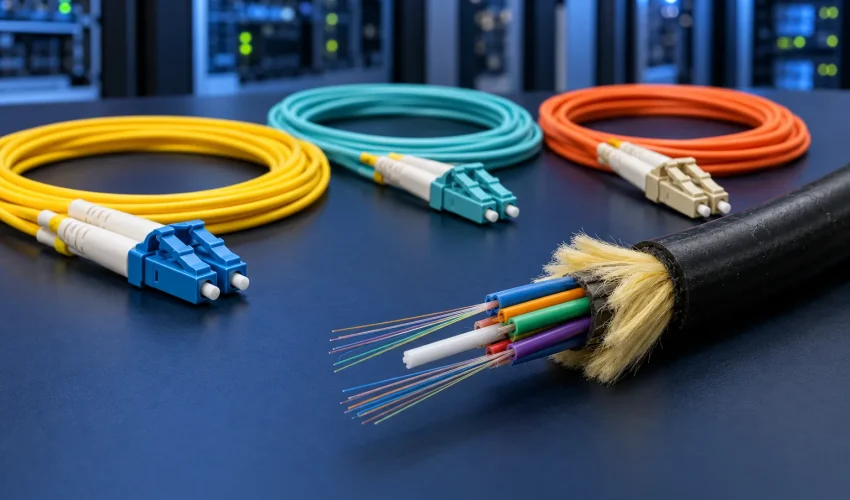
Fiber optic cable is sorted two ways. By the glass inside: single-mode (OS2, built on ITU-T G.652.D or bend-insensitive G.657 fiber) for anything longer than a few hundred metres, and multimode (OM3, OM4 or OM5) for short links inside buildings and data centres. And by how the cable is built around that glass: tight-buffered and breakout cable indoors; loose tube, ribbon and micro cable in ducts and trenches; ADSS and figure-8 cable on poles; drop cable to homes and small sites; armored cable where rodents, rock or crushing are a risk. A third label, the fire rating (FT4 or FT6 in Canada, OFNR or OFNP in the US), decides where the cable may run inside a building.
Open a large fiber stock list and the names pile up fast. One list we went through recently ran past 2,000 lines: RocketRibbon, MiniXtend HD, ezSPAN ADSS, SST-Drop, 1728-count IBR, LEAF hybrids printed for Bell Canada, a TXF hybrid for long haul, plenum interlocking armor, toneable flat drop in 1,000 ft boxes. Under the brand names there are far fewer types than it looks. Every one of those lines answers the same three questions: what glass is inside, how the fibers are packaged, and where the cable is allowed to go.
This guide works through those three questions in order. Then it maps each cable type to the place it belongs, shows how big each one really is, decodes spec lines and jacket prints, and lists the mistakes we see most often on fiber jobs around Toronto and the GTA. If your only question is single-mode versus multimode, our single-mode vs multimode guide goes deeper on that one choice.
In this guide
- The three decisions behind every fiber cable
- Fiber types: the glass inside
- OS1, OS2, G.652.D and G.657 explained
- Cable constructions at a glance
- Tight-buffered, distribution and breakout cable
- Loose tube cable
- Ribbon and rollable ribbon cable
- Micro cable and blown fiber
- Drop cable
- Aerial cable: lashed, figure-8, ADSS and OPGW
- Armored fiber cable
- Indoor/outdoor cable
- Hybrid and composite cable
- Patch cords, trunks and assemblies
- Fire ratings: FT4, FT6, OFNR, OFNP and LSZH
- Which fiber cable goes where
- Fiber count and cable diameter
- How to read a fiber cable spec line
- Mistakes we see on fiber jobs
- FAQ
The three decisions behind every fiber cable
Every fiber cable is three decisions stacked on top of each other. They are made for different reasons, and most ordering mistakes come from treating them as one.
| Decision | What it covers | Typical choices | What should drive it |
|---|---|---|---|
| 1. Glass | Core size and fiber standard | Single-mode OS2 (G.652.D, G.657.A1, G.657.A2), multimode OM3, OM4, OM5, specialty G.655 and G.654.E | Link length, data rate and the transceivers you plan to use |
| 2. Construction | How fibers are buffered, grouped, strengthened and protected | Tight-buffered, breakout, loose tube, ribbon, rollable ribbon, micro, drop, ADSS, figure-8, armored | The pathway: tray, riser, ceiling, duct, trench, pole or microduct |
| 3. Rating and jacket | Fire, smoke, sunlight, water and temperature performance | FT6 or OFNP, FT4 or OFNR, LSZH, UV-resistant polyethylene, gel-free water blocking | Building and electrical codes, and the environment along the route |
Get the glass wrong and the link will not reach. Get the construction wrong and the cable gets crushed, chewed or soaked. Get the rating wrong and an inspector can make you pull it out. The rest of this guide takes them in that order.
Fiber types: the glass inside
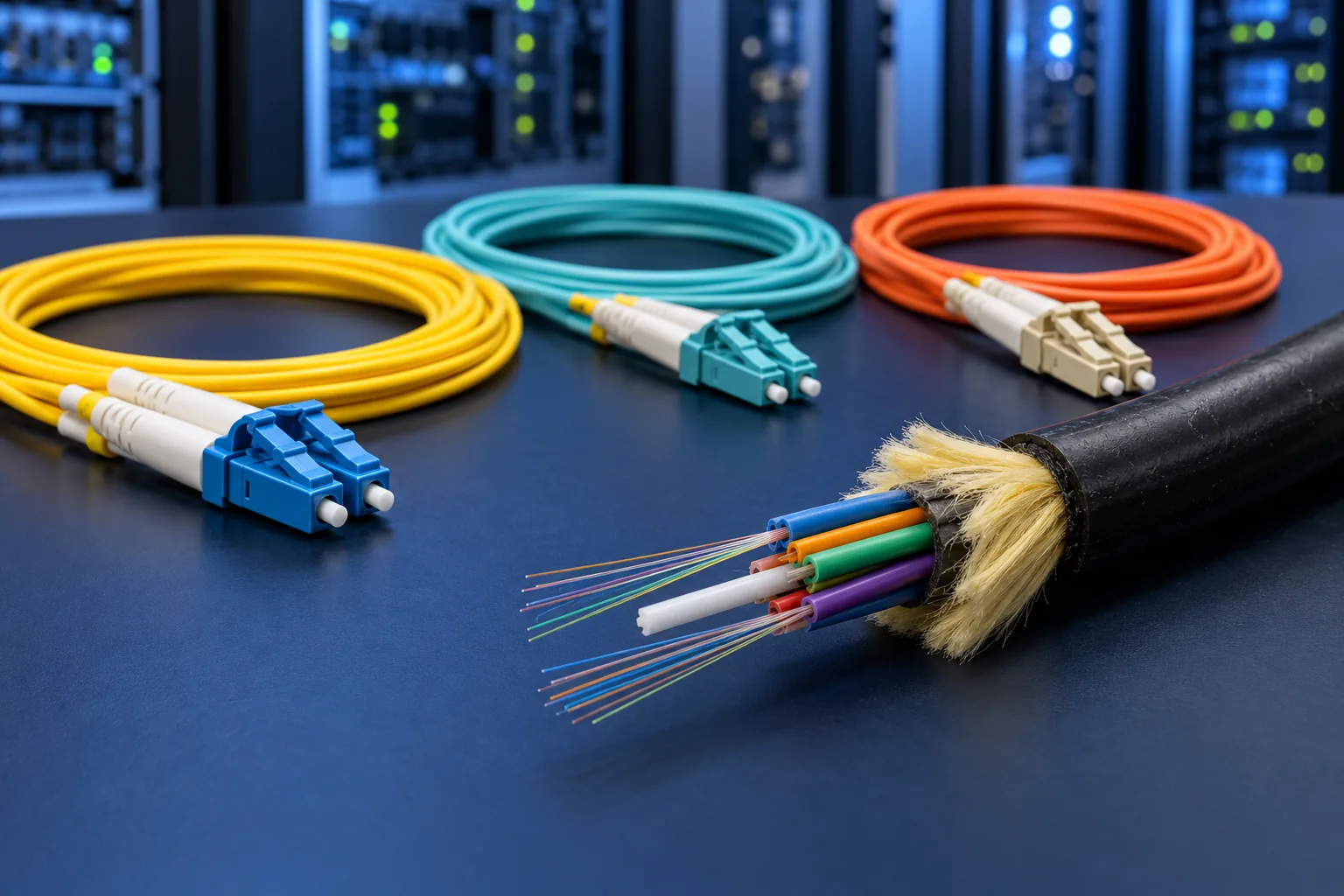
Every telecom fiber has the same 125 µm glass cladding. What changes is the core, the small centre that carries the light. Single-mode fiber has a core of about 9 µm, small enough that light travels down it on essentially one path. Multimode fiber has a 50 µm core (62.5 µm on older OM1), which lets light take many paths, or modes, at once.
That one difference decides the economics. Single-mode needs laser optics aimed at a tiny core, and in return the signal stays clean for tens of kilometres. Multimode works with cheaper short-wave VCSEL lasers, but the many light paths arrive at slightly different times, so the pulse smears and the usable distance at high speeds is measured in metres, not kilometres. In practice, multimode lives inside one building or one data hall. Anything that leaves the building should be single-mode.
Multimode grades: OM1 to OM5
Multimode fiber is graded by modal bandwidth, the figure that sets how far a given speed will run. The grades come from ISO/IEC 11801 and TIA. The reaches below are the IEEE 802.3 Ethernet limits.
| Grade | Core | Min. bandwidth at 850 nm | Indoor jacket colour | 10GBASE-SR | 40G / 100G SR4 | 400GBASE-SR4.2 | Use today |
|---|---|---|---|---|---|---|---|
| OM1 | 62.5 µm | 200 MHz·km | Orange | 33 m | Not supported | Not supported | Legacy |
| OM2 | 50 µm | 500 MHz·km | Orange | 82 m | Not supported | Not supported | Legacy |
| OM3 | 50 µm | 2,000 MHz·km | Aqua | 300 m | 100 m / 70 m | 70 m | Acceptable |
| OM4 | 50 µm | 4,700 MHz·km | Aqua (violet on some European OM4) | 400 m | 150 m / 100 m | 100 m | Default for new multimode |
| OM5 | 50 µm | 4,700 MHz·km, plus 2,470 at 953 nm | Lime green | 400 m | 150 m / 100 m | 150 m | Short-wave WDM links |
Sources: ISO/IEC 11801-1 fiber categories; IEEE 802.3 reach for 10GBASE-SR, 40GBASE-SR4, 100GBASE-SR4 and 400GBASE-SR4.2; TIA-598 jacket colours. Real links also depend on connector and splice loss.
Three practical points come out of that table:
- OM1 and OM2 are legacy. ISO/IEC 11801-1 lists them as grandfathered: fine to keep running, not recommended for new cabling. Many older office buildings still have orange OM1 backbones, and when a 10G uplink refuses to come up on an old riser, that is usually why. Our post on 62.5 micron fiber covers what to do with it.
- Never mix 62.5 and 50 µm cores on one link. They plug into the same connectors, which is exactly the problem. Coupling from a 62.5 µm core into a 50 µm core loses light at every joint.
- OM4 is the sensible multimode default. OM5 only pays off if you will run short-wave WDM optics such as 400GBASE-SR4.2, where it adds 50 percent more reach.
Single-mode fiber standards
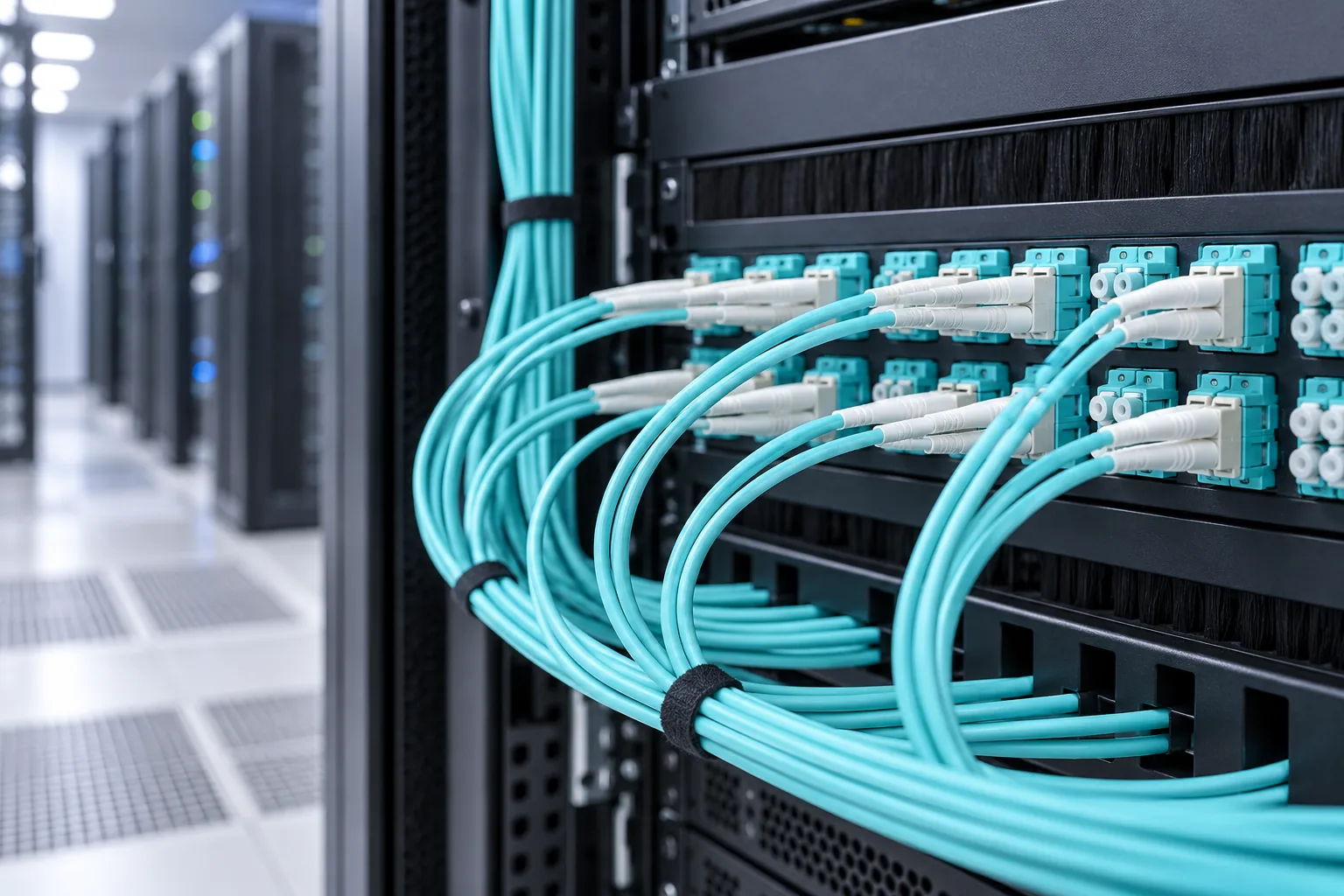
Single-mode fiber is specified by ITU-T recommendation. You will see these codes on every outside plant spec sheet:
| Standard | What it is | Where you see it |
|---|---|---|
| G.652.D | Standard single-mode with low water peak, so the whole band from 1260 to 1625 nm is usable, including the 1383 nm region needed for CWDM | Almost every campus, metro, FTTH and backbone cable |
| G.657.A1 | Bend-improved fiber specified down to a 10 mm bend radius, and fully compliant with G.652.D | Now the standard glass in a lot of indoor and outdoor cable |
| G.657.A2 | Specified to a 7.5 mm bend radius, still fully G.652.D compliant | Micro cables, riser cables in apartment buildings, crowded enclosures |
| G.657.B3 | Specified to a 5 mm bend radius. Compatible with G.652.D but not required to meet every G.652.D attribute | Indoor drops and hallway runs that get stapled around corners |
| G.655 (NZDSF) | Non-zero dispersion-shifted fiber designed for long-haul DWDM, such as Corning LEAF | Older long-haul routes, and hybrid cables built to match them |
| G.654.E | Cut-off shifted fiber with a large effective area (about 110 to 125 µm²) and attenuation around 0.16 to 0.19 dB/km at 1550 nm | New terrestrial long-haul routes for 400G and 800G coherent optics |
The A categories matter most in practice. Because G.657.A1 and A2 are fully compliant with G.652.D, they fusion-splice to older G.652.D cable with no special handling. The B categories are only required to be compatible, which is why B3 fiber is usually kept to short indoor drops.
For a new commercial backbone or campus link in Ontario, our default is OS2 cable built with G.652.D fiber that also meets G.657.A1. It tolerates the tight loops in splice trays and wall cabinets, and many makers now use it as their standard single-mode glass. G.655 and G.654.E are carrier and long-haul fibers; you will only meet them when a project ties into a carrier route.
OS1, OS2, G.652.D and G.657 explained
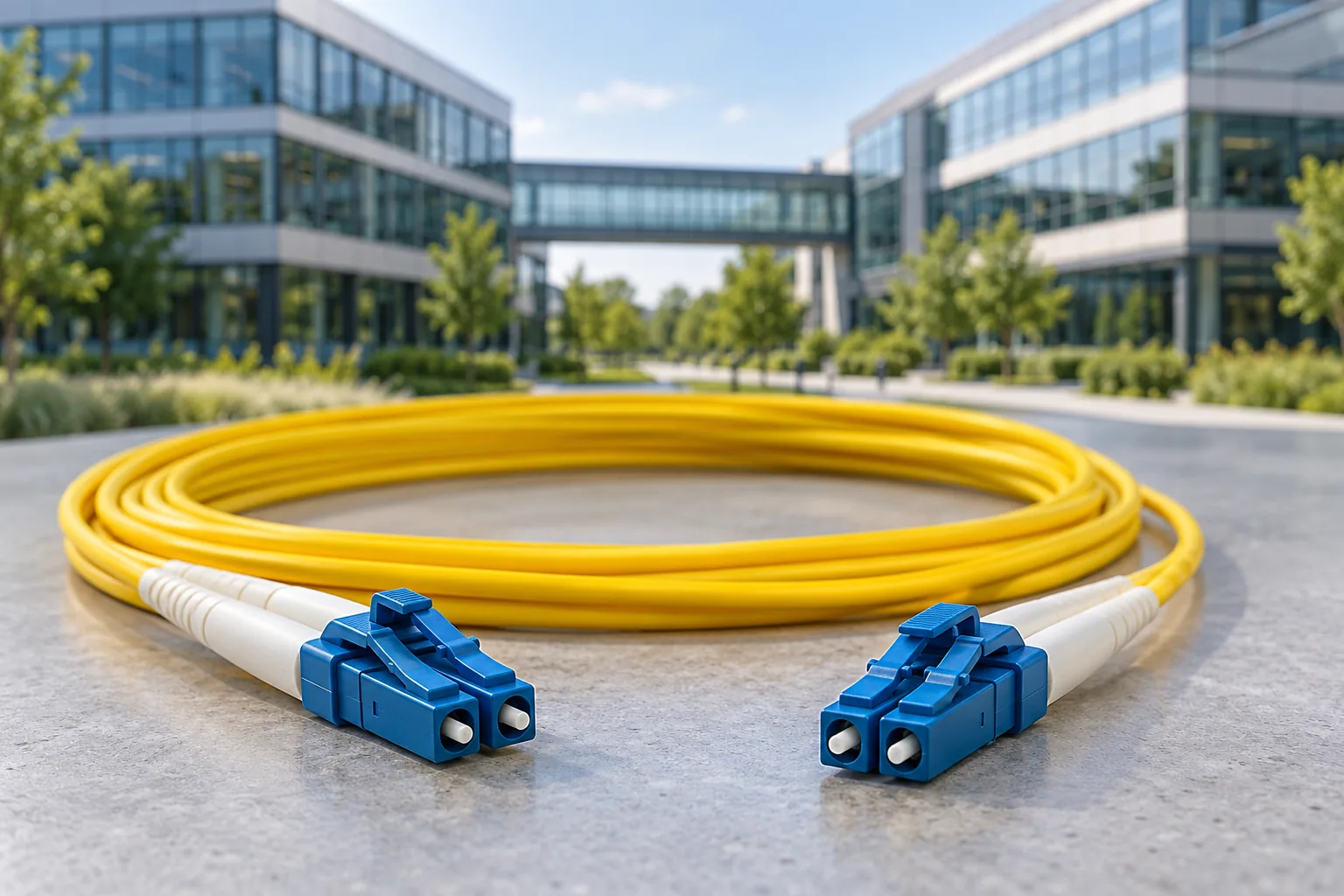
This is the most common confusion on fiber quotes, and several of the top search results get it wrong. OS1, OS1a and OS2 are not fiber types. They are cabled performance categories from ISO/IEC 11801 that set a maximum attenuation for the fiber once it is inside a cable:
| Category | Max. attenuation | Wavelengths | Status |
|---|---|---|---|
| OS1 | 1.0 dB/km | 1310 and 1550 nm | Grandfathered |
| OS1a | 1.0 dB/km | 1310, 1383 and 1550 nm | Current |
| OS2 | 0.4 dB/km | 1310, 1383 and 1550 nm | Current |
The old rule of thumb, that OS1 means tight-buffered indoor cable and OS2 means loose tube outdoor cable, came from how cables used to be built: tight buffering added loss, so indoor cable was rated to the looser number. It was never what the standard says. Today a tight-buffered riser cable from a major maker is sold as OS2, built on G.652.D fiber with a 0.4 dB/km maximum. So the right way to write a single-mode spec is the category plus the fiber standard, for example “OS2, ITU-T G.652.D and G.657.A1”.
Coatings and buffers
Fiber leaves the draw tower with a 250 µm acrylate coating. Loose tube and ribbon cables use it as is. Indoor cables add a 900 µm tight buffer so each fiber can be handled and connectorized on its own. Newer micro cables and rollable ribbons use reduced 200 µm coatings: the same 125 µm glass with about a third less cross-sectional area per fiber, which is how makers fit more fibers into a smaller duct. Single fibers splice exactly like 250 µm fiber; a 200 µm ribbon needs a pitch-conversion holder to mass-splice onto a 250 µm ribbon.
You will also see water peak terms on spec sheets: ZWP (zero water peak), LWP (low water peak) and RWP (reduced water peak). They are marketing names for the same idea: low loss at 1383 nm, which G.652.D already requires.
Plastic, hollow-core and multicore fiber
Plastic optical fiber uses a plastic core about 1 mm across. It shows up in cars, consumer audio and some industrial controls, never in building or campus cabling. When search results talk about “three types of fiber”, this is usually the third.
Hollow-core fiber guides light through air instead of glass. In September 2025, Microsoft and the University of Southampton reported a hollow-core fiber with attenuation of 0.091 dB/km at 1550 nm, lower than any solid glass fiber, and light moves through it faster than through glass, which cuts latency. Microsoft has said it plans 15,000 km of it in its Azure network and is scaling production with Corning and Heraeus Covantis.
Multicore fiber puts several cores inside one standard 125 µm cladding. Sumitomo has mass-produced a 2-core ultra-low-loss fiber since 2023, subsea systems are starting to use multicore designs, and in March 2026 Corning, AFL, Sumitomo and TeraHop formed an agreement to standardize 4-core fiber for data centre links. Neither hollow-core nor multicore fiber is something you would specify for an office or campus today.
Cable constructions at a glance
Once the glass is chosen, the construction decides where the cable can survive. These are the main families, drawn in cross-section. Tap any one to jump to its section.
Drawings are representative, not to scale against each other. Fiber and tube colours follow the TIA-598 order: blue, orange, green, brown, slate, white, red, black, yellow, violet, rose, aqua.
Tight-buffered, distribution and breakout cable
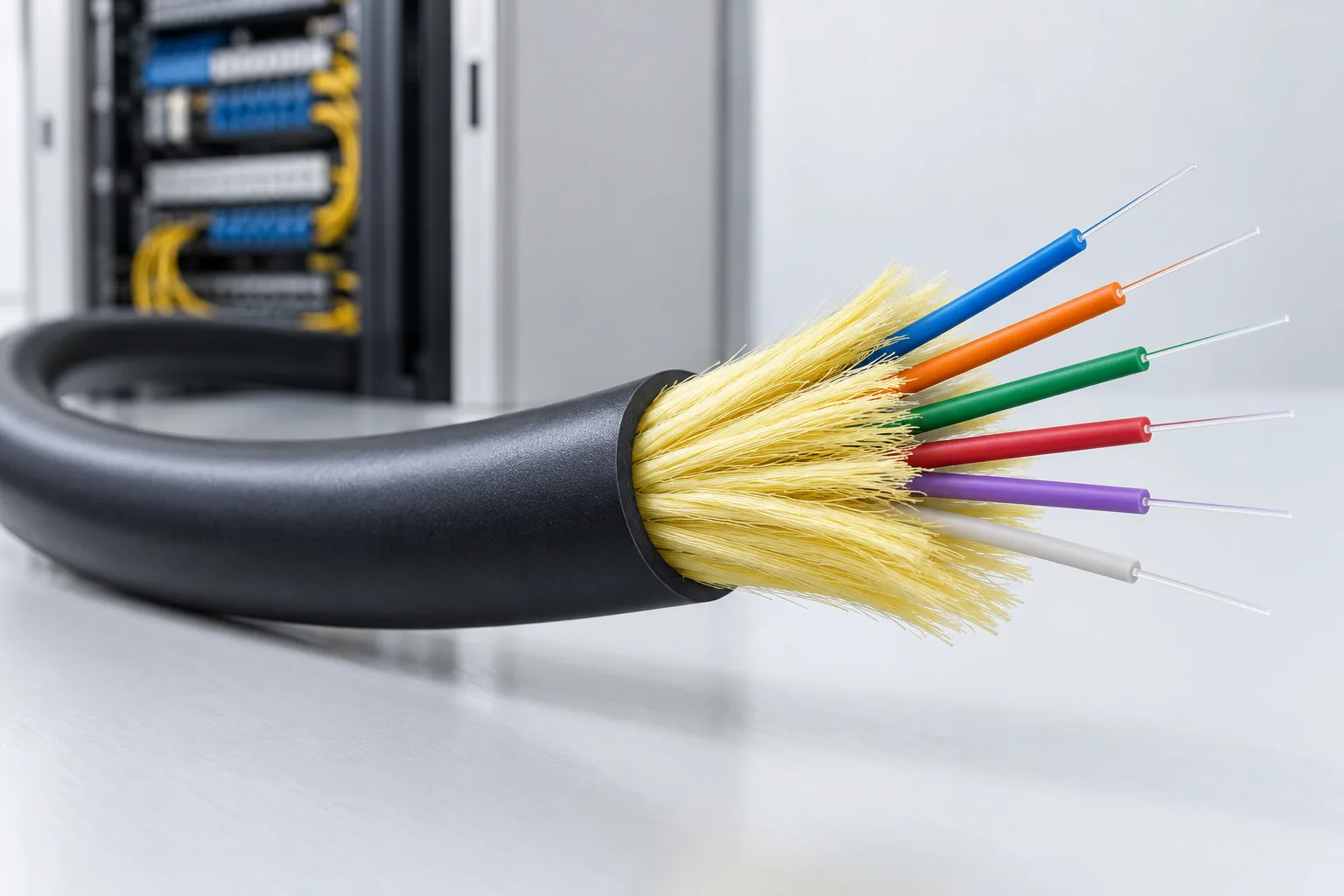
In a tight-buffered cable, each fiber gets its own 900 µm plastic buffer applied directly over the coating. That buffer is what lets a technician strip a fiber and put a connector on it without a fan-out kit, which is why almost every indoor cable is built this way.
- Simplex and duplex (zipcord): one or two buffered fibers, each wrapped in aramid yarn and a jacket. This is the cable inside nearly every patch cord.
- Distribution cable: several buffered fibers around a central strength member under one jacket, from 2 fibers up to larger counts built from 12-fiber subunits. It is the standard building backbone between a main equipment room and each telecom closet.
- Breakout cable: every fiber sits in its own jacketed subunit with its own aramid. It is bulkier and costs more per fiber, but each leg can be routed straight to equipment and is tough enough to survive without a patch panel. Industrial panels and shop floors use a lot of it.
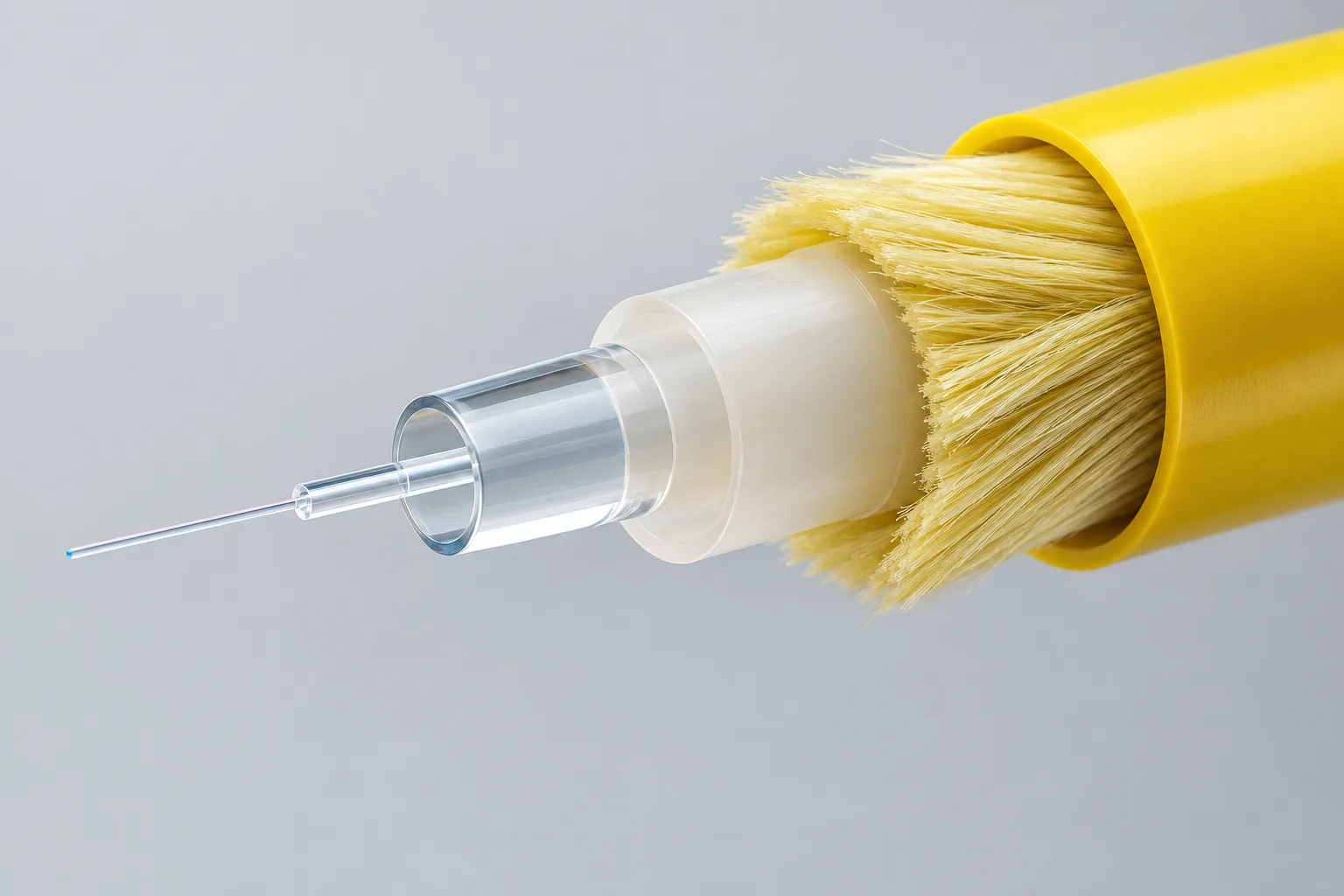
The trade-off is temperature and strain. In a tight-buffered cable, the fiber is locked to the buffer, so any stretch or shrink in the cable reaches the glass. A typical indoor tight-buffered riser cable is rated to operate from -20 °C to 70 °C, against -40 °C to 70 °C for outdoor loose tube. That is fine in a heated building and a poor choice for a long run across an unheated warehouse yard in February. For short building-to-building hops there are indoor/outdoor tight-buffered cables with UV-resistant black jackets, covered below.
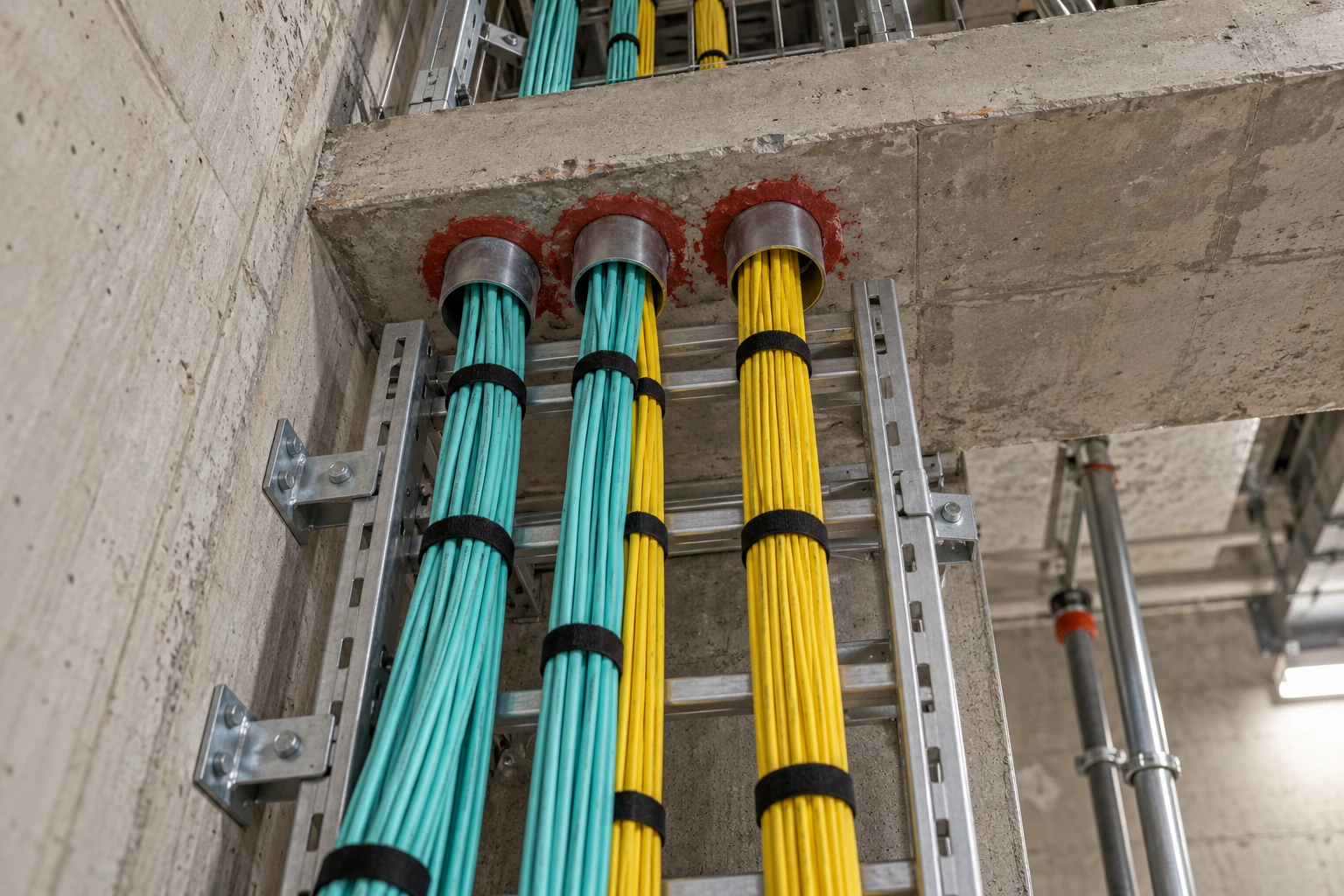
On office and warehouse jobs, the workhorse is a 12- or 24-fiber single-mode tight-buffered riser cable from the main equipment room to each telecom room. Our guide to MDF and IDF rooms covers how those rooms are laid out, and designing a fiber backbone for multi-tenant buildings covers fiber counts per floor.
Loose tube cable
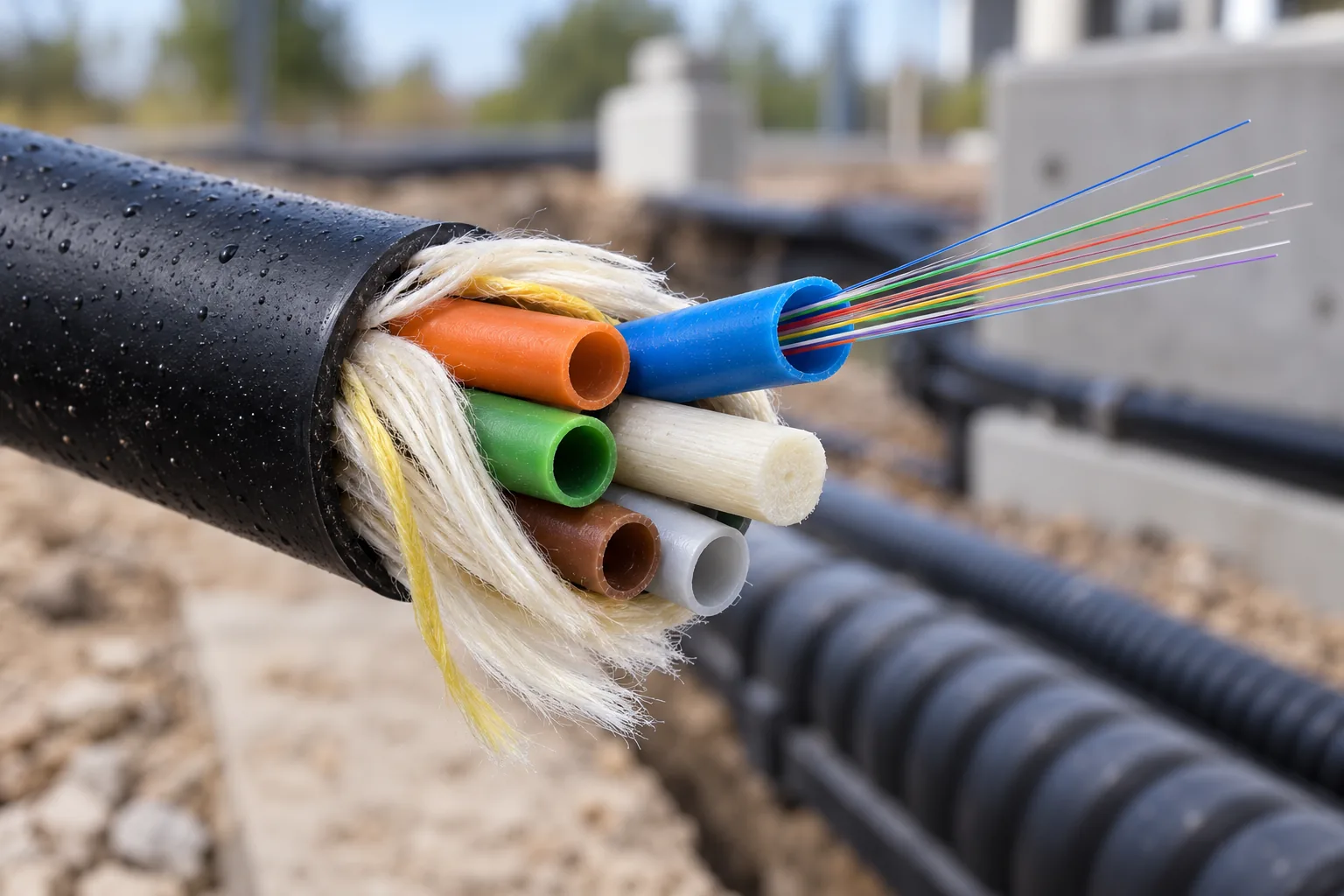
Loose tube is the standard outside plant design. The fibers keep their 250 µm coating and float loosely inside small plastic buffer tubes, usually 12 fibers per tube in a tube about 2.5 mm across. The fibers are slightly longer than the tube they sit in, so when the cable stretches during a pull or shrinks in a cold snap, the fibers straighten out instead of taking the strain.
Stranded or central tube
Stranded loose tube cables wind the tubes around a central strength member in a reverse-oscillating (SZ) lay. Because the lay changes direction, a splicer can open the sheath mid-span and pull out one tube without cutting the others, which is how branch points and taps are made on long routes. Most duct, campus and lashed aerial cable is built this way.
Central tube cables put all the fibers in one larger tube in the middle, with strength rods embedded in the jacket. They are smaller and lighter at low counts and are common for drops, short laterals and ribbon cables.
Gel-filled or dry
Water in a cable freezes, expands and adds loss, so outdoor cable has to be water-blocked. Older designs fill the tubes and the core with gel. Dry designs use water-swellable yarns and tapes that swell shut if water gets in. Dry cable is now the common choice for new duct and aerial work, mainly because there is no gel to clean off every fiber before splicing. Gel-filled tubes are still specified on some aerial and drop cables, and some designs mix the two: a dry core with gel inside the tubes.
Typical numbers
A mainstream gel-free, all-dielectric loose tube cable gives a feel for the class:
- Operating range -40 °C to 70 °C, installation range -30 °C to 70 °C.
- Rated for 2,700 N (600 lbf) during installation and 890 N (200 lbf) long term.
- About 10.5 mm across at 36 to 72 fibers, about 12 mm at 96 fibers and about 16 mm at 144 fibers.
- Bend radius of 20 times the cable diameter while pulling and 10 times once installed, which is also the TIA default when a maker gives no figure.
Loose tube cable cannot be connectorized directly. Each end is either spliced to factory-made pigtails in a splice tray or fitted with a fan-out kit that sleeves each fiber. Our fusion splicing crews do this on campus and building-to-building links across the GTA.
Ribbon and rollable ribbon cable
Ribbon cable groups fibers side by side, usually 12 at a time, so they can be spliced as a set. A mass fusion splicer joins all 12 fibers of a ribbon in one operation. On a 432-fiber cable that is 36 ribbon splices per joint instead of 432 single-fiber splices, which is why ribbon dominates once counts climb into the hundreds.
Flat ribbon
In a flat ribbon, the 12 fibers are bonded along their full length in a thin matrix. The ribbons are stacked inside a single central tube or spread across several stranded tubes. Central tube ribbon cables, such as Corning SST-Ribbon (up to 216 fibers) and SST-UltraRibbon (288 to 864 fibers using 24- and 36-fiber ribbons), keep the cable compact. Multi-tube designs spread the ribbons across stranded tubes for higher counts and easier mid-span access.
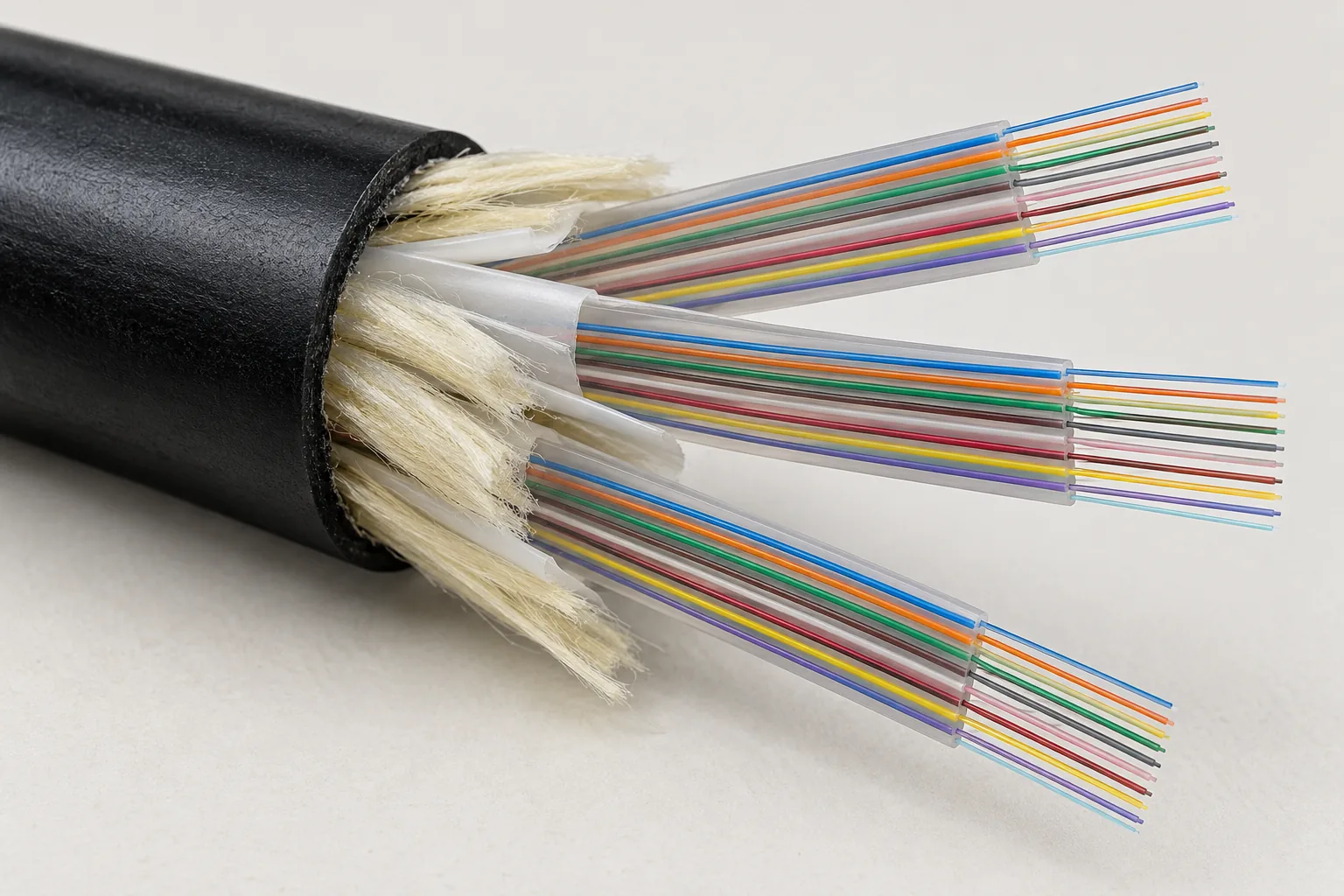
The weakness of a flat stack is geometry. A rectangle of ribbons inside a round tube leaves empty space in the corners, and a stack can only bend easily in one direction.
Rollable (intermittently bonded) ribbon
A rollable ribbon bonds each fiber to its neighbours only at short, staggered points instead of along its full length. Inside the cable the ribbon rolls or folds into a compact bundle, so the fibers pack like a loose bundle with no wasted corners and often no buffer tubes. At the splice point the technician lays it out flat again and mass-splices it exactly like a flat ribbon. Many of these cables also use 200 µm fiber to save more space.
Every major maker has its own name for the idea, which is why stock lists look so varied:
- Lightera (formerly OFS): rollable ribbon, coded RR, in cables such as AccuTube+ RR and DuctSaver RR.
- Fujikura and AFL: SpiderWeb Ribbon inside Wrapping Tube Cable (WTC).
- Prysmian: FlexRibbon inside MassLink multi-tube cable and FusionLink central tube cable.
- Corning: Flow Ribbon in the RocketRibbon XD Cable-200 Flow line. The original RocketRibbon is a different design, built from conventional flat 12-fiber ribbons grouped into 288-fiber subunits.
- Sumitomo: FREEFORM Ribbon. The generic term you will also see is IBR, intermittently bonded ribbon.
Rollable ribbon is what makes the very high counts possible. Published examples include 1,728 fibers in about 19 to 25 mm, 3,456 fibers in about 25 to 34 mm and 6,912 fibers in about 30 to 39 mm, depending on the maker and the fiber coating. The figures are in the size section below. These cables run between hyperscale and AI data centre buildings, across data centre campuses and in crowded city duct banks where one conduit has to carry thousands of fibers.
Ribbon only saves time if both ends are mass-spliced, which needs a ribbon splicer and ribbon-capable trays and enclosures. Below about 144 fibers, a standard loose tube cable is often the simpler choice.
Micro cable and blown fiber
Micro cables are small, light loose tube or ribbon cables designed to be blown, not pulled, into plastic microducts. A blowing machine pushes the cable while compressed air flows through the duct, so the cable floats along with very little friction. Microducts are typically sized by outside and inside diameter, such as 10/8, 12/10 or 16/13 mm, and come as single tubes or bundles that go into one trench or into an existing conduit.
The density comes from three things: reduced-coating fiber (200 µm, and 180 µm in some new designs), more fibers per tube and thinner jackets. Some published examples:
- Corning MiniXtend HD 288-fiber cable, with 36 fibers per tube: 8.1 mm across, for a microduct with at least a 10 mm inside diameter.
- The 432-fiber version of the same cable: 10.8 mm, for a 14 mm duct at minimum and 16 mm ideally.
- Sumitomo FREEFORM Ribbon micro cable with 864 fibers: 13.5 mm, for an 18 mm duct.
- Prysmian Sirocco Extreme with 864 fibers of 180 µm fiber: 9.8 mm, for a 12 mm duct.
The appeal is flexibility. A bundle of empty microducts can be placed once and filled years later as demand grows, and a damaged section can be blown out and replaced without digging the whole route. That is why FTTH builders and municipal networks use them, and why they suit campus routes where the conduit is already crowded.
The trade-offs are mechanical. Micro cables have lower tensile and crush ratings: one micro cable on that stock list is rated for 300 lbf, half the 600 lbf of a standard outside plant cable. They need blowing equipment, a duct system with sealed couplers that holds pressure, and a cable matched to the duct’s inside diameter. Heavy-duty “micro core” designs, rated for a normal 600 lbf pull, sit between the two families.
Drop cable
A drop cable is the last piece of the network: the short run from a terminal on a pole, pedestal or handhole to a home or small building. Most drops carry 1 to 12 fibers, a few go to 24, and TIA asks for at least 1,335 N (300 lbf) of pulling strength on drops that are pulled into place, or 440 N (100 lbf) on drops that are buried, trenched or blown into duct.
- Flat drop puts one central tube between two strength rods. The flat profile is easy to grip with aerial drop clamps and resists twisting.
- Toneable flat drop adds a small copper wire, usually 24 AWG, along one edge. That wire is what lets a locator find a buried all-dielectric cable. In Ontario, anyone digging has to request locates through Ontario One Call, and a buried dielectric cable with no tracer gives the electromagnetic locator nothing to follow.
- Round and figure-8 drops are miniature versions of the full-size cables, the figure-8 type with its own small messenger for longer aerial spans.
- Indoor/outdoor drops use tight-buffered G.657.B3 fiber and a riser or LSZH jacket so the same cable can continue inside a house or along a hallway.
- Preconnectorized drops arrive with a hardened, weatherproof connector on one or both ends, so the installer plugs in at the terminal instead of splicing on site.
- Pushable micro drops are stiff, very small cables made to be pushed by hand or blown into a microduct that is already in the ground.
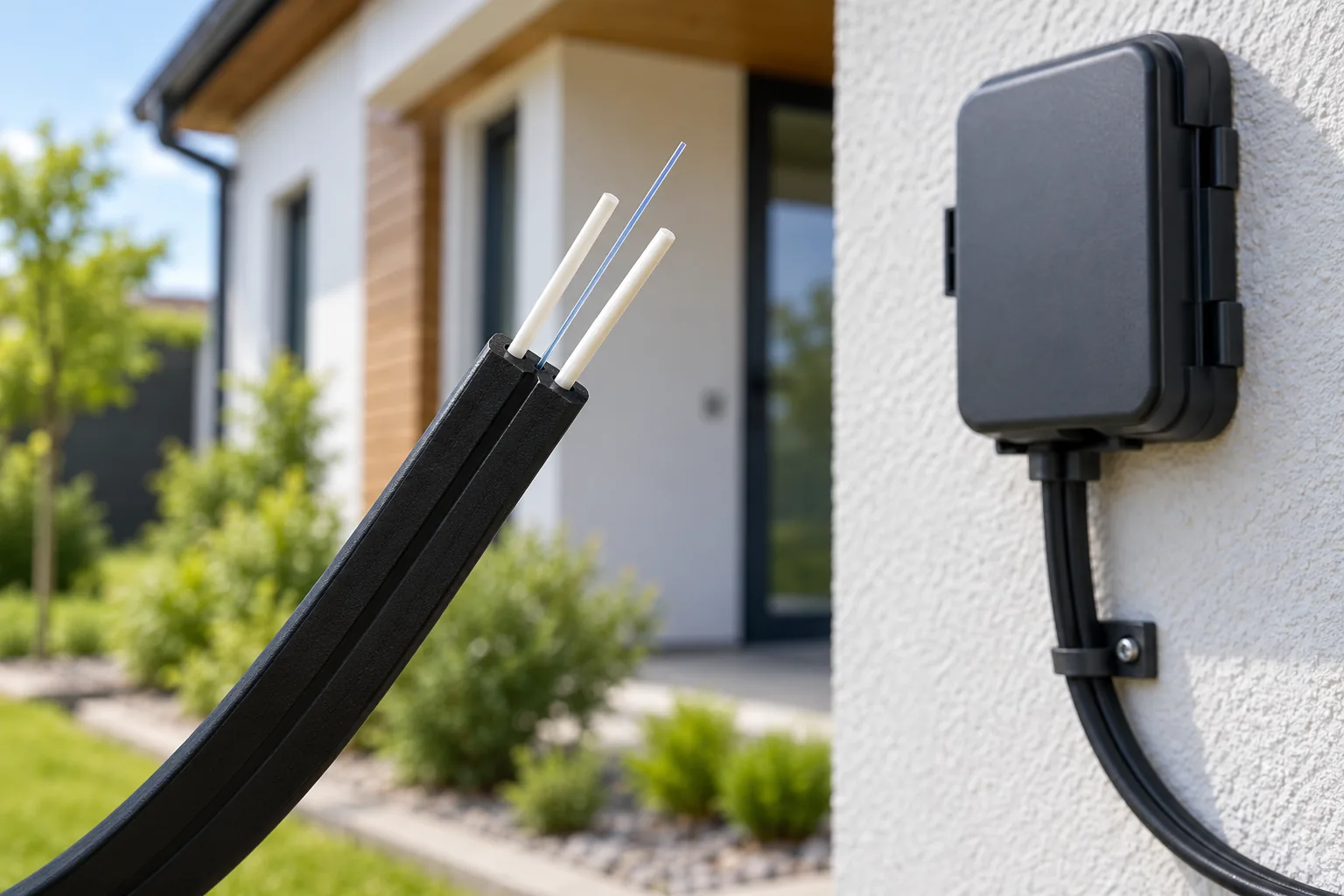
Drop cable is an access network product. For a business site with more than a few fibers, a small loose tube or indoor/outdoor cable is usually the better buy.
Aerial cable: lashed, figure-8, ADSS and OPGW
There are four ways to hang fiber on poles, and the choice mostly depends on where on the pole the cable will sit.
- Lashed cable. A standard loose tube cable is lashed with a thin wire to a separate galvanized steel strand. This is the traditional method on the telecom part of a pole and lets several cables share one strand.
- Figure-8 cable. The cable and a steel messenger share one jacket, so the whole thing goes up in one pass with no lashing. The trade-off is weight and a metallic messenger that must be bonded and grounded like any other strand.
- ADSS (all-dielectric self-supporting). No metal at all. Aramid yarn carries the load, so ADSS can be installed in the power space of a distribution pole, close to energized conductors, where nothing metallic belongs. Standard jackets are suited to electric space potential up to about 12 kV; tracking-resistant jackets are used up to about 25 kV to stop dry-band arcing from eating the jacket. Utilities also use ADSS on transmission structures, framed under the conductors.
- OPGW (optical ground wire). Fibers inside the steel and aluminum shield wire at the top of high-voltage transmission towers. It is a utility product, installed by line crews when the shield wire is replaced.
Span and loading for ADSS
An ADSS cable is designed for a span length and an ice and wind loading. In the US the loading districts come from the NESC: heavy loading assumes 12.7 mm (0.5 in) of radial ice at -18 °C (0 °F) with wind. In Canada, CSA C22.3 No. 1 sets the overhead loading, with its heavy loading case using 12.5 mm of ice at -20 °C. Heavier loading means shorter allowed spans. One ADSS line on the stock list we mentioned shows it clearly: rated for 700 ft spans under heavy loading, 1,100 ft under medium and 1,500 ft under light. Standard designs cover typical distribution spans of about 100 to 200 m, and long-span designs reach 800 m or more on transmission lines. The maker’s sag and tension tables, matched to the actual ruling span and loading zone, decide the hardware and the installed sag.
Attaching anything to a utility pole needs the pole owner’s permission and usually an engineered attachment plan, so aerial fiber is planned months ahead of the pull.
Armored fiber cable
Armor is added protection between the cable core and the outer jacket. The right type depends on what you are protecting against.
| Armor | Where it is used | What it protects against | Note |
|---|---|---|---|
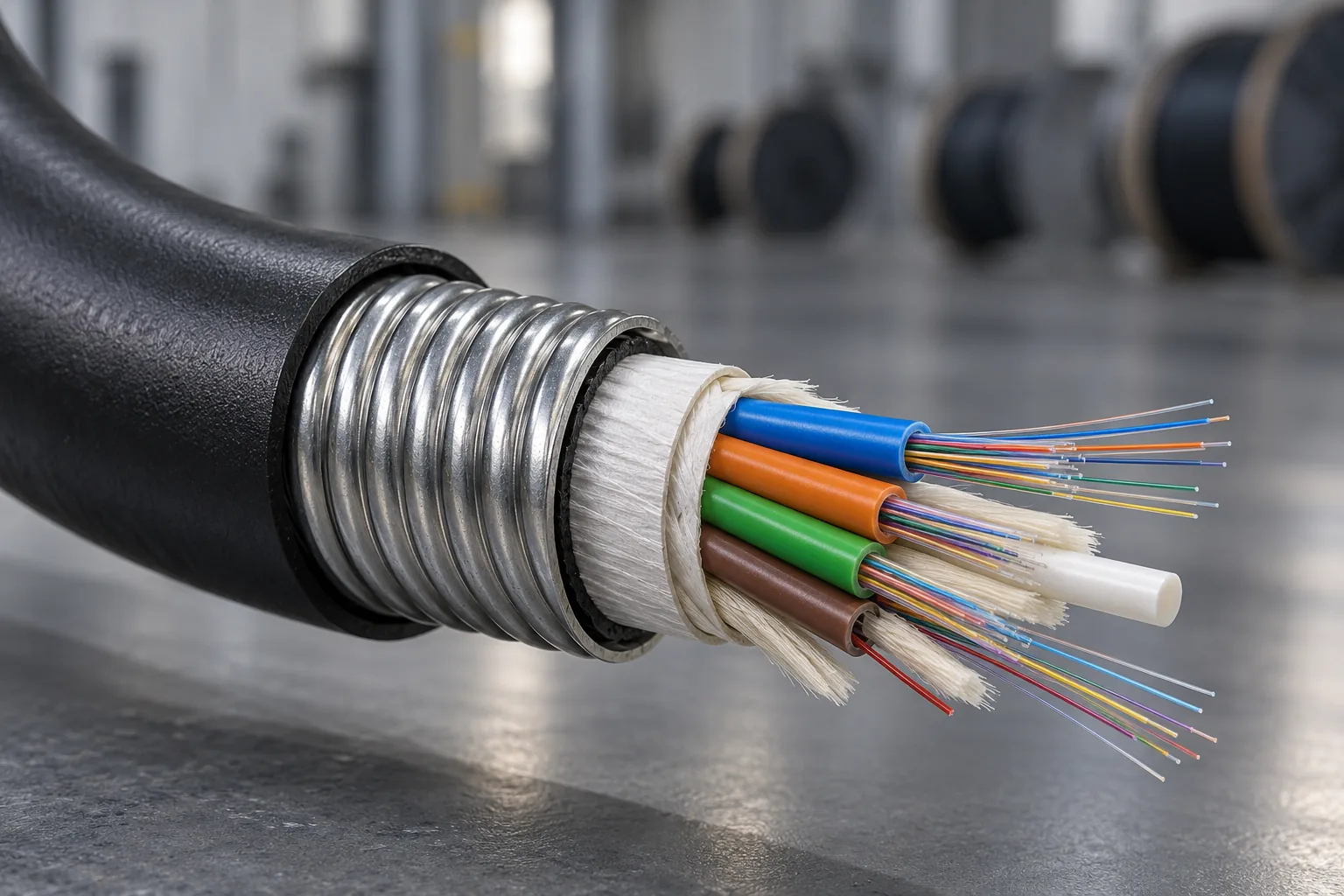
| Corrugated steel tape (single jacket, single armor, or SJSA) | Direct burial, rocky ground, ducts shared with other utilities | Rodents, crushing, stones in backfill | The standard outside plant armor |
| Double armor, triple jacket | Very harsh routes, heavy gopher or rodent pressure | The same, with a second layer | Heavy and stiff; specify only when needed |
| Light armor | Duct and burial where some protection is wanted with less weight | Rodents and handling damage | Thinner tape, smaller diameter |
| Dielectric armor | Near power lines or where no metal is allowed | Rodents, to a degree | Keeps the cable non-conductive, so no bonding is needed |
| Aluminum interlocking armor (AIA) | Indoor runs in data centres, plants, ceilings and exposed walls | Crushing, forklifts, accidental damage | Often chosen instead of innerduct; available plenum or riser rated |
Any metal armor makes the cable conductive in code terms. In Canada, Rule 56-214 of the Canadian Electrical Code requires the metal parts of a conductive optical fiber cable that is exposed to lightning or accidental contact with power conductors to be bonded to ground as close as possible to where the cable enters the building. In the US the equivalent cables are listed as OFCR or OFCP rather than OFNR or OFNP. Our article on armored vs non-armored fiber goes further into when the extra cost is worth it.
Indoor/outdoor cable
Outdoor cable is built for water, sunlight and cold, but its polyethylene jacket is not fire-rated for use inside a building. Indoor cable is fire-rated but not built for water or UV. Indoor/outdoor cable is designed to be both: water-blocked, UV-resistant and rated for cold, with a riser (FT4, OFNR) or plenum (FT6, OFNP) listing.
The point is to avoid a splice at the building entrance. With plain outside plant cable, the code limits how far it can run inside. The US National Electrical Code allows unlisted outside plant fiber to run up to 15 m (50 ft) from its point of entrance, outside risers and air-handling spaces, provided it ends in an enclosure. In Canada, Section 56 of the Canadian Electrical Code requires optical fiber cable inside a building to be an approved type from Table 19, and vertical shafts and plenums carry their own flame-spread rules. In practice that means one of two designs: splice the outdoor cable to an FT4 or FT6 cable in an entrance enclosure close to where it comes in, or run an indoor/outdoor cable that carries both ratings all the way to the telecom room. Your inspector has the final word on borderline cases.
Indoor/outdoor cable comes in tight-buffered versions for short runs and loose tube versions for longer ones. It usually costs more per metre than an outdoor-only cable of the same count, so on long campus runs it can still make sense to splice at the entrance.
Hybrid and composite cable
The word “hybrid” means two different things depending on who is talking:
- In cable catalogues, a hybrid cable holds two kinds of fiber in one sheath. Examples: 24 multimode plus 24 single-mode fibers for a campus that still runs legacy multimode equipment; G.652 single-mode plus G.655 LEAF fiber built to match an existing carrier route; or G.652 plus G.654.E TXF fiber for a long-haul build. Several lines on that stock list are exactly this, printed with a carrier’s name.
- In the Canadian Electrical Code, Rule 56-102 uses “hybrid” for a cable that combines optical fibers with current-carrying electrical conductors, and Rule 56-204 says it is classed and installed by the rules for its conductors. The US code calls the same thing a “composite” cable.
Fiber-plus-copper cables solve a real problem. A composite micro cable with two 16 AWG conductors can carry data and power to a small cell, a remote camera or a Wi-Fi access point hundreds of metres from the nearest switch. Cell sites use larger hybrid trunks for fiber to the antenna. A toneable drop is a mild version of the same idea: its tracer wire is copper, but it carries a locating tone, not power.
Patch cords, trunks and assemblies
Not all fiber cable is bought by the reel. A large share arrives as factory-terminated assemblies:
- Patch cords: simplex, duplex or uniboot, with LC, SC or other connectors. Single-mode connectors come in UPC (blue) or APC (green) polish. See our guides to fiber connector types and fiber polarity.
- MPO/MTP trunks: 8, 12, 16 or 24 fibers per connector, often built on indoor ribbon cable, for data centre backbones and 40G to 800G parallel optics. Our MTP vs MPO guide explains the differences, and our MPO polarity guide covers Type A, B and C.
- Pigtails: a connector on one end and bare fiber on the other, spliced onto outside plant or ribbon cable.
- Specialty cords: armored patch cords for exposed areas, and mode conditioning cables for running long-wave optics over old multimode.
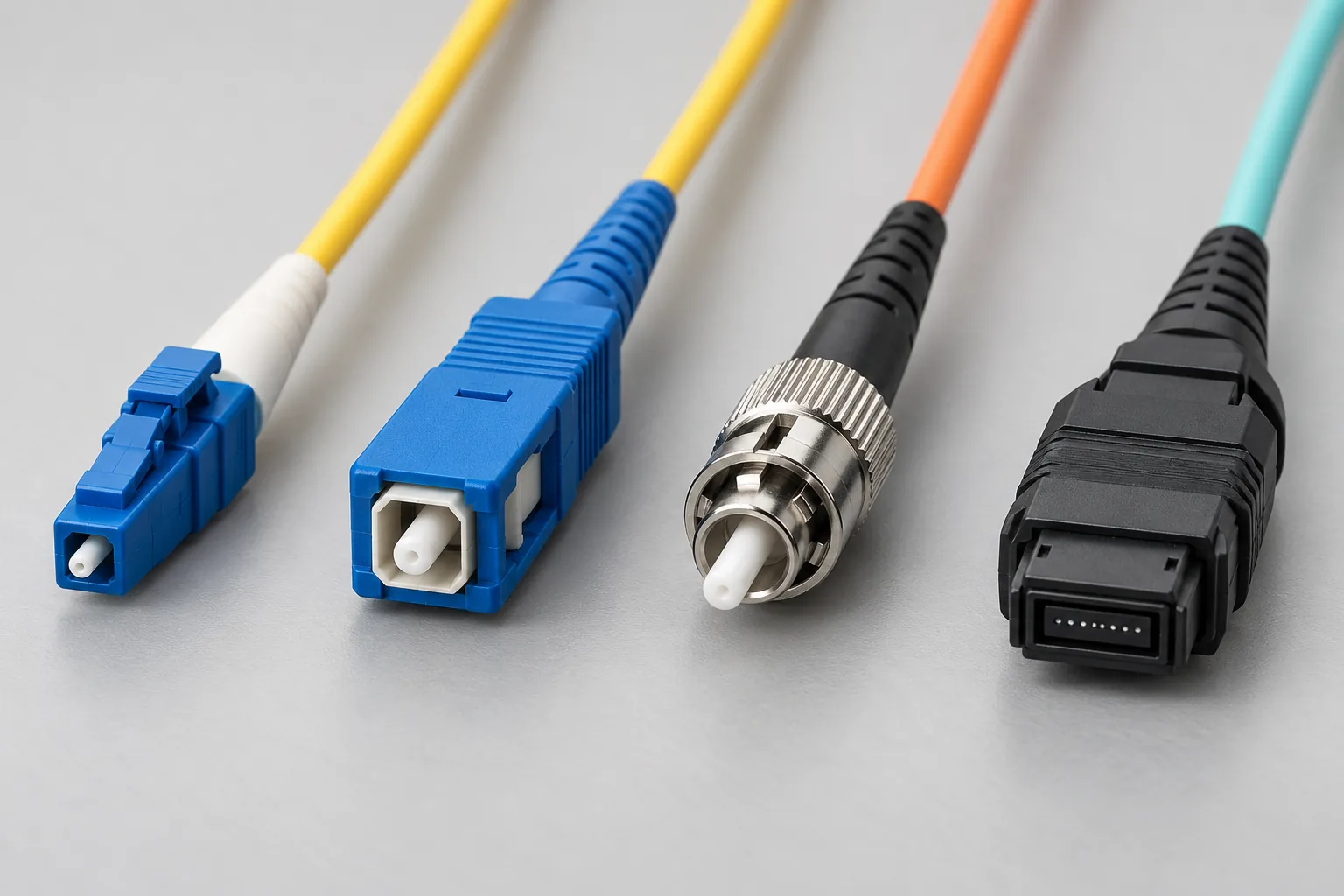
Custom lengths and counts are normal. Our guide to ordering custom fiber cables in Canada lists the details a supplier will ask for.
Fire ratings: FT4, FT6, OFNR, OFNP and LSZH
The fire rating printed on the jacket decides where a cable may legally run inside a building. Canada and the US use different markings for the same idea, and many cables sold here carry both.
| Space | Canada (CSA marking) | US (NEC listing) | Notes |
|---|---|---|---|
| Plenums and other air-handling spaces | FT6 | OFNP, or OFCP if conductive | The highest rating. A plenum cable can go anywhere a riser or general cable can. |
| Vertical shafts and risers | FT4, or any cable inside a non-combustible raceway | OFNR, or OFCR if conductive | FT4 is a vertical flame test. CEC Rule 56-208 applies it to shafts. |
| Everywhere else in a non-combustible building | FT4 | OFN or OFNG (general purpose) | In Canada, FT4 is effectively the floor in most commercial buildings, not just risers. |
| Combustible construction outside plenums | FT1 permitted | OFN or OFNG | Houses and many low-rise wood-frame buildings. |
The Canadian rules work like this. Rule 2-130 of the Canadian Electrical Code sends you to the National Building Code (or the Ontario Building Code here) for flame spread. In a building required to be of non-combustible construction, which covers most offices, warehouses and towers, cables with combustible jackets must pass the vertical FT4 test wherever they run exposed. Since the 2015 National Building Code, cables in air-handling plenums need FT6 whether the building is combustible or not. Section 56 of the electrical code then adds the fiber-specific rules: approved cable types from Table 19 inside buildings (Rule 56-104), FT4 or a non-combustible raceway in vertical shafts (Rule 56-208), plenum rules for ducts and air-handling spaces (Rule 56-210) and bonding for conductive cables (Rule 56-214). Ontario adopted the 2024 Canadian Electrical Code as the 29th edition of the Ontario Electrical Safety Code on May 1, 2025.
Two things trip people up:
- LSZH is a jacket chemistry, not a fire listing. Low smoke zero halogen cable is tested to IEC 60332, 60754 and 61034 for flame spread, acid gas and smoke. It is widely specified for transit, tunnels and data centres. But an LSZH cable is only a riser or plenum cable in North America if it also carries that listing, and LSZH fiber cable is far more often listed riser or general purpose than plenum. Order the listing you need and the chemistry you want, separately.
- Not every ceiling is a plenum. A plenum is a space used to move air, usually a return-air ceiling. A ducted return means the ceiling above the tiles may not be a plenum at all. The mechanical drawings, not the presence of a drop ceiling, decide whether you need FT6.
In the US, the 2026 National Electrical Code deleted Article 770. Optical fiber cable rules now sit in the limited-energy articles (720, 722 and 723), and Article 800 covers cables entering buildings, including the 15 m (50 ft) allowance for unlisted outside plant cable. Older spec sheets and guides still cite Article 770; the requirements did not disappear, they moved.
For copper and fiber together, our plenum vs riser vs direct burial guide and Canadian Electrical Code guide for low-voltage conduit cover the same ground from the pathway side. This section is general information, not code advice for a specific building; the authority having jurisdiction makes the call.
Which fiber cable goes where
Put the three decisions together and most projects fall into a handful of patterns. The drawing below follows one fiber route from an equipment room to a home, and the table after it gives our usual starting choice at each point.
| # | Location | Glass | Construction | Rating or jacket | Watch for |
|---|---|---|---|---|---|
| 1 | Equipment room or data hall | OS2 and OM4 | Duplex patch cords, MPO trunks on indoor ribbon cable | FT6 or FT4 | Polarity, connector type, slack management |
| 2 | Riser between floors | OS2 (plus OM4 if multimode equipment needs it) | Tight-buffered distribution, 12 to 48 fibers per closet | FT4 minimum | Firestop at every slab, bend radius in the closet |
| 3 | Ceiling plenum or air-handling space | As above | Tight-buffered, or interlocking armored where exposed | FT6 | Confirm whether the ceiling is really a return-air plenum |
| 4 | Building entrance | Same as outside run | Splice enclosure to indoor cable, or indoor/outdoor cable | FT4 or FT6 indoors | Bond conductive armor near the entrance |
| 5 | Underground duct between buildings | OS2 | Gel-free stranded loose tube, all-dielectric | Black polyethylene | Pulling tension (2,700 N typical), slack loops in handholes |
| 6 | Direct burial | OS2 | Armored loose tube (single or double armor) | Polyethylene over steel tape | Tracer or locatable cable, warning tape, depth |
| 7 | Power poles (power space) | OS2 | ADSS | Polyethylene or tracking-resistant | Span, loading zone, pole owner approval |
| 8 | Telecom space on poles | OS2 | Loose tube lashed to strand, or figure-8 | Polyethylene | Strand bonding, clearance to power |
| 9 | Drop to a home or small site | OS2, G.657.A2 or B3 | Flat drop, toneable if buried, often preconnectorized | Polyethylene; riser or LSZH indoors | Locating, entry point, indoor transition |
| 10 | Microduct | OS2, 200 µm fiber | Micro cable or micro rollable ribbon, blown in | Thin polyethylene | Matching cable to duct size, blowing distance |
| Warehouse, plant or cold storage | OS2 (OM4 for short runs) | Interlocking armored or tray-rated indoor/outdoor | FT4 | Forklift damage, -40 °C rating in freezers, long camera runs | |
| Tunnels, parking structures, transit | OS2 | Loose tube or tight-buffered | LSZH plus the required listing | Smoke and corrosive gas limits in the spec |
The single most useful rule in that table: if a link leaves the building, or might one day reach more than a few hundred metres, use single-mode. Multimode belongs inside a building, and increasingly only inside the equipment room.
Fiber count and cable diameter
Search results rarely say how big a cable actually is, and diameter decides what fits in a conduit, a tray or a pole attachment. Here are 288 fibers packaged four ways, drawn to scale from the makers’ published diameters.
| Construction | Example | Outside diameter | Installed by |
|---|---|---|---|
| Standard stranded loose tube, 2.5 mm tubes | Lightera Fortex DT | 18.0 mm | Pulling |
| Heavy-duty micro core loose tube | AFL LMHD MicroCore | 12.4 mm | Pulling (600 lb) into a 16 mm duct |
| Rollable ribbon micro cable, 200 µm fiber | Sumitomo FREEFORM Ribbon | 9.5 mm | Blowing into a 13 mm duct |
| High-density micro cable, 36 fibers per tube, 200 µm fiber | Corning MiniXtend HD | 8.1 mm | Blowing into a 10 mm (minimum) duct |
At the top end, published maker data for the largest cables looks like this:
| Fibers | Cable | Outside diameter | Duct named by maker |
|---|---|---|---|
| 864 | Prysmian Sirocco Extreme micro cable, 180 µm fiber | 9.8 mm | 12 mm microduct |
| 864 | Sumitomo FREEFORM Ribbon micro cable | 13.5 mm | 18 mm microduct |
| 1,728 | AFL Wrapping Tube Cable, 200 µm fiber at 200 µm pitch | 19.0 mm | Not stated |
| 1,728 | Corning RocketRibbon XD Cable-200 Flow | 20.1 mm | Not stated |
| 1,728 | AFL Wrapping Tube Cable with SpiderWeb Ribbon, 250 µm fiber | 23.0 mm | Not stated |
| 1,728 | Lightera AccuTube+ RR | 25.1 mm | 1.25 in duct |
| 3,456 | Corning RocketRibbon XD Cable-200 Flow | 26 mm | Not stated |
| 3,456 | Prysmian MassLink with FlexRibbon | 30.9 mm | 1.5 in duct |
| 3,456 | Lightera AccuTube+ RR | 33.5 mm | 2 in duct |
| 6,912 | AFL Wrapping Tube Cable, 200 µm fiber at 200 µm pitch | 29.8 mm | Not stated |
| 6,912 | Fujikura Wrapping Tube Cable | 34.5 mm | Not stated |
| 6,912 | Prysmian MassLink with FlexRibbon | 38.9 mm | 2 in duct |
Figures from manufacturer data sheets and announcements current in 2026. 6,912 fibers is the highest count we could confirm from a manufacturer. Check the current sheet before designing a duct fill.
How many fibers you need depends on the job, but some patterns repeat. A telecom room on an office floor usually gets 12 to 48 single-mode fibers from the main equipment room. A campus link between two buildings is often 24 to 144. FTTH feeders run from 144 into the high hundreds, and data centre interconnects go into the thousands. The cable itself is usually a small part of the installed cost, so order spare fibers. A second pull later costs far more than the extra strands.
How to read a fiber cable spec line
Distributor stock lists and jacket prints compress a whole specification into one line of abbreviations. Here is how to read them.
| Code | Meaning |
|---|---|
| 288F, 144FBR, 96ct | Fiber count |
| SM / MM | Single-mode / multimode |
| OS2, OM3, OM4, OM5 | ISO/IEC 11801 cabled fiber category |
| G.652.D, G.657.A1, G.657.A2, G.657.B3 | ITU-T single-mode fiber standard (G.657 = bend-improved) |
| G.655, LEAF / G.654.E, TXF | Long-haul fibers: non-zero dispersion-shifted / large-area cut-off shifted |
| ESMF, "SMF-28e compliant" | Enhanced single-mode fiber, a maker term for low-water-peak G.652.D. "SMF-28e compliant" means another maker's fiber meets the same spec as Corning's |
| ZWP, LWP, RWP | Zero, low or reduced water peak: low loss at 1383 nm |
| BI, BIF | Bend-insensitive fiber (G.657) |
| 12F/T, 36/tube | Fibers per buffer tube |
| LT / CT | Loose tube / central tube |
| RR, IBR | Rollable ribbon / intermittently bonded ribbon |
| SJ / DJ / TJ | Single, double or triple jacket |
| NA / SA / DA | Non-armored, single armor, double armor |
| SJSA, DJSA, TJDA | Jacket and armor combined, for example single jacket single armor |
| AD, All-Dielectric | No metal anywhere in the cable, so no bonding needed |
| Dry, Gel-Free, GF | Water blocked with swellable yarns and tapes instead of gel. GF usually means gel-free, but check, because a few sheets use it for gel-filled |
| AIA, Interlocking Armor | Aluminum interlocking armor, used indoors |
| OSP / ISP | Outside plant / inside plant |
| ADSS, Fig-8 | All-dielectric self-supporting / figure-8 with steel messenger |
| Toneable, TW | Has a copper tracer wire for locating |
| FT6, FT4, FT1 | CSA flame ratings used in Canada |
| OFNP, OFNR, OFN / OFCP, OFCR | US listings: plenum, riser, general; C = conductive |
| LSZH, LS0H | Low smoke zero halogen jacket chemistry |
| W/FAT, W/FAB, FastAccess | Corning FastAccess technology: a jacket that opens by hand, without tools |
| BABA, BABAA | Meets the US Build America, Buy America rules for federally funded projects |
| Print in ft / m, "Print: [carrier]" | Length markings in feet or metres, or a carrier's own jacket legend |
| 0.35/0.35/0.25 dB/km | Maximum attenuation at 1310, 1383 and 1550 nm |
| NESC Heavy / Medium / Light, 100 m span | ADSS ice-and-wind loading and the span it is designed for |
| GR-20, ICEA S-87-640, RUS 7 CFR 1755 | Outside plant cable standards and US Rural Utilities Service rules |
| ICEA S-83-596 / S-104-696 / S-110-717 | Indoor / indoor-outdoor / drop cable standards |
Brand names you will see on stock lists
Product family names are where most of the confusion comes from. This is what the common ones are. Names are trademarks of their owners and are listed only to help identify cables.
| Name | Maker | What it is |
|---|---|---|
| ALTOS, ALTOS Lite | Corning | Gel-free stranded loose tube outside plant cable; Lite is a lighter single-armor version |
| MiniXtend, MiniXtend HD | Corning | Blown micro cable; HD uses 200 µm fiber at 36 fibers per tube |
| RocketRibbon | Corning | Extreme-density cable of flat 12-fiber ribbons in 288-fiber subunits; the XD Cable-200 Flow version uses flexible Flow Ribbon |
| SST-Ribbon, SST-UltraRibbon | Corning | Single central tube ribbon cable |
| SST-Drop, ROC Drop | Corning | Drop cables, toneable and non-toneable |
| FREEDM, MIC | Corning | Indoor/outdoor cable, and tight-buffered indoor distribution cable |
| MassLink, FusionLink (FlexRibbon) | Prysmian | Multi-tube and central tube ribbon cables using flexible ribbon |
| ExpressLT, ezSPAN, ResiLink, Sirocco | Prysmian | Dry loose tube, ADSS, flat drop and blown micro cable |
| Wrapping Tube Cable (WTC), SpiderWeb Ribbon (SWR) | Fujikura and AFL | Tubeless cable built from intermittently bonded ribbon |
| AccuTube+ RR, DuctSaver RR, Fortex DT, MiDia | Lightera (formerly OFS) | Rollable ribbon cables, dry loose tube and micro cable |
| SMF-28 Ultra, SMF-28e+ | Corning | Standard single-mode fiber: G.652.D, and Ultra also meets G.657.A1 |
| AllWave+, BendBright XS | Lightera, Prysmian | Low-water-peak and bend-improved single-mode fiber |
| LEAF, TXF | Corning | Long-haul fibers: G.655 with 72 µm² effective area, and G.654.E with 125 µm² |
| ClearCurve | Corning | Bend-insensitive multimode, and single-mode (ZBL) that exceeds G.657.B3 |
One more naming change worth knowing: OFS now sells under the Lightera name, after its parent Furukawa launched the brand in April 2025.
And here are real lines from that stock list, some shortened, decoded:
288F SM 12F/T G.652.D SA SJ Gel Free
288 single-mode fibers in 24 tubes of 12, G.652.D glass, single armor, single jacket, dry tubes. A standard direct-burial or rodent-area cable.
MassLink Multi-Tube Ribbon Cable, Non-Armor, Single Jacket 12F/Ribbon, Gel Tube 432 Fiber Single Mode (ITU G.652.D) 0.35/0.35/0.25 dB/km at 1310/1383/1550 nm
A 432-fiber stranded ribbon cable: 36 ribbons of 12, in gel-filled tubes, no armor. The three attenuation figures are the maximum loss per kilometre at 1310, 1383 and 1550 nm, tighter than the 0.4/0.4/0.3 that G.652.D allows.
HYBRID Gel-Free 12-TXF G.654.E / 276-SMF-28 Ultra G.652.D/G.657.A1, Armored
An armored, gel-free hybrid with 288 fibers: 12 large-area G.654.E fibers for long-haul coherent links and 276 standard bend-improved single-mode fibers for everything else on the route.
MIC CABLE PLENUM INTERLOCKING ARMOR SMF 28e+
A tight-buffered indoor cable with aluminum interlocking armor and a plenum jacket, built on G.652.D single-mode fiber. Conductive, so the armor gets bonded.
12-FIBER SST-DROP CABLE TONEABLE SMF-28E+ MAX: 0.35/0.35/0.25 DB/KM G.652.D PRINT IN FT REEL IN A BOX 1000 FT
A 12-fiber central-tube flat drop with a copper tracer for locating, G.652.D fiber, footage printed in feet, shipped as 1,000 ft in a pay-out box.
Composite Microfiber 2X16AWG 7.9mm OD SMF28e+
A 7.9 mm micro cable that also carries two 16 AWG copper conductors for powering remote equipment. A “hybrid” cable in Canadian code terms.
When you need to identify an unknown cable on site, read the jacket print first. Beyond the fiber count and type, it usually gives the maker, the listing (FT4, OFNR and so on), the year of manufacture and a running footage or metre mark every metre or two. The jacket colour is a hint, not proof: indoor single-mode is usually yellow and OM3 or OM4 aqua, but outdoor cable of every type is black.
Mistakes we see on fiber jobs
- Outdoor cable run deep into a building. Black polyethylene outside plant cable pulled up a riser or across a ceiling has no FT4 or FT6 rating. It works, until an inspection or an insurance survey finds it.
- Ordering “LSZH” and assuming it covers a plenum. Check the listing on the spec sheet, not the jacket chemistry.
- Mixing 62.5 and 50 µm multimode. Old orange patch cords on a new OM4 link, or a new 50 µm cable spliced to an old 62.5 µm backbone, can lose several dB at each joint where light passes from the larger core into the smaller one.
- Multimode for a link that will grow. A warehouse camera run or a second building 350 m away might work on OM4 at 10G today and fail at the next speed. Single-mode leaves room for the next upgrade.
- Ignoring bend radius in closets. G.657 fiber forgives tight loops inside the cable, not a cable jacket crushed in a full cabinet door or a tray corner. The cable’s own minimum bend radius still applies.
- Buried dielectric cable with no tracer. If nobody can locate it, the next excavator will find it the hard way.
- No slack. Leave service loops at handholes, entrance enclosures and the telecom room. A repair or a move without slack means a new splice point, or a new cable.
- Testing only with a light meter on outside plant. Loss testing proves a link works. An OTDR trace shows where every splice, connector and stress point sits, which is what you want on file the day something breaks. Our fiber testing guide covers both.
Need fiber designed, installed or tested?
Cablify runs single-mode and multimode backbones, building-to-building links, armored and indoor/outdoor runs, fusion splicing and testing across Toronto and the GTA, with our own technicians. Send us the route, the buildings and the equipment at each end, and we will tell you which cable we would use and why.
FAQ
What are the main types of fiber optic cable?
Fiber cable is classified two ways. By the glass: single-mode (OS2, ITU-T G.652.D or G.657) and multimode (OM3, OM4, OM5). By construction: tight-buffered and breakout cable indoors, loose tube, ribbon and micro cable outdoors, ADSS and figure-8 cable for aerial runs, drop cable for the last link to a building, and armored cable where crushing or rodents are a risk.
What are the 3 types of fiber optic cable?
When people say three types, they usually mean single-mode, multimode and plastic optical fiber. Only the first two are used in building and network cabling. Plastic optical fiber is limited to short links in cars, consumer audio and some industrial controls.
Which type of fiber optic cable is most common?
Single-mode fiber built to ITU-T G.652.D, now often also meeting G.657.A1. It carries nearly every telecom, FTTH, campus and backbone link. Inside buildings, OM4 multimode is still common for short links in equipment rooms and data centres.
What is the difference between loose tube and tight-buffered fiber cable?
Tight-buffered cable puts a 900 micron buffer directly on each fiber, so fibers can be connectorized directly. It is the standard indoor design. Loose tube cable floats 250 micron fibers in gel-filled or dry tubes so the cable can stretch and shrink without straining the glass. It is the standard outdoor design, rated for about -40 to 70 degrees Celsius, and is spliced to pigtails at each end.
Can outdoor fiber cable be installed inside a building?
Only for a short distance. Outdoor polyethylene jackets are not fire-rated. In Canada, cable inside a building must be an approved type with the right flame rating (FT4, or FT6 in plenums), so outdoor cable is normally spliced to indoor cable in an enclosure near the entrance. The US code allows unlisted outside plant cable up to 15 m (50 ft) from the entrance. Indoor/outdoor cable carries both ratings and avoids the splice.
What do FT4 and FT6 mean on a fiber cable?
They are Canadian flame ratings from CSA. FT4 is a vertical flame test and is the minimum for exposed cable in most commercial buildings and in vertical shafts. FT6 is a flame and smoke test required in plenums and air-handling spaces. They roughly match the US riser (OFNR) and plenum (OFNP) listings, and many cables carry both markings.
When do I need armored fiber cable?
Use corrugated steel armor for direct burial, rodent-prone routes and ducts shared with other utilities. Use aluminum interlocking armor indoors where cable is exposed to crushing, such as plants, warehouses and data centres. Metal armor makes the cable conductive, so it must be bonded to ground near the building entrance.
What is ADSS fiber cable used for?
ADSS (all-dielectric self-supporting) cable hangs between poles without a separate messenger wire and contains no metal, so it can be installed in the power space of utility poles near energized lines. It is designed for a specific span length and ice and wind loading.
What is rollable ribbon fiber cable?
It is a ribbon whose 12 fibers are bonded to each other only at short, staggered points. Inside the cable it rolls into a compact bundle, so a single cable can carry 1,728 fibers in a 1.25 inch duct or 6,912 fibers in a 2 inch duct, and at the splice point it lays flat for mass fusion splicing. Makers sell it as rollable ribbon, SpiderWeb Ribbon, FlexRibbon, Flow Ribbon and FREEFORM Ribbon.
Is OM1 fiber still used?
Only in older buildings. OM1 (62.5 micron) supports 10 Gigabit Ethernet to just 33 m and is listed as grandfathered in ISO/IEC 11801-1. New multimode cabling should be OM4, and anything leaving the building should be single-mode.
How can I tell what type of fiber cable I have?
Read the jacket print. It normally gives the fiber count, fiber type (SM, OM3, OM4), standard (such as G.652.D), fire rating, maker and a length marking. Jacket colour helps indoors (yellow is single-mode, aqua is OM3 or OM4, orange is OM1 or OM2, lime is OM5), but outdoor cable of every type is black.
What is the minimum bend radius for fiber optic cable?
Use the maker's figure. Without one, TIA defaults are 20 times the cable diameter while pulling and 10 times once installed for outside plant cable, and 15 and 10 times for indoor backbone cable. Small 2- and 4-fiber indoor cables are allowed 25 mm unloaded and 50 mm under pulling load.