
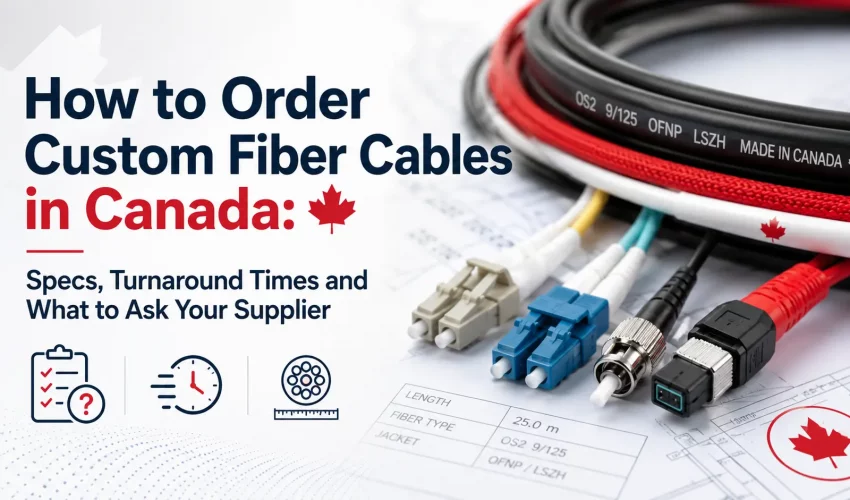
You know you need fiber. You know the stock 1, 2, 3, 5 and 10 metre patch cables on the shelf will not work for your rack layout, your riser run or your trunk pull. What you may not know is exactly how to write the specification so your supplier builds the right cable the first time.
This guide walks you through the six specifications every custom fiber order needs, gives you a copy-and-paste template that turns a vague request into a same-day quote, and covers the questions worth asking any supplier before you commit. It applies whether you are ordering two cables for a server room in Mississauga or two hundred trunk assemblies for a data centre in Texas.
If you already have your spec ready, you can skip straight to our buy fiber optic cables page and send it in. Quotes go out the same business day.
Why Custom Beats Stock for Most Commercial Installs
Stock patch cables exist because they are convenient, not because they fit. A 3 metre cable on a 1.8 metre run leaves 1.2 metres of slack coiled somewhere. Multiply that across 48 ports in a rack and you get blocked airflow, cable congestion that makes moves and changes painful, and bend radius violations hiding inside every coil.
Custom-length cables cost slightly more per unit and take a few extra days. In exchange you get clean cable management, easier troubleshooting, better airflow and fewer macrobend losses. For data centres, healthcare facilities and any environment audited for cable management standards, exact-length custom assemblies are the default, not the exception.
The other reason to go custom is configuration. Hybrid connector pairs like LC-ST, armored jackets, LSZH ratings and MTP/MPO trunk counts are rarely stocked in the combination you need. Those cables get built to order no matter where you buy them, so the only real question is who builds them well and how fast.
The Six Specifications Every Custom Fiber Order Needs
A fiber assembly is fully defined by six pieces of information. Get all six right and any competent supplier can build your cable without a single follow-up email.
1. Connector Type at Each End
Check the port label on your switch, transceiver or patch panel. It will say LC, SC, ST or FC. Modern 10G and 25G SFP+ transceivers almost always take LC. Older patch panels in schools, government buildings and industrial plants often still use ST or SC. If the two ends differ, you need a hybrid cable, and you must state which connector goes on which end.
For 40G and 100G trunk cabling, you are likely looking at MTP/MPO connectors carrying 12 or 24 fibers each. These add a polarity specification (Type A, B or C), so flag MTP orders early and confirm polarity against your transceiver documentation.
2. Length
Measure the actual cable path, not the straight-line distance. Follow the route through the tray, up the rack and down to the port, then add 10 to 15 percent for service slack and termination dressing. State the unit clearly. A “30” that meant feet but was built as 30 metres is one of the most common and most expensive ordering errors in this industry.
3. Fiber Type
Singlemode OS2 (yellow jacket) for long runs: campus backbone, inter-building links, anything past 300 metres. Multimode OM3 or OM4 (aqua or violet jacket) for short, high-speed runs inside a server room or data centre. OM4 carries 10G to 550 metres and 100G to 100 metres, which makes it the safe default for new multimode installs. Only order OM1 or OM2 if you are matching legacy 62.5/125 or older 50/125 infrastructure. Mixing fiber grades on the same link causes loss, so match what is already in your plant.
4. Simplex or Duplex
Duplex (two fibers, one connector pair per end) is standard for almost all switch-to-switch and switch-to-server links, since transmit and receive run on separate strands. Simplex covers single-strand applications like BiDi transceivers and some FTTH and PON setups. When in doubt for enterprise networking, it is duplex.
5. Jacket Type
This is the spec most buyers skip, and it is the one building inspectors care about.
- Standard PVC (OFNR riser): general purpose in-building use, the default for most office and server room runs.
- Plenum (OFNP): mandatory in air-handling spaces such as drop ceilings used as return air plenums. Required by code in most Canadian and US commercial buildings for those spaces.
- LSZH (low smoke zero halogen): emits minimal toxic smoke when burned. Specified in healthcare, transit, marine and many government projects.
- Armored: stainless steel interlocked armor over the standard construction. Use it under raised floors, in cable trays shared with heavy copper, outdoors in conduit, and anywhere rodents are a known problem.
6. Quantity
Order what the design calls for plus spares. A sensible rule for patch cables is 5 to 10 percent extra, minimum of two. Custom cables have a lead time, and a damaged connector on cutover night should never hold up a commissioning.
Copy-and-Paste Spec Template
Fill in the blanks below and email it to your supplier. This is the exact format our own quoting team works from, and a complete template like this one gets priced in a single pass.
Subject: Custom Fiber Cable Quote Request
1. Connector, End A: ______ (LC / SC / ST / FC / MTP)
2. Connector, End B: ______ (LC / SC / ST / FC / MTP)
3. Length: ______ (state metres or feet)
4. Fiber type: ______ (OS2 singlemode / OM3 / OM4 / OM1 / OM2)
5. Simplex or duplex: ______
6. Jacket: ______ (PVC riser / Plenum / LSZH / Armored)
7. Quantity: ______
8. Labeling or colour coding: ______ (optional)
9. Delivery city and postal or ZIP code: ______
10. Required-by date: ______
Send it to info@cablify.ca and you will have a quote the same business day. Not sure about one of the lines? Send the switch or transceiver model number instead and we will fill in the blank for you.
Quick Reference: Matching Fiber Type to the Job
| Fiber Type | Jacket Colour | Max Distance | Typical Use |
|---|---|---|---|
| OS2 Singlemode | Yellow | 10 km+ | Campus backbone, inter-building, telecom |
| OM4 Multimode | Violet or aqua | 10G to 550 m, 100G to 100 m | New data centre and server room installs |
| OM3 Multimode | Aqua | 10G to 300 m | Existing 10G server room infrastructure |
| OM1 / OM2 | Orange | 1G class | Legacy repairs and extensions only |
Realistic Turnaround Times in Canada and the USA
Lead time is where custom fiber orders most often go sideways, usually because the buyer assumed Amazon-style delivery on a built-to-order product. Here is what realistic timelines look like from a supplier with on-hand inventory and a domestic assembly pipeline.
- Stocked standard configurations: 1 to 3 business days to ship. LC-LC duplex in OM3, OM4 and OS2 at common lengths usually falls here.
- Custom assemblies: 3 to 7 business days for build, test and dispatch. Covers non-standard lengths, hybrid connector pairs, LSZH and armored jackets.
- MTP/MPO trunks and high fiber counts: 5 to 10 business days depending on fiber count, polarity and length.
- Rush orders: often possible on common configurations. Call before you assume either way. Cablify takes rush requests at 1-877-450-2134.
Add transit time on top: 1 to 4 business days for most Canadian destinations, and comparable timelines for US deliveries depending on the customs lane. If your cutover date is fixed, work backwards from it and order with at least two weeks of buffer.
Seven Questions to Ask Your Supplier Before You Order
Price per cable tells you very little. These questions tell you whether the cables will actually pass commissioning.
- Is every assembly tested before shipping, and do you provide insertion loss test reports? Factory-tested cables with documented insertion and return loss are the difference between plugging in and walking away versus chasing a flaky link for a week.
- Are the connectors and fiber from recognized manufacturers? Brand-name assemblies from Belkin, Tripp Lite, Startech or C2G carry manufacturer warranties. High-grade generic assemblies are fine for many projects, but you should know which one you are buying.
- What is the bend-insensitive fiber situation? Modern G.657 singlemode and BIMMF multimode tolerate tighter routing in dense racks. Worth confirming for high-density installs.
- Can you label and colour-code the cables before shipping? Pre-labeled cables save hours on large deployments and keep your documentation honest from day one.
- What happens if a cable arrives out of spec? Get the replacement policy and turnaround in writing before a deadline depends on it.
- Do you ship to my location, and who handles customs for cross-border orders? A Canadian supplier shipping into the US, or the reverse, should be able to explain duties and brokerage up front.
- Can you also terminate, splice and test on site if the project grows? A supplier who also installs understands what happens to a cable after it leaves the box. Cablify runs its own fiber installation crews in Toronto and the GTA, along with fiber termination and fusion splicing services, so the people quoting your cables have pulled and tested thousands of them.
Five Ordering Mistakes That Cost Real Money
Confusing metres and feet. Always state the unit. Twice if you have to.
Measuring point to point instead of along the cable path. The cable follows the tray and the rack rails, not a tape measure stretched across the room. Short cables are scrap; measure the route.
Ordering OM3 into an OM4 plant, or mixing 62.5 and 50 micron fiber. Mismatched multimode grades create loss at every mated pair. Match what is in the building.
Forgetting the plenum requirement. If the cable crosses an air-handling space, PVC jacket will fail inspection. Confirm the pathway rating before ordering, not after the inspector visits.
Ordering zero spares. Connectors get damaged during installation. On a built-to-order product, the replacement is a week away. Spares are the cheapest insurance in networking.
Ordering Custom Fiber Cables in Canada and the USA
Cablify supplies custom fiber patch cables and assemblies from 0.5 metres to 300 metres and beyond, in every connector combination (LC, SC, ST, FC, MTP/MPO), every fiber grade (OS2, OM1 through OM4) and every jacket type including plenum, LSZH and armored. We are authorized Canadian resellers for Belkin, Tripp Lite, Startech and C2G, and we ship across every province and territory with free delivery on orders over $100.
We ship nationwide to Toronto, Mississauga, Vancouver, Calgary, Edmonton, Ottawa, Montreal, Winnipeg, Halifax and everywhere in between, with local pickup and supply available through our Mississauga fiber cable location. US buyers are covered through our American operation at cablify.com, with the same spec template and the same quoting process.
Government, education and healthcare buyers can request certificates of conformance and full product documentation for procurement compliance. Contractors and MSPs ordering monthly volume qualify for trade pricing.
Ready to Order Custom Fiber Cables?
Fill in the spec template above and send it over. Quotes the same business day, custom builds in 3 to 7 business days, shipping across Canada and the USA.
Frequently Asked Questions
How long does it take to get custom fiber cables made in Canada?
Custom fiber assemblies typically take 3 to 7 business days to build, test and ship, plus 1 to 4 business days in transit depending on your location. MTP/MPO trunk cables and very high fiber counts can take 5 to 10 business days. Rush service is often available on common configurations.
What information do I need to order a custom fiber patch cable?
Six specifications: connector type at each end, length with the unit stated, fiber type (OS2, OM3, OM4 or legacy OM1/OM2), simplex or duplex, jacket type (PVC, plenum, LSZH or armored) and quantity. If you can also provide your switch or transceiver model, a good supplier can verify the spec for you.
Is there a minimum order for custom fiber cables?
At Cablify there is no practical minimum. We build single custom cables as readily as hundred-unit volume orders, though per-unit pricing improves with quantity. Free delivery applies on orders over $100 across Canada.
Do custom fiber cables come tested?
They should. Every custom assembly Cablify supplies is factory terminated and tested for insertion loss before dispatch, and test documentation is available on request. If a supplier cannot confirm per-cable testing, keep shopping.
Can I order custom fiber cables from Canada to the USA?
Yes. Cablify ships custom fiber assemblies across Canada and serves US customers through cablify.com. The spec process is identical, and we handle the cross-border logistics so the cables arrive ready to install.
Need the cables installed and certified as well as supplied? Our commercial structured cabling team handles supply, installation, termination and OTDR testing across Toronto and the GTA, from a single patch cable to a full campus backbone.