


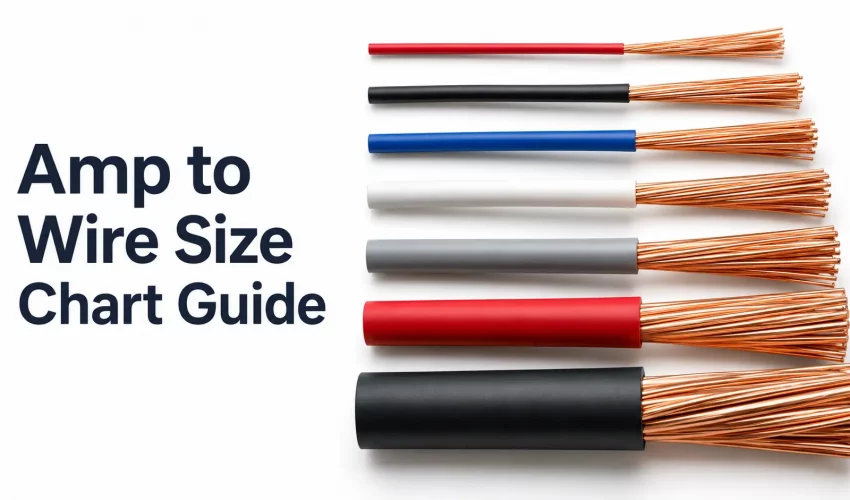
Wire sizing is one of those topics where the wrong answer costs real money, and in the worst case, lives. A breaker that holds 30 amps on a 14-gauge wire will eventually start a fire. A wire that’s too thin for a long run will drop voltage and burn out motors. So getting the gauge right matters.
This guide gives you the amp to wire size chart for the situations homeowners and contractors search most: 120V branch circuits, 240V appliances and EV chargers, 12V automotive and solar systems, and full residential service feeds up to 400 amps. The tables match the National Electrical Code (NEC) Table 310.16 and the Canadian Electrical Code (CEC) Table 2, which are nearly identical for the conductor sizes most people care about.
If you only need a quick answer, jump to the chart below. If you’re sizing wire for a long run or a tricky load, read the section on voltage drop and the calculation formula further down.
Quick Amp to Wire Size Chart (Copper, 75°C Column)
This is the chart most electricians use day to day. It assumes copper conductors with THHN or THWN-2 insulation, terminations rated for 75°C (which covers almost all modern breakers and equipment over 100A), and a standard 30°C ambient temperature.
| Amperage | Copper Wire Size (AWG) | Common Use |
|---|---|---|
| 15 A | 14 AWG | Lighting, general 120V outlets |
| 20 A | 12 AWG | Kitchen, bathroom, garage outlets |
| 30 A | 10 AWG | Dryer, water heater, small A/C |
| 40 A | 8 AWG | Electric range, larger A/C |
| 50 A | 8 AWG (75°C) or 6 AWG (60°C / NM cable) | Range, hot tub, Level 2 EV charger |
| 60 A | 6 AWG | Sub-panel feeder, large hot tub |
| 70 A | 4 AWG | Small sub-panel |
| 80 A | 4 AWG | Sub-panel feeder |
| 90 A | 3 AWG | Sub-panel, small service |
| 100 A | 3 AWG copper or 1 AWG aluminum | 100A residential service or sub-panel |
| 110 A | 2 AWG | Feeder |
| 125 A | 1 AWG copper or 2/0 aluminum | 125A panel feed |
| 150 A | 1/0 AWG copper or 3/0 aluminum | 150A service |
| 175 A | 2/0 AWG copper or 4/0 aluminum | 175A service |
| 200 A | 3/0 AWG copper or 4/0 aluminum | Standard 200A residential service |
| 225 A | 4/0 AWG copper or 250 kcmil aluminum | Feeder |
| 250 A | 250 kcmil copper or 300 kcmil aluminum | Service entrance |
| 300 A | 350 kcmil copper or 500 kcmil aluminum | Light commercial |
| 400 A | 500 kcmil copper or 750 kcmil aluminum | Large residential, light commercial |
A printable PDF of this chart is linked at the bottom of the page. Keep a copy in your truck or pinned in the shop.
How to Read the Chart (Temperature Ratings Explained)
The same wire can have three different ampacity ratings depending on what column you use. This trips up a lot of people, so here’s the plain explanation.
Every conductor has an insulation temperature rating: 60°C, 75°C, or 90°C. THHN and THWN-2 wire, the most common types in raceway, are rated 90°C. NM-B cable (Romex) is technically 90°C rated, but code forces you to use the 60°C column for it.
The rule that actually decides which column you use is NEC 110.14(C). In short:
- Circuits 100 amps or less with standard breakers: use the 60°C column unless every termination is marked 75°C
- Circuits over 100 amps: use the 75°C column
- The 90°C column is only used as a starting point for derating calculations, never as the as-installed ampacity
Here’s the full copper ampacity table, all three columns, from NEC 310.16:
| Wire Size (AWG/kcmil) | 60°C Ampacity | 75°C Ampacity | 90°C Ampacity |
|---|---|---|---|
| 14 AWG | 15 A | 20 A | 25 A |
| 12 AWG | 20 A | 25 A | 30 A |
| 10 AWG | 30 A | 35 A | 40 A |
| 8 AWG | 40 A | 50 A | 55 A |
| 6 AWG | 55 A | 65 A | 75 A |
| 4 AWG | 70 A | 85 A | 95 A |
| 3 AWG | 85 A | 100 A | 115 A |
| 2 AWG | 95 A | 115 A | 130 A |
| 1 AWG | 110 A | 130 A | 145 A |
| 1/0 AWG | 125 A | 150 A | 170 A |
| 2/0 AWG | 145 A | 175 A | 195 A |
| 3/0 AWG | 165 A | 200 A | 225 A |
| 4/0 AWG | 195 A | 230 A | 260 A |
| 250 kcmil | 215 A | 255 A | 290 A |
| 300 kcmil | 240 A | 285 A | 320 A |
| 350 kcmil | 260 A | 310 A | 350 A |
| 400 kcmil | 280 A | 335 A | 380 A |
| 500 kcmil | 320 A | 380 A | 430 A |
| 600 kcmil | 350 A | 420 A | 475 A |
| 750 kcmil | 400 A | 475 A | 535 A |
Important: NEC 240.4(D) caps the overcurrent device size on small conductors regardless of column. No matter what the ampacity table says, 14 AWG copper cannot be protected by more than a 15A breaker, 12 AWG by more than 20A, and 10 AWG by more than 30A.
Aluminum Wire Sizing
Aluminum is common in service entrance cables, feeders, and large branch circuits because it’s cheaper per amp. The trade-off is that aluminum conducts less efficiently, so you need a larger gauge to carry the same current. As a rough rule, aluminum sizes up one or two AWG steps from copper.
| Amperage | Copper (75°C) | Aluminum (75°C) |
|---|---|---|
| 30 A | 10 AWG | 8 AWG |
| 50 A | 8 AWG | 6 AWG |
| 100 A | 3 AWG | 1 AWG |
| 125 A | 1 AWG | 2/0 AWG |
| 150 A | 1/0 AWG | 3/0 AWG |
| 200 A | 3/0 AWG | 4/0 AWG |
| 400 A | 500 kcmil | 750 kcmil |
If you’re using aluminum, make sure your lugs and breakers are listed for aluminum (look for the CU/AL or AL/CU stamp) and use antioxidant compound on the terminations.
Canadian Electrical Code (CEC) Notes
The CEC Table 2 ampacities match NEC 310.16 for the most common sizes. The Canadian code has a few special rules worth knowing if you’re working in Ontario, BC, Alberta, or anywhere else under CSA jurisdiction.
- 100A residential service: A #3 AWG copper or #1 AWG aluminum conductor at 75°C is typically used. Some authorities require #1 AWG copper for overhead service drops.
- 200A residential service: Per a specific note in CEC Table 2, a 3-wire 120/240V residential service is permitted to use #2/0 AWG copper at 200A (a small bump above the standard ampacity, allowed for residential services only).
- Minimum conductor size (CEC Rule 4-002): No copper conductor smaller than 14 AWG, and no aluminum smaller than 12 AWG, is permitted for general wiring.
If you’re in Canada, always verify with your local AHJ (Authority Having Jurisdiction). Provinces add their own amendments to the CEC. In Ontario, that’s the ESA. In BC, it’s Technical Safety BC. In Alberta, Municipal Affairs Safety Services.
Amp to Wire Size Chart for 240V Circuits
The wire size for a 240V circuit depends only on the amperage, not the voltage. A 50A circuit at 240V uses the same gauge wire as a 50A circuit at 120V. What changes with voltage is the wattage the circuit can deliver (240V circuits carry twice the power for the same amperage) and the voltage drop on long runs (lower as voltage rises).
Here’s the practical 240V chart for the loads most people search:
| 240V Load | Typical Amps | Wire Size (Copper) |
|---|---|---|
| Window A/C | 15 A | 14 AWG |
| Baseboard heater (small) | 20 A | 12 AWG |
| Electric dryer | 30 A | 10 AWG |
| Electric range (small) | 40 A | 8 AWG |
| Electric range (full) | 50 A | 8 AWG (THHN) or 6 AWG (NM cable) |
| Hot tub | 50–60 A | 6 AWG |
| Level 2 EV charger (40A continuous) | 50 A breaker | 6 AWG |
| Level 2 EV charger (48A continuous) | 60 A breaker | 6 AWG |
| Welder | 50–60 A | 6 AWG |
| Sub-panel (100A) | 100 A | 3 AWG copper or 1 AWG aluminum |
Continuous loads (anything running over three hours, like EV chargers) must be sized at 125% per NEC 210.19. That’s why a 40A continuous EV charger needs a 50A breaker.
Amp to Wire Size Chart for 12V Circuits
12V DC is a completely different beast. Because the voltage is so low, even small voltage drops are a big deal. A 0.5V drop is 4% of a 12V system but only 0.2% of a 240V system. So you size 12V wires for voltage drop, not just ampacity.
Here’s the standard 12V wire size chart for short runs (under 10 feet round trip):
| Amps | Wire Size (AWG) |
|---|---|
| 5 A | 16 AWG |
| 10 A | 14 AWG |
| 15 A | 12 AWG |
| 20 A | 10 AWG |
| 30 A | 10 AWG |
| 40 A | 8 AWG |
| 50 A | 6 AWG |
| 75 A | 4 AWG |
| 100 A | 2 AWG |
| 150 A | 1/0 AWG |
| 200 A | 2/0 AWG |
For longer 12V runs, jump up a gauge for every doubling of distance. A 50A run at 20 feet round trip should use 4 AWG instead of 6.
Common Wire Size Questions
These are the questions homeowners, contractors, and apprentices search for over and over, so here are direct answers.
What size wire do I need for 100 amps?
For a 100A circuit, use 3 AWG copper or 1 AWG aluminum at the 75°C column. This applies to a 100A sub-panel feed or a 100A residential service in most cases. If the run is longer than about 100 feet, bump up one size for voltage drop.
What size wire do I need for 125 amps?
Use 1 AWG copper or 2/0 AWG aluminum. A 125A panel feeder typically runs 1 AWG copper THHN in 1¼” conduit.
Do I need 6 or 8 gauge wire for a 50 amp circuit?
It depends on the wire type and terminal rating:
- 8 AWG THHN copper in conduit, with 75°C-rated terminals: 50A is the exact rating, so 8 AWG works
- 6 AWG copper NM-B (Romex) for a 50A circuit: required, because NM cable uses the 60°C column where 8 AWG is only 40A
- For a hot tub, EV charger, or anything outdoors in conduit, 6 AWG is the safer pick
When in doubt, go with 6 AWG. The extra few dollars buy you margin on a long run.
What’s the amp rating of 6/3 wire?
6/3 NM-B (Romex) is rated for 55 amps based on the 60°C column, which is what NEC 334.80 requires for NM cable. In practice, 6/3 NM is the standard cable for 50A circuits (electric ranges, hot tubs, dryers with a separate neutral), since it has three insulated conductors plus a ground.
If you see 6/3 in conduit as individual THHN conductors, the same wire jumps to 65A (75°C) or 75A (90°C). But in cable form, 55A is your limit.
Can 4 AWG carry 100 amps?
No, not for a standard installation. 4 AWG copper is rated 70A at 60°C, 85A at 75°C, and 95A at 90°C. None of those columns reach 100A. For 100 amps you need 3 AWG copper or larger, or 1 AWG aluminum. The only exception is welding cable or other specialty cables with higher temperature ratings, which doesn’t apply to building wiring.
What size wire for 50 amps in Canada?
The CEC matches NEC for this one. Use 6 AWG copper in cable (NMD90), or 8 AWG copper in conduit if all terminations are 75°C rated. For most Canadian residential 50A circuits (range, hot tub, sub-panel) you’ll see 6 AWG copper NMD90 or 6 AWG aluminum.
What size wire do I need to carry 100 amps over 100 feet?
For a 100A circuit at 240V running 100 feet one way, voltage drop becomes the deciding factor. Standard 3 AWG copper is fine for ampacity but pushes about 3% voltage drop at full load over that distance. To stay under 3%, bump up to 2 AWG copper or 1/0 AWG aluminum for that run. For 120V circuits at 100 amps over 100 feet, jump to 1 AWG copper or 2/0 aluminum.
What gauge wire for a 1000 watt or 1200 watt car amp?
This is a 12V car audio question. At 12V the current draw is roughly:
- 1000W amp: about 83 amps continuous, peaks higher
- 1200W amp: about 100 amps continuous, peaks higher
For most car audio installations:
- 1000W amp: 4 AWG power and ground
- 1200W amp: 4 AWG works for short runs, 2 AWG is safer for long runs
- 1500W and above: 2 AWG or 1/0 AWG
The CEA-2006 standard for car audio uses a different efficiency calculation than electrical building codes, so amp manufacturer recommendations sometimes differ. When in doubt, go bigger. Voltage drop on a 12V system kills amplifier headroom fast.
How to Calculate Wire Size for Amps
The full calculation uses two checks: ampacity (does the wire handle the current safely) and voltage drop (does the voltage stay within tolerance at the load).
Step 1: Determine the load current
For resistive loads: I = P / V
For motor loads, look up the FLA (Full Load Amps) on the motor nameplate, or use the NEC motor tables.
For continuous loads (running three or more hours): multiply the load by 1.25.
Step 2: Pick the wire from the ampacity chart
Match the calculated current to the 75°C column (or 60°C for residential branch circuits up to 100A).
Step 3: Check voltage drop
The voltage drop formula for single-phase (or DC) is:
VD = (2 × K × L × I) / CM
Where:
- VD = voltage drop in volts
- K = 12.9 for copper, 21.2 for aluminum (ohm-cmil per foot)
- L = one-way length in feet
- I = current in amps
- CM = cross-section of the wire in circular mils (look up by AWG)
You want VD to stay under 3% of the system voltage for branch circuits, or 5% combined for branch plus feeder.
For three-phase circuits, replace the 2 with 1.732 (the square root of 3).
Quick voltage drop rule of thumb
If your run is longer than 100 feet, go up one wire size for every additional 100 feet at the same amperage. This is rough but works for most residential and light commercial work.
Sizing Wire by kW (Kilowatt Load)
If your load is rated in kilowatts (common for heaters, ovens, motors), convert to amps first:
Amps = (Watts) / (Volts × Power Factor)
For resistive loads, power factor is 1.0. For motors, it’s usually 0.8 to 0.95. Examples:
- 5 kW heater on 240V: 5000 / 240 = 20.8A → 12 AWG copper
- 10 kW range on 240V: 10000 / 240 = 41.7A → 8 AWG copper
- 15 kW heater on 240V single-phase: 62.5A → 4 AWG copper
- 20 kW motor at 480V 3-phase, PF 0.9: 26.7A → 10 AWG copper
Then check the chart and voltage drop.
Ambient Temperature and Derating
The ampacity tables assume a 30°C ambient. If the wire runs through a hot attic, an industrial environment, or any space hotter than that, the ampacity drops. NEC Table 310.15(B)(1) gives correction factors. A few common values for 90°C wire:
- 40°C ambient: multiply by 0.96
- 50°C ambient: multiply by 0.87
- 60°C ambient: multiply by 0.76
Also, when you have more than three current-carrying conductors in a single raceway, you apply adjustment factors per NEC 310.15(C)(1):
- 4 to 6 conductors: 80%
- 7 to 9 conductors: 70%
- 10 to 20 conductors: 50%
These are why a wire that “should” handle the current on paper sometimes needs to go up a size in real installations. The same principle applies to conduit fill calculations, which limit how many conductors you can pull through a given raceway.
When to Call a Licensed Electrician
This chart and the calculations cover the standard cases, but real installations have variables: voltage drop on long underground runs, parallel conductors, motor starting current, harmonic loads on neutrals, special equipment terminations, local code amendments. If you’re working on service entrance conductors, a panel change, or any 240V appliance circuit and you’re not licensed, hire someone who is. The cost of a service call is small compared to the cost of a fire or a failed inspection.
At Cablify, our team handles structured cabling and low-voltage work across the GTA. For high-voltage electrical work we partner with licensed master electricians. If you’re planning a build-out or service upgrade and need both pulled together cleanly, get in touch and we’ll coordinate it.
Download the Amp to Wire Size Chart (PDF)
For a printable one-page reference with all the copper and aluminum ampacities, common loads, and voltage drop quick-rules, download the free PDF and keep a copy on your phone or in your truck.
Frequently Asked Questions
Is 4 gauge wire enough for a 1200 watt amp?
Yes for a short run (under 10 feet). For longer runs in a vehicle, step up to 2 AWG to keep voltage drop in check.
What size wire for a 50 amp breaker?
6 AWG copper in cable form (NM-B or NMD90), or 8 AWG copper in conduit if the terminals are rated 75°C.
Can you put a 30 amp breaker on 12 gauge wire?
No. NEC 240.4(D) caps 12 AWG copper at 20 amps regardless of insulation type. Putting a 30A breaker on 12 AWG is a code violation and a fire risk.
What size wire for 200 amp service?
3/0 AWG copper or 4/0 AWG aluminum for standard residential service in conduit. In Canada under the CEC, 2/0 AWG copper is permitted for 200A residential service under the 3-wire residential note in Table 2.
Does wire length matter for sizing?
Yes. For runs longer than 100 feet, voltage drop becomes the deciding factor. Increase wire size one step for each additional 100 feet at the same current.
Aluminum vs copper, which is better?
Copper is more conductive and more compact for the same ampacity. Aluminum is cheaper and lighter for large feeders and service entrances. For branch circuits inside walls, stick with copper.
What’s the difference between AWG and kcmil?
AWG (American Wire Gauge) is the standard for smaller conductors. As the AWG number gets smaller, the wire gets bigger (14 AWG is thinner than 8 AWG). Once you go past 4/0 AWG, the system switches to kcmil (thousand circular mils), and bigger numbers mean bigger wire (500 kcmil is bigger than 250 kcmil).
How do I know if my wire is THHN, THWN, or NM?
The type is printed on the outer jacket every few feet. THHN/THWN-2 is single insulated conductor for use in conduit. NM-B (often called Romex) is a sheathed cable with multiple conductors and a ground, used inside walls in dry locations. NMD90 is the Canadian equivalent of NM-B.
This guide is for reference only and does not replace a licensed electrician’s design or inspection. All electrical work should comply with the latest edition of the NEC (in the US) or CEC (in Canada) plus any local amendments. Always verify ampacities, derating factors, and overcurrent protection requirements against the current code edition before installation.