<?xml version="1.0" encoding="UTF-8"?><rss version="2.0"
	xmlns:content="http://purl.org/rss/1.0/modules/content/"
	xmlns:wfw="http://wellformedweb.org/CommentAPI/"
	xmlns:dc="http://purl.org/dc/elements/1.1/"
	xmlns:atom="http://www.w3.org/2005/Atom"
	xmlns:sy="http://purl.org/rss/1.0/modules/syndication/"
	xmlns:slash="http://purl.org/rss/1.0/modules/slash/"
	>

<channel>
	<title>cat7-cabling Archives - Cablify</title>
	<atom:link href="https://www.cablify.ca/tag/cat7-cabling/feed/" rel="self" type="application/rss+xml" />
	<link>https://www.cablify.ca/tag/cat7-cabling/</link>
	<description></description>
	<lastBuildDate>Sat, 25 Oct 2025 17:03:00 +0000</lastBuildDate>
	<language>en-CA</language>
	<sy:updatePeriod>
	hourly	</sy:updatePeriod>
	<sy:updateFrequency>
	1	</sy:updateFrequency>
	<generator>https://wordpress.org/?v=7.0</generator>
	<item>
		<title>A guide to Cat7 cabling</title>
		<link>https://www.cablify.ca/a-guide-to-cat7-cabling/</link>
		
		<dc:creator><![CDATA[HP]]></dc:creator>
		<pubDate>Tue, 27 Mar 2018 23:59:27 +0000</pubDate>
				<category><![CDATA[Cat7 Cabling]]></category>
		<category><![CDATA[cat7-cabling]]></category>
		<guid isPermaLink="false">https://www.cablify.ca/?p=4138</guid>

					<description><![CDATA[<p>The post <a href="https://www.cablify.ca/a-guide-to-cat7-cabling/">A guide to Cat7 cabling</a> appeared first on <a href="https://www.cablify.ca">Cablify</a>.</p>
]]></description>
										<content:encoded><![CDATA[<div class="wpb-content-wrapper"><div class="vc_row wpb_row row"><div class="wpb_column vc_column_container col-sm-12"><div class="vc_column-inner"><div class="wpb_wrapper">
	<div class="wpb_raw_code wpb_raw_html wpb_content_element" >
		<div class="wpb_wrapper">
			<!DOCTYPE html>
<html lang="en">
<head>
    <meta charset="UTF-8">
    <meta name="viewport" content="width=device-width, initial-scale=1.0">
    <title>Cat6 vs. Cat7 Technical Infographic</title>
    <script src="https://cdn.tailwindcss.com"></script>
    <script src="https://cdn.jsdelivr.net/npm/chart.js"></script>


    <style>
      body {
        font-family: ui-sans-serif, system-ui, -apple-system, BlinkMacSystemFont, "Segoe UI", Roboto, "Helvetica Neue", Arial, "Noto Sans", sans-serif, "Apple Color Emoji", "Segoe UI Emoji", "Segoe UI Symbol", "Noto Color Emoji";
      }
    </style>
</head>
<body class="bg-gray-100 text-[#073B4C]">

    <div class="container mx-auto p-4 md:p-8 max-w-6xl">
        
        <header class="text-center mb-16">
            <h1 class="text-4xl md:text-5xl font-bold mb-4 text-[#073B4C]">Cat6 vs. Cat7: The Technical Deep Dive</h1>
            <p class="text-lg text-gray-700 max-w-3xl mx-auto">
                Choosing the right Ethernet cable is critical for network performance and future-proofing. While Cat6 is a robust standard, Cat7 offers significant technical advantages, primarily in shielding and potential bandwidth. This infographic breaks down the key differences.
            </p>
        </header>

        <main>
            <section class="mb-16">
                <h2 class="text-3xl font-bold mb-6 text-[#118AB2] text-center">The 10 Gbps Challenge: Distance is Key</h2>
                <p class="text-gray-700 text-center mb-8 max-w-2xl mx-auto">
                    Both Cat6 and Cat7 can handle 10 Gigabit per second (Gbps) speeds, but their ability to maintain that speed over distance is the most significant practical difference.
                </p>
                
                <div class="bg-white rounded-lg shadow-md p-6">
                    <div class="relative w-full max-w-2xl mx-auto h-72 md:h-80 max-h-[400px]">
                        <canvas id="distanceChart"></canvas>
                    </div>
                    <p class="text-center text-gray-600 mt-6">
                        <b>Key Takeaway:</b> Cat7 reliably delivers 10 Gbps speed over the full 100-meter (328 ft) Ethernet standard distance, making it ideal for backbone connections. Cat6 is limited to just 55 meters (180 ft) for the same speed.
                    </p>
                </div>
            </section>

            <section class="mb-16">
                <h2 class="text-3xl font-bold mb-6 text-[#118AB2] text-center">Core Specs: Bandwidth (Frequency)</h2>
                <p class="text-gray-700 text-center mb-8 max-w-2xl mx-auto">
                    Bandwidth, measured in Megahertz (MHz), defines the cable's data-carrying capacity. A higher frequency allows more data to be transmitted simultaneously.
                </p>
                
                <div class="bg-white rounded-lg shadow-md p-6">
                    <div class="relative w-full max-w-xl mx-auto h-80 md:h-96 max-h-[450px]">
                        <canvas id="bandwidthChart"></canvas>
                    </div>
                    <p class="text-center text-gray-600 mt-6">
                        <b>Key Takeaway:</b> Cat7 offers more than double the minimum bandwidth of Cat6 (600 MHz vs. 250 MHz). This increased capacity is what enables it to support higher data rates over longer distances with less signal degradation.
                    </p>
                </div>
            </section>

            <section class="mb-16">
                <h2 class="text-3xl font-bold mb-6 text-[#118AB2] text-center">The Shielding Difference: Why Cat7 is More Robust</h2>
                <p class="text-gray-700 text-center mb-8 max-w-2xl mx-auto">
                    The single biggest physical difference is shielding. Cat7's design is mandatory and complex, built to eliminate interference from other cables (alien crosstalk) and external electromagnetic noise (EMI/RFI).
                </p>

                <div class="grid grid-cols-1 md:grid-cols-2 gap-8">
                    <div class="bg-white rounded-lg shadow-md p-6 flex flex-col">
                        <h3 class="text-2xl font-bold mb-4 text-[#FF6B6B] text-center">Cat6 (Typically UTP)</h3>
                        <p class="text-gray-700 mb-6 text-center flex-grow">
                            Uses Unshielded Twisted Pairs (UTP). It relies only on the twist in the wires to cancel out noise. A simple plastic "spline" may separate the pairs but offers no electrical shielding.
                        </p>
                        <div class="border-4 border-gray-400 rounded-lg p-6 bg-gray-100 h-48 flex items-center justify-center mx-auto w-full">
                            <div class="grid grid-cols-2 gap-4 text-center">
                                <div class="p-2 border-2 border-blue-500 rounded-lg bg-white shadow">Pair 1</div>
                                <div class="p-2 border-2 border-orange-500 rounded-lg bg-white shadow">Pair 2</div>
                                <div class="p-2 border-2 border-green-500 rounded-lg bg-white shadow">Pair 3</div>
                                <div class="p-2 border-2 border-brown-500 rounded-lg bg-white shadow">Pair 4</div>
                            </div>
                        </div>
                        <p class="text-center text-sm mt-4 text-gray-600">Outer Jacket (Gray Border)</p>
                    </div>

                    <div class="bg-white rounded-lg shadow-md p-6 flex flex-col">
                        <h3 class="text-2xl font-bold mb-4 text-[#06D6A0] text-center">Cat7 (Always S/FTP)</h3>
                        <p class="text-gray-700 mb-6 text-center flex-grow">
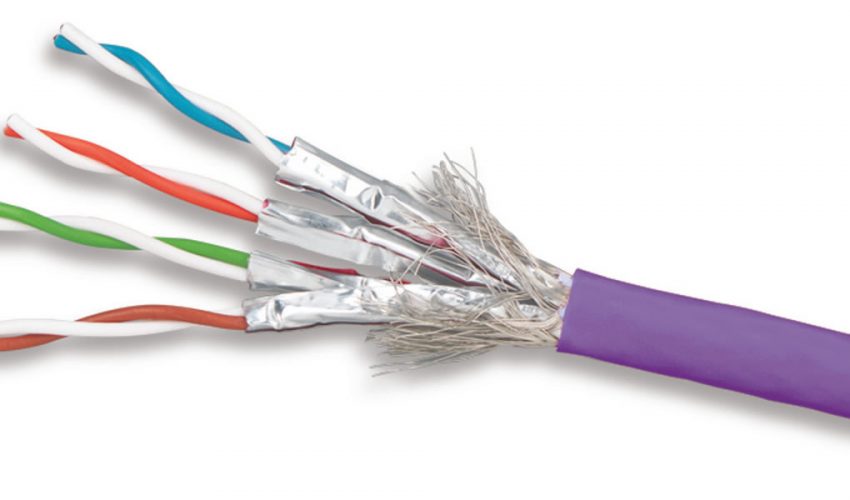
                            Uses Screened Foiled Twisted Pairs (S/FTP). Each pair is wrapped in foil, and the entire bundle of four pairs is wrapped in a high-density metal braid.
                        </p>
                        <div class="border-4 border-gray-700 rounded-lg p-4 bg-gray-400 h-48 flex items-center justify-center mx-auto w-full">
                            <div class="grid grid-cols-2 gap-3 text-center">
                                <div class="p-2 border border-gray-500 bg-gray-300 rounded-md shadow-inner">Foil (Pair 1)</div>
                                <div class="p-2 border border-gray-500 bg-gray-300 rounded-md shadow-inner">Foil (Pair 2)</div>
                                <div class="p-2 border border-gray-500 bg-gray-300 rounded-md shadow-inner">Foil (Pair 3)</div>
                                <div class="p-2 border border-gray-500 bg-gray-300 rounded-md shadow-inner">Foil (Pair 4)</div>
                            </div>
                        </div>
                        <p class="text-center text-sm mt-4 text-gray-600">Overall Braid Shield (Dark Border) + Individual Foil Wraps (Gray Boxes)</p>
                    </div>
                </div>
            </section>

            <section class="mb-16">
                <h2 class="text-3xl font-bold mb-6 text-[#118AB2] text-center">Connectors & Compatibility</h2>
                <p class="text-gray-700 text-center mb-8 max-w-2xl mx-auto">
                    Connector type is a major factor in adoption. While Cat7 *can* use the standard RJ45 connector, it is limited by it.
                </p>

                <div class="grid grid-cols-1 md:grid-cols-2 gap-8">
                    <div class="bg-white rounded-lg shadow-md p-6">
                        <h3 class="text-2xl font-bold mb-4 text-center">Cat6: The Standard 🔌</h3>
                        <p class="text-gray-700">
                            Exclusively uses the standard, universal <b>RJ45</b> connector. It is ubiquitous, cheap, and easy to terminate.
                        </p>
                    </div>
                    <div class="bg-white rounded-lg shadow-md p-6">
                        <h3 class="text-2xl font-bold mb-4 text-center">Cat7: The Specialist 🔌</h3>
                        <p class="text-gray-700">
                            To achieve its full 600+ MHz specification, Cat7 requires specialized, shielded connectors like <b>GG45</b> or <b>TERA</b>. While it can be terminated to an RJ45 port, it will not perform at its full potential.
                        </p>
                    </div>
                </div>
            </section>
            
            <section>
                <h2 class="text-3xl font-bold mb-6 text-[#118AB2] text-center">Conclusion: Which Cable Should You Choose?</h2>
                <p class="text-gray-700 text-center mb-8 max-w-2xl mx-auto">
                    While Cat7 is technically superior, the practical choice often comes down to cost and compatibility. For many 10 Gbps applications, Cat6A (Augmented Cat6) has become the TIA/EIA-approved standard.
                </p>

                <div class="bg-white rounded-lg shadow-md p-6 overflow-x-auto">
                    <table class="w-full min-w-max text-left">
                        <thead class="border-b-2 border-gray-300">
                            <tr>
                                <th class="p-4 text-sm font-bold uppercase text-[#073B4C]">Scenario</th>
                                <th class="p-4 text-sm font-bold uppercase text-[#073B4C]">Recommendation</th>
                                <th class="p-4 text-sm font-bold uppercase text-[#073B4C]">Rationale</th>
                            </tr>
                        </thead>
                        <tbody>
                            <tr class="border-b border-gray-200">
                                <td class="p-4 font-medium">Standard Home/Office (1 Gbps)</td>
                                <td class="p-4 font-bold text-[#FF6B6B]">Cat6</td>
                                <td class="p-4 text-gray-700">Most cost-effective and easy-to-install option. More than sufficient for 1 Gbps speeds.</td>
                            </tr>
                            <tr class="border-b border-gray-200">
                                <td class="p-4 font-medium">High-Performance Home/Office (10 Gbps)</td>
                                <td class="p-4 font-bold text-[#FFD166]">Cat6A</td>
                                <td class="p-4 text-gray-700">The TIA/EIA-recognized standard for 10 Gbps over 100 meters using standard RJ45 connectors. The best balance of price and performance.</td>
                            </tr>
                            <tr>
                                <td class="p-4 font-medium">Data Center / High-Noise Environments</td>
                                <td class="p-4 font-bold text-[#06D6A0]">Cat7 or Cat8</td>
                                <td class="p-4 text-gray-700">Cat7's superior S/FTP shielding is ideal for environments with high EMI/RFI or dense cable runs where crosstalk is a major concern.</td>
                            </tr>
                        </tbody>
                    </table>
                </div>
            </section>
        </main>

        <footer class="text-center text-gray-500 mt-16 border-t pt-8">
            <p>A technical infographic.</p>
        </footer>
    </div>

    <script>
        document.addEventListener('DOMContentLoaded', () => {

            const tooltipTitleCallback = {
                plugins: {
                    tooltip: {
                        callbacks: {
                            title: function(tooltipItems) {
                                const item = tooltipItems[0];
                                let label = item.chart.data.labels[item.dataIndex];
                                if (Array.isArray(label)) {
                                    return label.join(' ');
                                } else {
                                    return label;
                                }
                            }
                        }
                    }
                }
            };
            
            const ctxDistance = document.getElementById('distanceChart').getContext('2d');
            new Chart(ctxDistance, {
                type: 'bar',
                data: {
                    labels: ['Cat6', 'Cat7'],
                    datasets: [{
                        label: 'Max Distance for 10 Gbps (meters)',
                        data: [55, 100],
                        backgroundColor: ['#FF6B6B', '#06D6A0'],
                        borderWidth: 0,
                        barThickness: 60
                    }]
                },
                options: {
                    indexAxis: 'y',
                    responsive: true,
                    maintainAspectRatio: false,
                    scales: {
                        x: {
                            beginAtZero: true,
                            title: {
                                display: true,
                                text: 'Distance (meters)',
                                font: {
                                    size: 14
                                }
                            },
                            grid: {
                                display: true,
                                drawBorder: false
                            }
                        },
                        y: {
                            grid: {
                                display: false
                            },
                            ticks: {
                                font: {
                                    size: 16,
                                    weight: 'bold'
                                }
                            }
                        }
                    },
                    plugins: {
                        ...tooltipTitleCallback.plugins,
                        legend: {
                            display: false
                        }
                    }
                }
            });

            const ctxBandwidth = document.getElementById('bandwidthChart').getContext('2d');
            new Chart(ctxBandwidth, {
                type: 'bar',
                data: {
                    labels: ['Cat6', 'Cat7 (Minimum)'],
                    datasets: [{
                        label: 'Maximum Bandwidth (MHz)',
                        data: [250, 600],
                        backgroundColor: ['#FF6B6B', '#06D6A0'],
                        borderWidth: 0,
                        barThickness: 60
                    }]
                },
                options: {
                    responsive: true,
                    maintainAspectRatio: false,
                    scales: {
                        y: {
                            beginAtZero: true,
                            title: {
                                display: true,
                                text: 'Bandwidth (MHz)',
                                font: {
                                    size: 14
                                }
                            },
                            grid: {
                                display: true,
                                drawBorder: false
                            }
                        },
                        x: {
                            grid: {
                                display: false
                            },
                            ticks: {
                                font: {
                                    size: 16,
                                    weight: 'bold'
                                }
                            }
                        }
                    },
                    plugins: {
                        ...tooltipTitleCallback.plugins,
                        legend: {
                            display: false
                        }
                    }
                }
            });
        });
    </script>
</body>
</html>

		</div>
	</div>

	<div class="wpb_raw_code wpb_raw_html wpb_content_element" >
		<div class="wpb_wrapper">
			<section class="mb-16">
                <h2 class="text-3xl font-bold mb-6 text-[#118AB2] text-center">Deep Dive: Full Technical Comparison (Cat6 vs. Cat7)</h2>
                
                <div class="bg-white rounded-lg shadow-xl p-4 md:p-6">
                    <p class="text-gray-700 mb-6">
                        Category 7 cables, commonly referred to as Cat7, are an advanced choice in network cabling, supporting the infrastructure for high-speed data transmission required by modern applications. The foremost advantage of the Cat7 cable is the <span class="font-bold cat7-highlight">shielded twisted pairs</span>, eliminating the noise disturbances and cross-talks.
                    </p>
                    
                    <div class="overflow-x-auto w-full">
                        <table class="table-auto w-full min-w-[1000px] text-left border-collapse">
                            <thead>
                                <tr>
                                    <th class="p-3 table-header-color text-xs md:text-sm font-semibold w-1/5 rounded-tl-lg">Specification</th>
                                    <th class="p-3 table-header-color text-xs md:text-sm font-semibold w-1/5">Cat6 Cable</th>
                                    <th class="p-3 table-header-color text-xs md:text-sm font-semibold w-1/5">Cat7 Cable</th>
                                    <th class="p-3 table-header-color text-xs md:text-sm font-semibold w-2/5 rounded-tr-lg">Technical Insight (2025)</th>
                                </tr>
                            </thead>
                            <tbody>
                                <tr class="border-b border-gray-200 hover:bg-gray-50">
                                    <td class="p-3 font-semibold">Standard</td>
                                    <td class="p-3">ANSI/TIA 568-C.2 (Cat 6)</td>
                                    <td class="p-3 cat7-highlight">ISO/IEC 11801 Class F</td>
                                    <td class="p-3 text-gray-600">Cat7 is governed by stricter ISO international shielding and bandwidth standards.</td>
                                </tr>
                                <tr class="border-b border-gray-200 hover:bg-gray-50">
                                    <td class="p-3 font-semibold">Max Data Rate</td>
                                    <td class="p-3">10 Gbps (up to 55m), 1 Gbps (up to 100m)</td>
                                    <td class="p-3 cat7-highlight">10 Gbps (up to 100m); 40 Gbps (up to 50m)</td>
                                    <td class="p-3 text-gray-600">Cat7 maintains 10GbE speeds over full 100m runs with minimal crosstalk.</td>
                                </tr>
                                <tr class="border-b border-gray-200 hover:bg-gray-50">
                                    <td class="p-3 font-semibold">Bandwidth (Freq.)</td>
                                    <td class="p-3">250 MHz</td>
                                    <td class="p-3 cat7-highlight">600 MHz (Cat7) / 1000 MHz (Cat7a)</td>
                                    <td class="p-3 text-gray-600">Higher frequency enables higher packet throughput and lower latency under heavy traffic.</td>
                                </tr>
                                <tr class="border-b border-gray-200 hover:bg-gray-50">
                                    <td class="p-3 font-semibold">Shielding Type</td>
                                    <td class="p-3">UTP or STP (optional)</td>
                                    <td class="p-3 cat7-highlight">S/FTP (shielded twisted pair + overall foil braid)</td>
                                    <td class="p-3 text-gray-600">Cat7’s dual shielding completely isolates each pair and resists EMI up to 90 dB.</td>
                                </tr>
                                <tr class="border-b border-gray-200 hover:bg-gray-50">
                                    <td class="p-3 font-semibold">Wire Construction</td>
                                    <td class="p-3">23 or 24 AWG copper</td>
                                    <td class="p-3 cat7-highlight">22 or 23 AWG oxygen-free copper</td>
                                    <td class="p-3 text-gray-600">Cat7’s thicker conductors reduce impedance but are stiffer during installation.</td>
                                </tr>
                                <tr class="border-b border-gray-200 hover:bg-gray-50">
                                    <td class="p-3 font-semibold">Connector Type</td>
                                    <td class="p-3">Standard RJ45</td>
                                    <td class="p-3 cat7-highlight">TERA or GG45 (RJ45 backward compatible)</td>
                                    <td class="p-3 text-gray-600">RJ45-compatible GG45 supports backward connection but allows high-bandwidth switching.</td>
                                </tr>
                                <tr class="border-b border-gray-200 hover:bg-gray-50">
                                    <td class="p-3 font-semibold">Noise Immunity</td>
                                    <td class="p-3 text-[#FFD166]">Good</td>
                                    <td class="p-3 cat7-highlight">Excellent</td>
                                    <td class="p-3 text-gray-600">Enhanced alien-crosstalk protection and EMI resilience via full foil pair shielding.</td>
                                </tr>
                                <tr class="border-b border-gray-200 hover:bg-gray-50">
                                    <td class="p-3 font-semibold">Signal Attenuation</td>
                                    <td class="p-3 text-[#FF6B6B]">~32 dB</td>
                                    <td class="p-3 cat7-highlight">~20–24 dB</td>
                                    <td class="p-3 text-gray-600">Cat7 supports longer distances with less signal weakening under full bandwidth utilization.</td>
                                </tr>
                                <tr class="border-b border-gray-200 hover:bg-gray-50">
                                    <td class="p-3 font-semibold">Frequency Crosstalk (NEXT)</td>
                                    <td class="p-3">44 dB at 100 MHz</td>
                                    <td class="p-3 cat7-highlight">65 dB at 600 MHz</td>
                                    <td class="p-3 text-gray-600">Cat7 exhibits nearly 50% better near-end crosstalk control, vital in dense switch farms.</td>
                                </tr>
                                <tr class="border-b border-gray-200 hover:bg-gray-50">
                                    <td class="p-3 font-semibold">Recommended Environments</td>
                                    <td class="p-3">Offices, small enterprise, residential LAN</td>
                                    <td class="p-3 cat7-highlight">Data centers, EMF-heavy industrial areas, 10G+ backbones</td>
                                    <td class="p-3 text-gray-600">Cat7 is ideal where EMI and long-distance bandwidth stability are concerns.</td>
                                </tr>
                                <tr class="border-b border-gray-200 hover:bg-gray-50">
                                    <td class="p-3 font-semibold">Average Cost (per ft.)</td>
                                    <td class="p-3 text-[#06D6A0]">$0.50–$1.00</td>
                                    <td class="p-3 text-[#FF6B6B]">$2.00–$3.50</td>
                                    <td class="p-3 text-gray-600">Cat7 costs 3–4x higher due to construction complexity and metal shielding.</td>
                                </tr>
                                <tr class="hover:bg-gray-50">
                                    <td class="p-3 font-semibold rounded-bl-lg">Network Future-Proofing</td>
                                    <td class="p-3">Up to 10 Gbps</td>
                                    <td class="p-3 cat7-highlight">Up to 25–40 Gbps (next-gen compatibility)</td>
                                    <td class="p-3 text-gray-600 rounded-br-lg">Cat7’s high structural return loss tolerance allows seamless transition to future 25GBASE-T.</td>
                                </tr>
                            </tbody>
                        </table>
                    </div>
                </div>
            </section>
		</div>
	</div>

	<div class="wpb_raw_code wpb_raw_html wpb_content_element" >
		<div class="wpb_wrapper">
			<section class="mb-16">
                <h2 class="text-3xl font-bold mb-6 text-[#118AB2] text-center">Applications of Cat7 Cabling</h2>
                <p class="text-gray-700 text-center mb-8 max-w-2xl mx-auto">
                    Cat7’s robust performance makes it ideal for environments where stability, high data transfer rates, and minimal interference are non-negotiable requirements.
                </p>

                <div class="grid grid-cols-1 md:grid-cols-2 gap-6">
                    <div class="bg-white rounded-lg shadow-md p-6 border-l-4 border-[#06D6A0]">
                        <h3 class="text-xl font-bold mb-2 flex items-center text-[#073B4C]">
                            &#x2301; Data Centers & Server Rooms
                        </h3>
                        <p class="text-gray-700 text-sm">
                            The superior shielding helps maintain data integrity across dense network environments where high data transfer rates and interference are common issues in server-to-server communications.
                        </p>
                    </div>
                    <div class="bg-white rounded-lg shadow-md p-6 border-l-4 border-[#06D6A0]">
                        <h3 class="text-xl font-bold mb-2 flex items-center text-[#073B4C]">
                            &#x1F50C; EMF-Heavy Industrial Areas
                        </h3>
                        <p class="text-gray-700 text-sm">
                            Cat7 is used in industrial environments with high electromagnetic noise (EMI) where its full shielding is necessary to prevent signal corruption.
                        </p>
                    </div>
                    <div class="bg-white rounded-lg shadow-md p-6 border-l-4 border-[#06D6A0]">
                        <h3 class="text-xl font-bold mb-2 flex items-center text-[#073B4C]">
                            &#x1F4BB; High-Performance Computing Networks
                        </h3>
                        <p class="text-gray-700 text-sm">
                            Beneficial in research facilities conducting complex simulations and analyses, where large volumes of data are processed and transmitted rapidly.
                        </p>
                    </div>
                    <div class="bg-white rounded-lg shadow-md p-6 border-l-4 border-[#06D6A0]">
                        <h3 class="text-xl font-bold mb-2 flex items-center text-[#073B4C]">
                            &#x1F3E0; Future-Proof Home Installations
                        </h3>
                        <p class="text-gray-700 text-sm">
                            Supports smart homes with extensive VoIP, video conferencing, and high-speed streaming, ensuring the network infrastructure is not a limiting factor in data communication.
                        </p>
                    </div>
                </div>
            </section>
		</div>
	</div>

	<div class="wpb_text_column wpb_content_element" >
		<div class="wpb_wrapper">
			<p>Category 7 cables, commonly referred to as Cat7, are an advanced choice in network cabling, supporting the infrastructure for high-speed data transmission required by modern applications. Let’s explore Cat7 in greater detail, especially in comparison with its predecessor, Cat6, and delve into its varied applications.</p>
<p>A category 7 cable primarily known as cat7 cables are widely used for <a href="https://www.cablify.ca/">cabling</a> infrastructure of 1000 Gigabit Ethernet. The performance of Cat7 cable is up to 600 Mhz. The cat7 cable is the preceding version of all the previous Ethernet cable standards including cat5 and cat6 cables. Every preceding advancement in technologies has its own leverages and exceptions from the previous ones.&nbsp; The foremost advantage of the cat7 cable is the shielded twisted pairs eliminating the noise disturbances and cross-talks.</p>

		</div>
	</div>

	<div class="wpb_text_column wpb_content_element" >
		<div class="wpb_wrapper">
			<p>Cat7 cables offer several improvements over Cat6 cables, which are also widely used for gigabit Ethernet networks. Here’s a closer look at how Cat7 outperforms Cat6:</p>
<ul>
<li><strong>Frequency and Performance:</strong> Cat7 cables support frequencies up to 600 MHz, double that of Cat6 cables, which support up to 250 MHz. This higher frequency allows for faster data transmission and greater bandwidth.</li>
<li><strong>Shielding and Crosstalk:</strong> Cat7 cables use shielded twisted pair (SSTP) technology, where each pair is individually shielded, and an additional layer of shielding covers the entire set of pairs. This is superior to the more common shielded twisted pair (STP) or unshielded twisted pair (UTP) used in Cat6. The additional shielding in Cat7 reduces signal attenuation and crosstalk between the pairs and external sources.</li>
<li><strong>Transmission Speeds:</strong> Both Cat6 and Cat7 cables support speeds up to 10 Gbps. However, Cat7 cables maintain this speed over 100 meters of cabling, whereas Cat6 cables may require signal boosters or a reduced maximum length to sustain the same speed.</li>
</ul>
<p>&nbsp;</p>
<h3>Applications of Cat7 Cabling</h3>
<p>Cat7&#8217;s robust performance makes it ideal for several key applications:</p>
<ul>
<li><strong>Data Centers:</strong> Cat7 is highly suited for data centers where high data transfer rates are crucial. The superior shielding helps maintain data integrity across dense network environments where interference is a common issue.</li>
<li><strong>Server Rooms:</strong> Similar to data centers, server rooms benefit from Cat7’s enhanced bandwidth and frequency capabilities, facilitating faster data access and greater efficiency in server-to-server communications.</li>
<li><strong>High-Performance Computing Networks:</strong> Cat7 is beneficial in environments where large volumes of data are processed and transmitted rapidly, such as research facilities conducting complex simulations and analyses.</li>
<li><strong>Office Buildings:</strong> For businesses requiring a reliable and future-proof network infrastructure, Cat7 provides the necessary speed and reliability to handle extensive VoIP, video conferencing, and data communications.</li>
<li><strong>Smart Home Installations:</strong> As homes become smarter and more connected, the need for high-speed internet with minimal latency is increasing. Cat7 can support a wide range of smart home devices simultaneously without compromising on speed or quality.</li>
</ul>
<p>&nbsp;</p>
<h3>Extended Network Requirements</h3>
<ul>
<li><strong>Backward Compatibility:</strong> One of the significant advantages of upgrading to Cat7 is its backward compatibility with previous Ethernet standards (Cat5, Cat5e, Cat6). This makes Cat7 a versatile choice for upgrades or new installations, as it can easily integrate into existing network setups.</li>
<li><strong>Future-Proofing:</strong> Opting for Cat7 cabling is a decision that can future-proof an installation, anticipating advancements in technology that demand higher data speeds and more reliable network connections.</li>
</ul>
<p>Upgrading to Cat7 from Cat6 or earlier versions offers a noticeable improvement in network performance due to its higher frequency support, enhanced shielding, and superior speed consistency over longer distances. Whether for industrial, commercial, or residential use, Cat7 cables provide a robust infrastructure capable of supporting the demands of current and future network applications. By choosing Cat7, organizations and individuals can ensure their network infrastructure won&#8217;t be a limiting factor in data communication and internet connectivity needs.</p>
<p>Although being the expensive cable than <a href="https://www.cablify.ca/cat5e-cabling/">cat5e</a> and <a href="https://www.cablify.ca/cat6-cabling/">cat6 cables</a>, the cat7 cables have a longer lifespan. This reduces the overall the investment costs and is preferred to be the best choice for future cabling.</p>
<p>&nbsp;</p>
<h3><strong>Cost</strong></h3>
<p>Although Cat7 Ethernet cable is a bit expensive than the Cat5 and Cat6 cables, the lifespan of Cat7 cables is longer. This reduces the overall investment cost up to 50%.</p>
<p>&nbsp;</p>
<h3>Advantages of Cat7 in Home Networks</h3>
<p>Whether using Cat7 cabling in a home setting is considered overkill depends on several factors including the current and anticipated networking needs, budget constraints, and the desire for future-proofing the home&#8217;s network infrastructure. Here are some considerations to help determine if Cat7 is a suitable choice for home use:</p>
<ul>
<li><strong>High-Speed Internet:</strong> If you have a gigabit or faster internet service, Cat7 cables ensure you are getting the maximum speed your service offers without any bottleneck at the cabling level.</li>
<li><strong>High Bandwidth Needs:</strong> For homes with significant streaming, gaming, or home office needs, especially where multiple devices are used simultaneously, Cat7 can provide the necessary bandwidth and speed.</li>
<li><strong>Reduced Interference:</strong> The shielding in Cat7 cables can significantly reduce signal interference from other cables and devices, which is beneficial in densely wired environments.</li>
<li><strong>Future-Proofing:</strong> As home technologies evolve, having Cat7 cables installed could mean fewer upgrades in the future, supporting higher-speed internet services as they become available.</li>
</ul>
<p>&nbsp;</p>
<h3>Considerations for Home Use</h3>
<ul>
<li><strong>Cost:</strong> Cat7 cables are typically more expensive than Cat5e and Cat6 cables. The installation might also be more costly due to the stiffer, shielded cables which are less flexible and harder to manipulate.</li>
<li><strong>Necessity:</strong> For most typical home internet usage scenarios, Cat6 and even Cat5e cables are sufficient to handle the speeds provided by the internet service provider. Cat6 cables, which can also support up to 10 Gbps and bandwidths of 250 MHz over shorter distances, might be entirely adequate for current needs.</li>
<li><strong>Device Compatibility:</strong> The full benefits of Cat7 cabling can only be utilized if the other elements of the network, such as routers, switches, and modems, are designed to handle such high specifications.</li>
</ul>
<p>&nbsp;</p>
<h3>Scenario Analysis</h3>
<ul>
<li><strong>High-End Usage:</strong> If your home is packed with the latest technology, including high-speed gaming rigs, numerous smart home devices, and multiple streaming services running simultaneously, investing in Cat7 might make sense.</li>
<li><strong>Average Home Use:</strong> For most homes where internet usage is confined to browsing, streaming at HD or even 4K, and moderate gaming, Cat7 is likely more than what is needed, and the additional cost may not translate to noticeable improvements.</li>
</ul>
<p>For most residential scenarios, Cat7 could be considered overkill. Cat6 or even Cat5e might be more cost-effective and still provide all the necessary functionality for a home network. However, for tech-savvy households with high demands and future-oriented investments in technology, Cat7 offers a robust solution that could be worth considering.</p>
<p>&nbsp;</p>

		</div>
	</div>
</div></div></div></div>
</div><p>The post <a href="https://www.cablify.ca/a-guide-to-cat7-cabling/">A guide to Cat7 cabling</a> appeared first on <a href="https://www.cablify.ca">Cablify</a>.</p>
]]></content:encoded>


			</item>
	</channel>
</rss>