
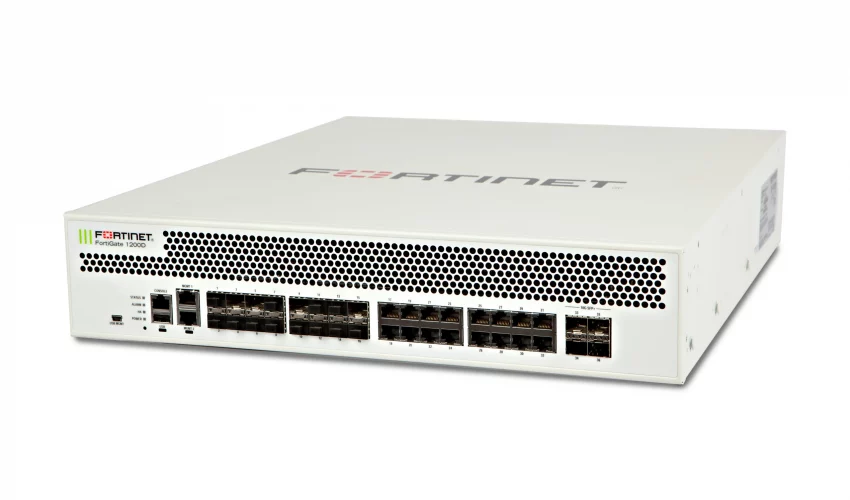
Fortinet has launched the FortiGate 1200G series, a new high end firewall built for data centers, large campuses and hybrid environments. It is aimed at organizations dealing with the two things reshaping enterprise networks right now: growing volumes of encrypted traffic and the extra load that AI tools put on the network. If you buy or manage network security in Canada, this is a platform worth knowing about.
This article introduces the 1200G in plain terms. What it is, what it does, the new FortiSASE Outpost capability, and the specs that matter, with a quick look at how it lines up against comparable firewalls so you have context. No sales pitch buried in the numbers.
As an authorized Fortinet reseller in Toronto and across Canada, Cablify sizes, supplies and deploys FortiGate hardware for businesses every week, so the perspective below comes from the field, not a brochure.
Why Fortinet Built the 1200G
The short version: traffic is growing, more of it is encrypted, and inspecting encrypted traffic is expensive in compute terms. A firewall that can pass raw packets quickly but chokes the moment you turn on deep inspection is not much use in 2026.
Three pressures are driving this generation of hardware:
- Encrypted traffic everywhere. The vast majority of web traffic is now TLS encrypted. To see threats inside it, the firewall has to decrypt, inspect and re-encrypt on the fly, which is one of the heaviest jobs a firewall performs.
- AI workloads and east-west traffic. AI tools, agents and connected devices generate a lot of internal traffic that never used to exist. Some of it should be inspected locally rather than hauled out to a cloud checkpoint and back.
- Hybrid infrastructure. Workloads sit in the office, in data centers and in the cloud all at once. Businesses want to decide where inspection happens based on latency, cost, data residency and compliance, not based on a rigid product limitation.
The 1200G is Fortinet’s answer to all three. It leans on a custom FortiASIC chip to handle security processing in hardware instead of burning general purpose CPU cycles, which is how it keeps latency low while inspection is switched on.
The Performance Numbers, In Plain Terms
Fortinet published throughput figures for the 1200G alongside a set of competitor platforms. Here they are. Remember that vendor supplied benchmarks are always measured under favorable conditions, so treat them as a ceiling rather than a guarantee. Real world numbers with your rule set and your traffic mix will be lower.
| Metric | FortiGate 1200G | What it tells you |
|---|---|---|
| Firewall throughput | 397 Gbps | Raw packet forwarding with basic rules. The best case number, rarely the one that matters most. |
| IPsec VPN throughput | 102 Gbps | Encrypted site to site tunnel capacity. Important for multi-site and data center links. |
| Threat protection | 40 Gbps | Throughput with firewall, IPS, application control, malware scanning and logging all on. This is the honest real world number. |
| Concurrent sessions | 40 million | How many simultaneous connections it can track. Matters for busy, high user count environments. |
| New connections per second | 1 million | How fast it opens new sessions. Relevant under bursty load and certain attack patterns. |
The one to watch is threat protection throughput, 40 Gbps. The 397 Gbps firewall figure looks impressive, but almost nobody runs a firewall with everything switched off. The number that reflects how you will actually deploy it, with IPS and inspection enabled, is the 40 Gbps line. Always compare firewalls on their threat protection number, not their raw firewall number.
For Context: How It Lines Up Against Other Firewalls
To put the 1200G’s numbers in perspective, Fortinet placed it against comparable platforms from Palo Alto, Cisco, Check Point and Juniper. The comparison below uses Fortinet’s published figures for competitor devices, drawn from public data sheets. Independent testing methodologies differ between vendors, so read this as a directional picture rather than a lab certified result.
| Platform | Firewall (Gbps) | IPsec VPN (Gbps) | Concurrent Sessions | New Conn/sec |
|---|---|---|---|---|
| FortiGate 1200G | 397 | 102 | 40M | 1M |
| Check Point Quantum 9800 | 185 | 75 | 29M | 715K |
| PAN PA-5410 | 52.4 | 20 | 5M | 270K |
| Cisco Firepower 4115 | 80 | 15 | 15M | 210K |
| Juniper SRX 2300 | 39 | 36 | 5M | 450K |
The gap on raw firewall throughput is large, and that is partly the point of building a dedicated ASIC. Where you should focus your own evaluation is on how each platform performs with full inspection enabled, on the quality of the management software your team will live in daily, and on total cost over the life of the box including support renewals. Throughput is only one leg of the stool.
Power and Cooling: The Cost Nobody Quotes
Data center budgets are increasingly shaped by power and cooling, not just hardware price. Fortinet leaned into this by publishing efficiency figures for the 1200G, measured as watts consumed per gigabit of throughput. Lower is better.
| Efficiency Metric | FortiGate 1200G | Competitor Average |
|---|---|---|
| Watts per Gbps, firewall | 1.9 | 10.5 |
| Watts per Gbps, IPsec VPN | 7.3 | 32.4 |
Over a three to five year life, the difference in energy draw between an efficient platform and a power hungry one can add up to real money, especially in colocation where you pay per rack and per amp. If you are comparing firewalls, ask each vendor for maximum power consumption from the hardware guide, not the typical figure from the marketing page, and run the math on your own electricity rate.
FortiSASE Outpost: The Interesting Part
The specification numbers will grab headlines, but the more useful idea here is what Fortinet calls a FortiSASE Outpost. In plain terms, it lets a FortiGate act as a local SASE point of presence inside your own environment.
Here is why that matters. In a typical cloud delivered SASE model, user traffic is routed out to a cloud checkpoint for inspection, then on to its destination. That works well for a lot of traffic. It works badly for traffic that is latency sensitive, or that legally should not leave a certain jurisdiction, or that is simply internal and does not benefit from a round trip to the cloud.
With the Outpost approach, you get to choose per traffic type:
- Route it to the cloud POP when that is the efficient path.
- Inspect it locally on the FortiGate when latency, cost or data residency say it should stay put.
Both paths are managed from the same console, with the same policies and the same zero trust rules, so you are not running two separate security worlds. For Canadian organizations with data residency obligations, in healthcare, finance, legal, education and the public sector, the ability to keep specific traffic and logs inside a defined boundary without bolting on a separate system is genuinely useful.
Connectivity and Availability
The 1200G offers flexible 10G, 25G and 100G interfaces, which is what you would expect at this tier and gives room to grow into higher speed links as your backbone catches up. Fortinet also points to hardware level protections, secure credential storage and built in redundancy aimed at platform integrity and uptime.
Fortinet has stated the FortiGate 1200G is expected to be available in Q3 2026. If it is on your roadmap, the sensible move is to start sizing and budgeting now, so the purchase lands in the right fiscal window rather than becoming a scramble.
Buying Fortinet in Canada? Talk to Cablify First
Cablify is an authorized Fortinet reseller in Toronto and across Canada. We size FortiGate hardware to your actual traffic, not to the biggest box on the shelf, and we back it with competitive Canadian pricing, proper licensing, and installation by technicians who work with this gear every week.
Whether you are pricing a 1200G for a data center or a smaller FortiGate for a branch office, we will give you an honest recommendation and a written quote. No pressure, no oversizing.
The Bottom Line
The FortiGate 1200G is aimed squarely at organizations that need to inspect a lot of encrypted, AI-driven traffic without watching performance collapse the moment protection is enabled. The ASIC design is what makes the throughput and power efficiency numbers stand out on paper.
If you are evaluating it, do three things. Compare it on threat protection throughput rather than raw firewall throughput. Run the power math against your own colocation or electricity costs. And weigh the FortiSASE Outpost model seriously if data residency or latency is a real constraint for your business, because that flexibility, not the raw speed, may be the deciding factor.
When you are ready to price it out for a Canadian deployment, reach out to Cablify. We will tell you whether the 1200G is the right box for your environment or whether a smaller FortiGate does the job for less.
Performance figures cited in this article are Fortinet published specifications and, for competitor platforms, are drawn from publicly available data sheets. Vendor benchmarks are measured under controlled conditions and real world performance will vary with configuration and traffic. Product names and brands are the property of their respective owners and are used for identification purposes only.