

The Coming Storm of Data in Toronto’s Business Districts
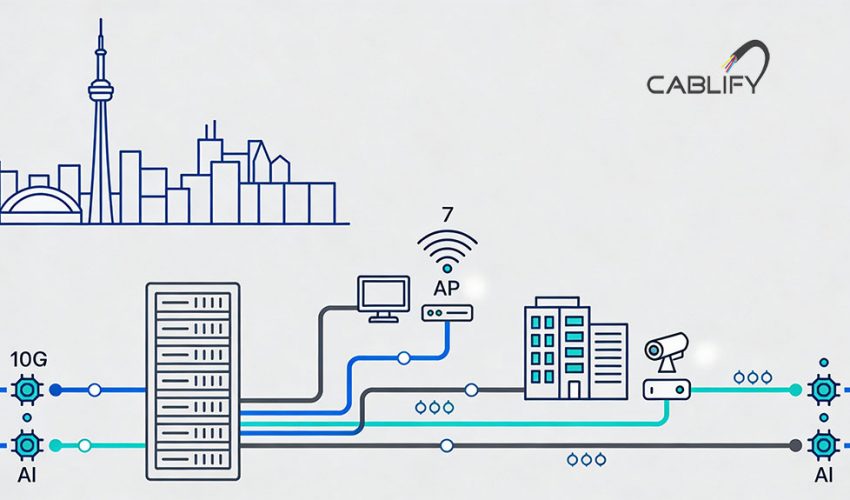
In the heart of Toronto’s Financial District and across the GTA’s sprawling business parks, a silent infrastructure crisis is brewing. The network cabling installed a decade ago—often Cat5e or Cat6—is reaching its breaking point. By 2026, three technological tsunamis will hit simultaneously: the widespread adoption of Wi-Fi 7, the necessity of multi-gigabit and 10G connections to the desktop, and the deployment of AI-driven applications at the network edge. For Toronto businesses, the foundation for this revolution isn’t in the cloud; it’s in the conduits, cable trays, and patch panels running through your walls.
At Cablify, Toronto’s leading commercial network cabling specialist, we engineer the backbone that turns these future technologies from concepts into competitive advantages. Learn more about our enterprise cabling services here.
Chapter 1: Wi-Fi 7’s Hidden Demand—Your Cabling is the Choke Point
Wi-Fi 7 (802.11be) promises theoretical speeds over 40 Gbps, reduced latency, and more efficient use of spectrum. Toronto offices racing to support hybrid work, AR/VR collaboration, and seamless video will demand it. However, there’s a critical, often overlooked fact:
Every Wi-Fi 7 Access Point (AP) will require a multi-gigabit wired backhaul connection.
An AP delivering 40 Gbps wirelessly cannot be fed by a 1 Gbps copper link. This creates a strict cabling mandate:
- The New Minimum: Category 6A (Cat6A) shielded cabling is the 2026 baseline. It supports 10GBase-T up to 100 meters, providing the necessary 10 Gbps backhaul for high-performance Wi-Fi 7 APs.
- Beyond the Ceiling: For power-dense areas like open-plan offices in downtown Toronto towers, Category 8 (Cat8) cabling may be specified for short runs to support 25G or 40G to AP clusters, future-proofing for the next wave.
- The Legacy Risk: Existing Cat5e or Cat6 installations will bottleneck Wi-Fi 7 entirely, wasting significant capital investment on premium wireless gear.
Chapter 2: 10G to the Desk—Not Science Fiction, But a 2026 Reality
The move to 10G isn’t just for data centers. For Toronto businesses in media production, financial analytics, engineering, and architecture, it’s becoming a workstation requirement.
- AI-Powered Workloads: Local AI models for design simulation, data analysis, and real-time rendering require rapid access to centralized data. A 1G connection creates a productivity deadlock.
- High-Performance Computing (HPC) Islands: Departments using localized HPC will need 10G links to function within the broader enterprise network.
- Cabling Specification: Reliable 10GBase-T over 100m demands Cat6A or higher. Precision termination, professional certification (with results documentation), and adherence to BICSI and TIA-568.2-E standards are non-negotiable to ensure performance. Poorly installed Cat6A will fail at 10G speeds.
Chapter 3: AI at the Edge—When Intelligence Meets Infrastructure
AI inference is moving from the cloud to the “edge”—your office server closet, your factory floor, your retail location. In Toronto, this means IoT sensors, smart building systems, and on-premises AI servers processing data locally for speed and privacy.
This “Edge AI” has profound cabling implications:
- Power & Data Convergence: Technologies like Power over Ethernet (PoE++) (IEEE 802.3bt) will deliver up to 90W per port over Cat6A, powering everything from advanced security cameras with on-board AI analytics to digital signage and access control systems.
- Latency is King: AI-driven processes are latency-sensitive. A well-designed, high-bandwidth structured cabling system with optimized pathways reduces signal latency and jitter, ensuring AI decisions happen in real-time.
- Fiber to the Edge: For AI appliances in server rooms or dedicated closets, OM5 multimode or OS2 single-mode fiber backbones are essential. OM5 supports higher-density wavelengths (SWDM), perfect for 40G/100G links to edge switches with fewer fibers, simplifying deployment for Toronto businesses scaling their AI capabilities.
The 2026 Cabling Specification for a Toronto Enterprise
| Technology Driver | Minimum Cabling Solution | Recommended Future-Proof Solution | Risk of Legacy Cabling (Cat5e/6) |
|---|---|---|---|
| Wi-Fi 7 Access Points | Cat6A (Shielded) for 10G backhaul | Cat8 for 25G/40G in high-density zones | Bottleneck. Wi-Fi 7 performance crippled. |
| 10G to Workstation | Certified Cat6A Channels | Fiber (OM5/OS2) to workgroup switches | Obsolescence. Cannot support required speeds. |
| AI Edge & PoE++ | Cat6A (23AWG recommended) for 90W PoE | Cat6A with intelligent PDUs & monitoring | Overheating & Failure. Inadequate power delivery. |
| Backbone / AI Appliance | OM4 Multimode Fiber | OM5 or OS2 Single-Mode Fiber | Incapacity. Cannot scale for AI data loads. |
Your Toronto Business’s 2026 Infrastructure Audit
The strategic importance of your physical network layer has never been greater. The convergence of Wi-Fi 7, 10G access, and Edge AI means the cabling decisions you make today will lock in your competitive capability—or limit it—for the next decade.
For Toronto’s commercial and enterprise sectors, the path forward requires a partnership with a cabling contractor who understands both the technical minutiae and the strategic business outcome.
Ready to future-proof your Toronto workspace?
Contact Cablify for a comprehensive 2026 Network Infrastructure Assessment. Our BICSI-certified team will survey your current plant, model future demands, and provide a clear roadmap to an agile, high-performance network.
Schedule Your Professional Cabling Assessment Today →
Serving Toronto’s commercial core and the Greater Toronto Area: Downtown, North York, Mississauga, Brampton, Vaughan, and Markham.