
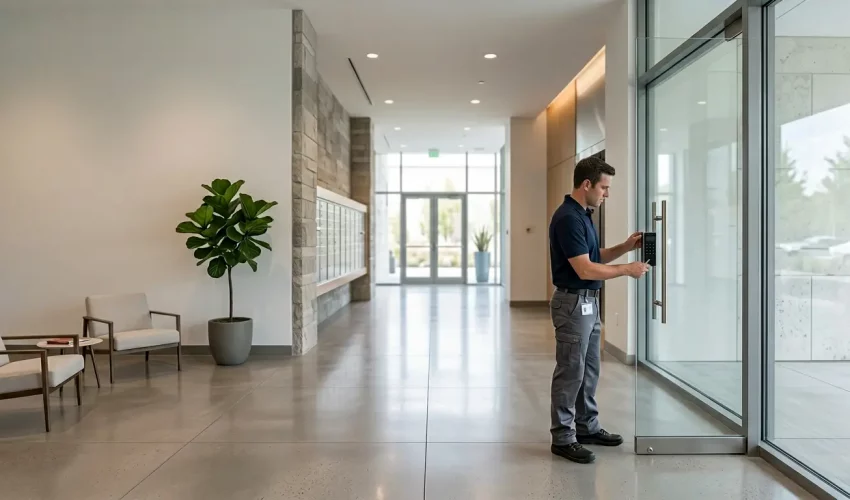
The 0.8-Second Heist: Why Your Condo’s Front Door is Wide Open
Picture this: A resident of a prestigious Bay Street condominium steps into the elevator. A stranger stands beside them, holding a smartphone in a casual, unassuming manner. There is no contact. No suspicious behavior. But in 0.8 seconds, that stranger’s phone—equipped with a $15 RFID copier app and a tiny antenna—has just cloned the resident’s key fob. The next night, that same stranger returns, swipes a blank fob at the amenity room door, and walks away with $15,000 in gym equipment and a MacBook from the co-working space.
This is not a scene from a spy thriller. This is the documented, widespread vulnerability of 125kHz Proximity Access Control Systems—the technology powering approximately 70% of condominiums built in the Greater Toronto Area before 2018.
At Cablify, we do not just install cameras. We audit the infrastructure of security. And the infrastructure of most GTA condos is based on a technology that was cracked and rendered obsolete over a decade ago. For condo boards and property managers in Toronto, Mississauga, Markham, and Vaughan, this is no longer a theoretical risk; it is a fiduciary and legal liability.
Part 1: The Technical Autopsy of a 125kHz Proximity Fob
To understand the liability, you must understand the technology—or lack thereof.
| Component | 125kHz Prox (Legacy) | 13.56MHz Smart Card | Mobile Credential (BLE/NFC) |
|---|---|---|---|
| Frequency | 125 kHz (Low Frequency) | 13.56 MHz (High Frequency) | 2.4 GHz / 13.56 MHz |
| Communication | One-Way, Broadcast | Two-Way, Encrypted Session | Two-Way, Encrypted, Rotating Keys |
| Data Transmission | Plain Text ID Number | AES-128 / 3DES Encrypted | AES-256 with Ephemeral Keys |
| Cloning Vulnerability | Trivial ($15 device) | Extremely Difficult (Requires Lab) | Impossible (Bound to Device Secure Enclave) |
| Range | 3-6 inches (Passive) | 1-4 inches | 30+ feet (BLE) / 2 inches (NFC) |
| Typical GTA Condo Age | Pre-2015 Installations | 2016+ New Builds | Forward-Thinking Upgrades |
The Critical Failure: Static Facility Code + Card Number
A standard HID ProxCard II or equivalent fob transmits a fixed string of digits. The reader asks, “Who are you?” The fob shouts back, “I am Facility Code 17, Card Number 04582!” Every single time. There is no secret handshake. There is no changing password. It is the digital equivalent of writing your ATM PIN on the back of the card.
The $15 Arsenal: Proxmark3, Flipper Zero, and Handheld Cloners
These devices are not dark web contraband. They are sold on Amazon and AliExpress, marketed as “RFID diagnostic tools” or “key fob duplicators for your apartment.” A 16-year-old with a YouTube tutorial can clone a fob from across the elevator. A determined criminal can use a high-gain antenna to skim fobs from outside the glass lobby door while pretending to wait for a ride-share.
Part 2: The GTA Condominium Liability Landscape (Legal & Insurance)
The vulnerability is technical. The consequence is legal. Ontario’s Condominium Act, 1998 places a clear duty on the condominium corporation’s board of directors.
Section 17(3) Duty to Control and Manage:
“The corporation shall control, manage and administer the common elements and the assets of the corporation.”
Section 26(1) Duty of Care:
“Every director and every officer of a corporation in exercising their powers and discharging their duties shall… exercise the care, diligence and skill that a reasonably prudent person would exercise in comparable circumstances.”
The Legal Argument (Plaintiff’s Counsel Perspective):
If a unit owner suffers a break-in, assault, or theft in the common elements, and the plaintiff’s attorney discovers:
- The building used known-vulnerable 125kHz technology.
- The property manager or board had been notified of the risk (via a security audit or even an article like this one).
- A reasonable and available alternative (encrypted smart cards or mobile credentials) existed.
Then the condominium corporation faces a high likelihood of a successful negligence claim. Insurance carriers are already taking note. During renewal, underwriters for GTA condos are beginning to ask:
“What type of access control credential is in use? Is the system capable of generating an audit trail of unique, non-repudiable entries?”
A “yes” to prox and a “no” to encryption may result in higher premiums or, in extreme cases, coverage exclusions for theft from common areas.
Part 3: The Airbnb and Short-Term Rental Amplification Effect
Toronto’s short-term rental bylaw (Chapter 547) requires principal residence only. Despite this, illegal commercial Airbnb operations persist in many downtown condos. The vulnerability of 125kHz fobs makes enforcement nearly impossible.
Scenario A (Prox Fob): An Airbnb host buys a $20 cloner. They duplicate their own fob 20 times. They leave the fob in a lockbox outside the building for guests. The building’s access log shows one resident entering the building 20 times a day. There is no way to differentiate the owner from the guest.
Scenario B (Encrypted Mobile Credential): The host can only issue a temporary, time-limited mobile key through the official building management app. The guest’s identity is verified via phone number or email. Access expires at 11:00 AM checkout time. The audit log shows Guest_Jane_Doe_Apt_2207 entered at 9:14 PM.
For condo boards struggling with bylaw enforcement and nuisance complaints, the upgrade to a modern access control infrastructure is the single most effective compliance and governance tool available.
Part 4: The Infrastructure Gap — Why You Need More Than New Readers
This is the most critical section for GTA property managers to understand. You cannot simply swap out the reader at the front door and call it a day.
The “IP Everywhere” Problem:
125kHz legacy systems often use Wiegand wiring (a simple 3-wire or 5-wire interface) back to a central control panel in a locked telecom closet. This panel is not connected to the internet. It is a standalone appliance.
Encrypted mobile credentials require:
- Networked Door Controllers: Each controller (or reader) must have a Power over Ethernet (PoE) connection back to the building’s network switch.
- Structured Cabling Backbone: In a 40-story Toronto condo, the existing Wiegand wire is insufficient. You need Cat6 or Cat6A cabling from the basement MDF (Main Distribution Frame) to IDF closets on every few floors, and then to every single access-controlled door (Front Lobby, Parking Elevator Lobby, Amenity Gym, Pool, Rooftop Terrace, Mailroom).
- Managed PoE Network Switches: These switches must be configured with VLANs to isolate security traffic from resident Wi-Fi. This prevents a resident from accidentally (or maliciously) taking down the entire access control system.
- UPS Battery Backup: Cloud-connected doors fail closed (or fail safe) during a power outage. In a high-rise, the network gear in the IDF closet must have at least 30-60 minutes of backup power to ensure egress and fire alarm integration function during a blackout.
The Cablify Difference: We Build the Backbone
This is where Cablify’s expertise as a structured cabling and network infrastructure firm separates us from a simple security alarm company. We specialize in the retrofit. We navigate the challenges of:
- Fishing Cat6 through 1980s concrete risers.
- Installing fire-rated pathway sleeves between floors.
- Certifying every cable run with Fluke DSX-8000 testers to ensure it meets the bandwidth requirements for future 10-Gigabit upgrades.
Commercial Structured Cabling Services for Multi-Residential Buildings
System Spotlight: Platforms Cablify Deploys in GTA Condos
- UniFi Access (Ubiquiti): Excellent for mid-size condos and boutique buildings. Offers sleek readers, mobile tap-and-go with NFC, and integrates seamlessly with UniFi Protect CCTV cameras (which we also cable).
- Brivo: Enterprise cloud solution preferred by large REITs and property management firms managing multiple GTA assets. Requires robust, redundant internet and cellular failover—which we design into the IDF closet.
Part 5: The Migration Strategy — From Prox to Phone
Upgrading a 500-unit condo in North York does not happen overnight. A phased approach is essential for budget planning and resident communication.
Phase 1: Infrastructure Audit & Backbone Installation (Cablify Scope)
- Survey all access points (doors, gates, garage shutters).
- Install Cat6A cabling to all door locations.
- Install managed PoE switches and fire-rated enclosures in IDF closets.
Phase 2: Dual-Technology Reader Deployment
- Install new readers that support both 125kHz Prox (for current fobs) and 13.56MHz Smart/Mobile (for new credentials).
- This allows a smooth transition. Residents can keep their old fob until they are onboarded to the new app.
Phase 3: Resident Onboarding & Communication
- Educate residents on the security benefits. Frame it not as “taking away convenience” but as “preventing a $2,000 special assessment due to theft or insurance hikes.”
- Issue new encrypted fobs or guide residents through mobile app setup (UniFi Identity or Brivo Mobile Pass).
Phase 4: Legacy System Decommissioning
- After 90% adoption, disable the 125kHz antenna on the new readers.
- Enjoy a building that is now immune to $15 cloners.
The ROI: Insurance, Resale Value, and Peace of Mind
| Benefit | Legacy 125kHz Prox | Cablify Upgraded Encrypted Mobile Infrastructure |
|---|---|---|
| Cloning Risk | High / Certain | Zero |
| Audit Trail | Anonymous (Facility Code + Card #) | Named User, Time-Stamped, Non-Repudiable |
| Lost Fob Cost | $15 replacement + $75 lock re-key risk | $0 (Remote Deactivation in 5 seconds) |
| Package Theft Resolution | “Blurry video of someone in a hoodie.” | “Guest_Delivery_Amazon entered 2:14pm, left 2:17pm.” |
| Property Manager Time | 2 hours/week managing fob inventory | 5 minutes/week managing app permissions |
| Insurance Premium Impact | Increasing Scrutiny | Potential Reduction with Certificate of Compliance |
The Liability Stop-Gap: What To Do While You Plan an Upgrade
While the board plans a capital expenditure for a full infrastructure upgrade (which Cablify can scope and quote), there are immediate, low-cost steps to mitigate risk:
- Disable the “Prox” Antenna on Any Unused Wiegand Ports: Ensure no empty wires in the closet can be tapped.
- Increase CCTV Coverage on All Entry Doors: If the fob log is unreliable, the video log becomes your primary evidence. (Ensure those cameras are on a wired Cat6 backbone, as detailed in our previous article on wireless interference).
- Mandate “Fob in Hand” Rule for Amenities: Do not allow residents to leave fobs in gym bags unattended.
The Fob is the Weakest Link in GTA Condo Security
For too long, condominium security in Toronto has focused on visible deterrents: cameras and concierge desks. The actual point of entry—the credential that opens the door—has been ignored because it was “invisible” to the naked eye.
The technology to clone these credentials is now in the hands of anyone with a credit card and an internet connection. As a property manager or board director, your duty of care now extends to the cryptographic integrity of the door lock.
Cablify is ready to help GTA condominiums bridge the gap between vulnerable legacy wiring and a secure, encrypted future. We start with the wire in the wall.
Schedule a Condominium Access Control Infrastructure Audit with Cablify