

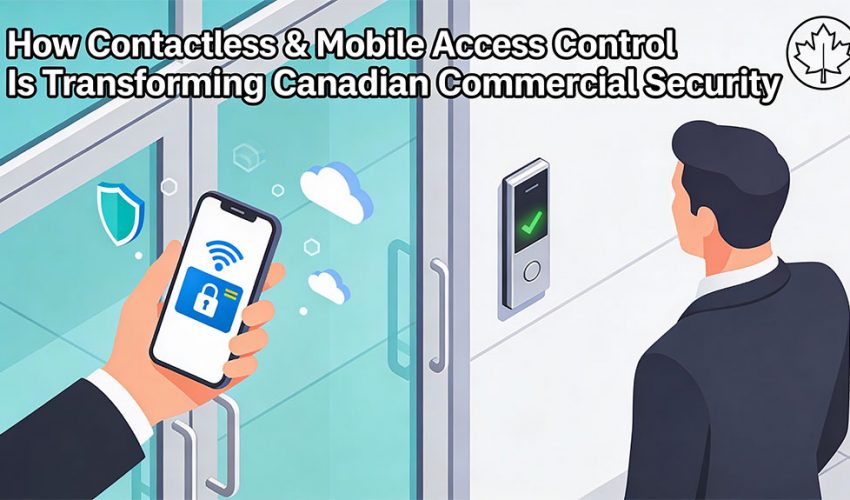
From Bluetooth Low Energy to Digital Wallet Integration—Why Canadian Businesses Are Ditching Keycards for Good
In an era where your smartphone can pay for coffee, unlock your car, and board a flight, why are Canadian businesses still fumbling with plastic keycards? The answer is: they shouldn’t be—and increasingly, they aren’t.
The shift to contactless and mobile access control has accelerated from post-pandemic convenience to mission-critical infrastructure. With mobile credentials now becoming the default standard and AI-powered security monitoring reducing incident response times by 60%, Canadian commercial property managers and business owners face a stark reality: legacy access systems aren’t just outdated—they’re liabilities
What Is Contactless & Mobile Access Control?
Contactless access control eliminates physical touchpoints through wireless communication, while mobile access control transforms smartphones, smartwatches, and even rings into encrypted digital keys. But in 2026, the technology has evolved far beyond simple phone-tapping.
The Core Technologies Defining 2026
Bluetooth Low Energy (BLE) 5.0+ now enables true frictionless entry—your phone stays in your pocket while the reader detects your approach, authenticates your identity, and unlocks the door before you reach for the handle. With ranges up to 100 meters and sub-half-second unlock speeds, BLE has become the backbone of modern commercial access.
Near Field Communication (NFC) remains the gold standard for ultra-secure, proximity-based authentication. Operating within centimeters, NFC’s short-range nature makes it inherently resistant to relay attacks. 2026 marks the year NFC wallet-based credentials achieved cost parity with traditional plastic badges, making adoption economically inevitable.
Ultra-Wideband (UWB) is the emerging star of 2026, providing precise spatial awareness that distinguishes between you standing at the door versus walking past it. This prevents accidental unlocks and enables directional awareness—the system knows if you’re approaching from inside or outside.
Readerless Mobile Credentials represent the biggest disruption of 2026. New SaaS developments have eliminated the need for costly reader hardware upgrades, allowing businesses to deploy mobile access using existing infrastructure while achieving unlock speeds under 0.5 seconds.
What’s New in 2026: Cutting-Edge Innovations
1. Digital Wallet Integration
The game-changer for 2025 is Apple Wallet and Google Wallet integration. Employees can now store access credentials alongside payment cards, creating a unified digital experience. This isn’t just convenience—it’s enterprise-grade security with consumer simplicity.
2. AI-Driven Predictive Access
Modern systems don’t just grant entry; they learn behavior patterns. AI and machine learning algorithms analyze user movements to identify anomalies—unusual access times, unauthorized zone attempts, or suspicious repetition. For Canadian commercial buildings, this means shifting from reactive security to predictive threat prevention.
3. Wearable Technology Expansion
Beyond smartphones, Apple Watches, smart rings, and biometric wristbands are entering the commercial space. Imagine granting warehouse access via a rugged smartwatch or enabling hands-free entry for healthcare workers who can’t touch their devices during procedures.
4. Cyber-Physical Security Convergence
With ransomware attacks targeting building systems, 2025 systems feature end-to-end encryption, blockchain-verified audit trails, and zero-trust architecture. Physical access control is now cybersecurity infrastructure.
5. IoT Ecosystem Integration
Access control systems now communicate with HVAC, lighting, and occupancy sensors. When an employee badges into a conference room, the lights adjust, temperature optimizes, and video conferencing activates automatically.
Who Benefits? Canadian Commercial Sectors Leading Adoption
Commercial Property Management & Multi-Tenant Buildings
-
- Remote tenant onboarding: Issue credentials without in-person meetings
- Dynamic visitor management: Temporary access for deliveries, maintenance, tours
- Real-time occupancy analytics: Optimize cleaning schedules and energy usage
- Instant revocation: Terminate access immediately upon lease expiration
Corporate Offices & Enterprise Campuses
-
- Hybrid work optimization: Grant flexible access for hot-desking and shared spaces
- Integration with existing IT stacks: SSO (Single Sign-On) compatibility with Microsoft Azure, Okta
- Detailed audit trails: Compliance with Canadian privacy regulations and internal security policies.
Healthcare Facilities
-
- Infection control: Touchless entry reduces surface contact in sterile environments
- Zone-based permissions: Restrict pharmaceutical storage, patient records, surgical suites
- Emergency lockdown capabilities: Instant site-wide access suspension during threats
Manufacturing & Industrial
-
- Ruggedized durability: BLE works in environments with metal interference
- Contractor management: Time-limited credentials for external trades
- Safety compliance: Ensure only certified personnel access hazardous zones
Educational Institutions & Research Labs
-
- 80% of American universities already adopting mobile credentials—Canadian institutions are following
- Research security: Protect intellectual property with biometric + mobile MFA
- Student housing: Eliminate rekeying costs in residence halls
The Business Case: Quantifiable Benefits for Canadian Enterprises
Security Enhancement
-
- Encryption & Authentication: Mobile credentials use AES encryption and rotating security keys—unlike cloneable proximity cards
- Multi-Factor Authentication (MFA): Combine mobile possession with PIN, fingerprint, or facial recognition
- Instant Deactivation: Lost phone? Revoke access remotely in seconds versus the 12.5-minute average to replace a physical credential
Operational Cost Reduction
-
- Eliminate rekeying: Physical lock changes cost $75-$200 per door; mobile revocation is free
- Reduce credential management: Organizations with 40,000 employees lose 10,000+ credentials annually
- Lower IT burden: Self-service credential provisioning through mobile apps
Administrative Efficiency
-
- Remote management: Grant access from Toronto to Vancouver without site visits
- Automated onboarding: New hires receive credentials via email before their first day
- Visitor self-check-in: QR codes sent directly to guest smartphones
Sustainability & ESG Compliance
-
- Eliminate plastic waste: No more PVC card production and disposal
- Reduced travel: Remote management cuts carbon footprint from site visits
- Energy integration: Smart building connectivity supports net-zero goals
Tenant Experience & Retention
-
- Modern amenity: Tech-forward buildings command 7-10% rent premiums
- Frictionless entry: No more fumbling for cards with full hands
- 24/7 flexibility: After-hours access without security desk coordination.
Technical Deep Dive: How It Works
The Authentication Flow
-
- Credential Storage: Digital keys encrypted in secure smartphone enclaves or digital wallets
- Proximity Detection: BLE beacon or NFC field detected by reader
- Encrypted Handshake: Mutual authentication between device and controller
- Cloud Verification: Real-time permission check against cloud directory
- Access Grant: Door unlocks with audit log generated in milliseconds
Infrastructure Requirements
-
- Readers: Dual-technology units supporting BLE 5.0, NFC, and legacy cards
- Controllers: IP-connected or cellular-enabled for cloud communication
- Power: PoE (Power over Ethernet) or battery backup for continuous operation
- Network: Encrypted TLS 1.3 connection to cloud management platform
Canadian Compliance Considerations
-
- PIPEDA Alignment: Ensure vendor data residency and privacy protocols
- ULC Standards: Fire safety integration for automatic unlock during emergencies
- Accessibility: AODA compliance for visually impaired users (audio feedback, tactile indicators)
Implementation Strategy: Migration Without Disruption
Phase 1: Pilot Program
Deploy mobile access at a single entrance or department. Test with tech-savvy users and gather feedback.
Phase 2: Parallel Operation
Run mobile and card systems simultaneously. Gradually migrate departments while maintaining legacy backup.
Phase 3: Full Transition
Deactivate card system once 95%+ adoption achieved. Retain limited cards for contractors without smartphones.
Critical Success Factors
-
- Executive sponsorship: Leadership must champion the change
- User training: 15-minute onboarding sessions reduce helpdesk tickets
- Network readiness: Ensure robust WiFi/cellular coverage at all entry points
- Vendor selection: Choose platforms with open APIs for future integration
The Canadian Market Landscape
The Canada access control market is projected to grow at 2.27% CAGR through 2035, with cloud-based and mobile solutions driving the fastest expansion. Recent developments include:
-
- September 2023: ASSA ABLOY partnering with Canadian firms for smart access solutions
- August 2023: Tyco Security Products expanding Canadian operations
- June 2023: Allegion acquiring Canadian technology firms to enhance offerings
North America leads globally with 34.91% market share, driven by strict data protection regulations and rapid cloud adoption. Canadian businesses benefit from proximity to innovation hubs while maintaining sovereign data control.
Future-Proofing Your Investment
The access control systems installed today must adapt to tomorrow’s threats. Look for:
-
- Over-the-air updates: Firmware upgrades without hardware replacement
- Open standards: OSDP (Open Supervised Device Protocol) for reader communication
- API ecosystem: Integration with HR platforms, visitor management, and BI tools
- Biometric readiness: Facial recognition or fingerprint modules for step-up authentication
The Time Is Now
Contactless and mobile access control isn’t a futuristic concept—it’s the current standard for competitive Canadian businesses. With 77% increase in mobile credential usage over the past two years
, organizations delaying adoption risk security vulnerabilities, operational inefficiencies, and talent retention challenges.
For facility managers and property owners across Canada, the question isn’t whether to upgrade, but how quickly you can deploy. The technology is mature, the costs are justified, and the benefits are immediate.
Ready to modernize your commercial security infrastructure? Partner with certified installers who understand Canadian compliance requirements, cyber-physical integration, and the unique demands of your industry.
Looking for mobile access control installation in Canada? Contact our team of certified security integrators to design a solution tailored to your commercial property needs.
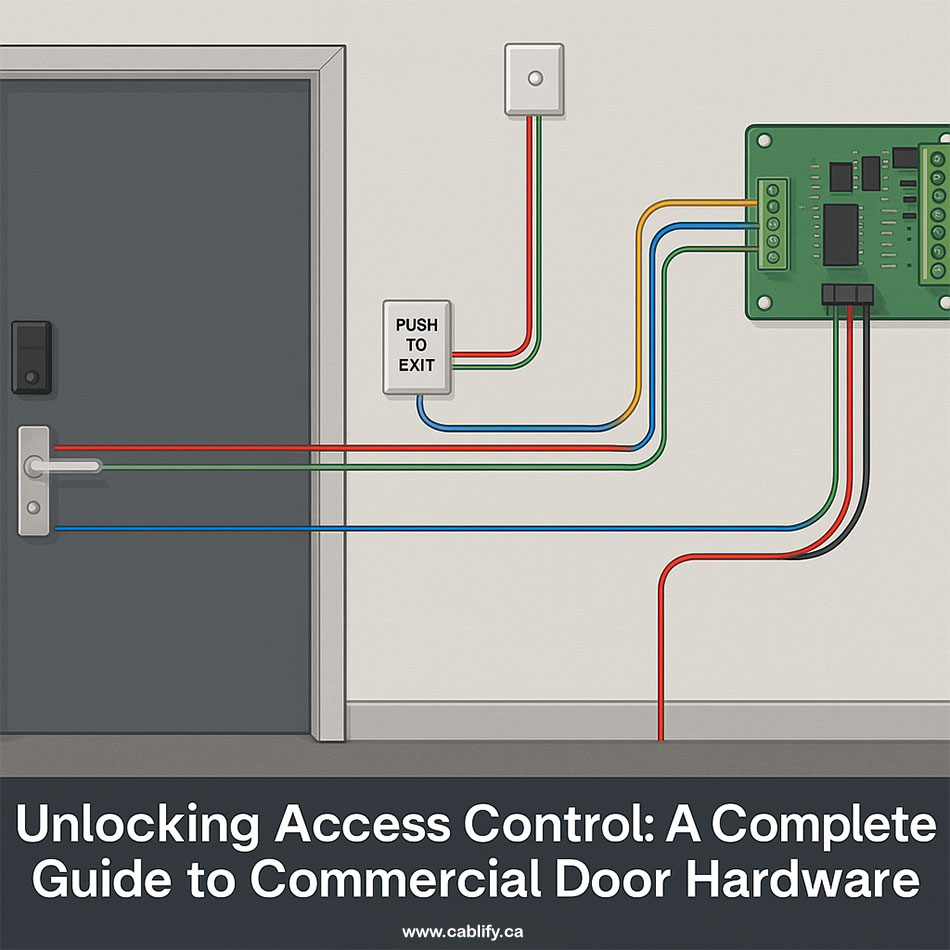
Unlocking Access Control: A Complete Guide to Commercial Door Hardware
In the world of business security, the humble door has evolved. Gone are the days of simple locks and keys. Modern commercial security relies on access control systems—intelligent networks that manage who can enter a space, when, and where. Whether you're a facility manager, a business owner, or a security installer, understanding the components and requirements [...]
Troubleshooting Door Access System Failures: The Complete Technician’s Guidebook
Unlock the secrets to fixing access control failures in 2025! This in-depth guidebook covers the most common issues, step-by-step troubleshooting, and pro strategies for diagnosing power supply, reader, lock, and communication failures. Ideal for installers and access control technicians.
Understanding Access Control Cables: Types and Functions Explained
When setting up an access control system, understanding the wiring and cabling requirements is crucial for ensuring seamless functionality and security. This article provides an in-depth look at how each component works within an access control setup, details the types of cables used, and includes real-world scenarios that demonstrate how this knowledge applies to commercial [...]
How to Choose the Right Door Access Control System for Your Business
In today’s fast-paced world, security is a top priority for businesses. Whether you operate a small office or a large corporation, ensuring that only authorized individuals can access your premises is crucial. This is where door access control systems come into play. They provide businesses with the ability to manage who can enter certain areas, […]
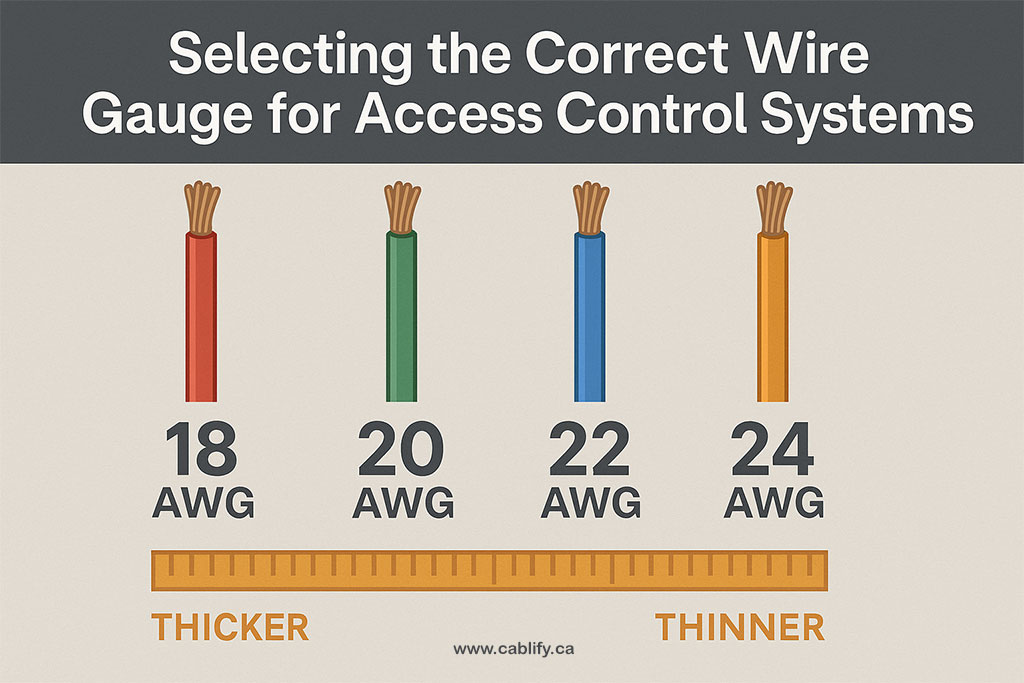
Selecting the Correct Wire Gauge for Access Control Systems
Selecting the correct wire gauge for your access control system is crucial for ensuring reliable performance and minimizing voltage drop. Use the provided charts to determine the appropriate wire gauge based on current load and distance, and always comply with local codes for installation.

Comprehensive Guide to Security Wires in Commercial Applications
Security wires are essential components in the infrastructure of modern security systems, ensuring the reliable transmission of data and power to various devices such as door access systems, alarms, door strikes, and card readers. In commercial settings like offices, warehouses, and production facilities, choosing the right type of wire is crucial for both performance and […]