


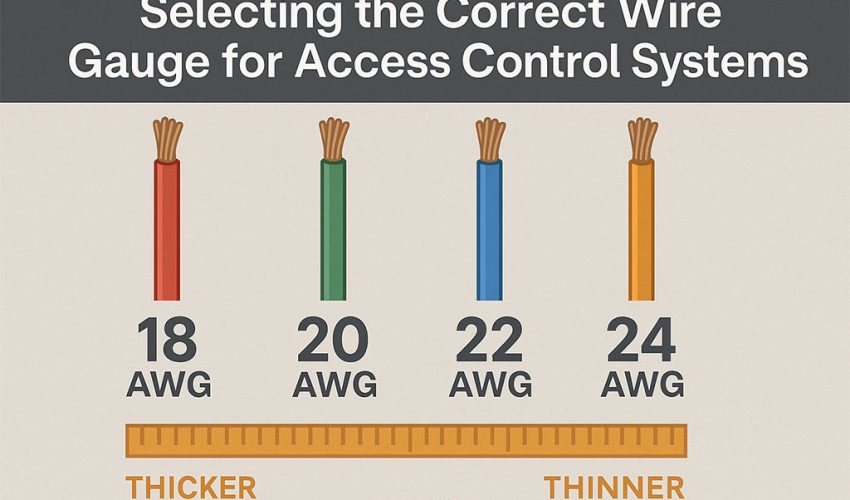
Choosing the right wire gauge isn’t just a technicality—it’s the difference between a reliable, secure access system and one that fails unexpectedly. Undersized wires cause voltage drop, leading to malfunctioning locks, corrupted data, and frustrated users.
This guide cuts through the complexity, providing a clear, step-by-step process to select the perfect wire gauge for your access control installation.
The 3 Essentials for Choosing Wire Gauge
To select the correct wire, you need just three pieces of information:
-
Total Current Draw (Amps): The sum of the current required by all devices on the circuit (e.g., electric strikes, maglocks).
-
Circuit Voltage (Volts): Typically 12V or 24V DC for access control locks.
-
Distance (Feet): The one-way distance from the power supply to the farthest device on the circuit.
Step-by-Step Wire Selection Guide
Step 1: Calculate Your Total Current Draw
First, identify the current draw (in Amps) for every powered device on the circuit. This information is in the product’s datasheet.
-
Example: A single electric strike might draw 0.25 A, and a maglock might draw 0.5 A.
-
Calculation: If you have three electric strikes on one circuit, the total current draw is 3 x 0.25 A = 0.75 A.
Step 2: Measure the Critical Distance
Measure the cable run in feet from your power supply to the very last lock on that specific circuit. This is the most critical distance for calculating voltage drop.
Step 3: Use the Wire Gauge Chart
Use the chart below to find the intersection of your total current (Amps) and distance (Feet). The corresponding number is the minimum wire gauge you should use to stay within a safe 5% voltage drop.
Wire Gauge Chart for 12V DC/AC Systems
Find the minimum AWG gauge based on Total Amps and Distance.
Wire Gauge Selection Guide (AWG)
Minimum Gauge for 12V DC/AC Systems
| Total Circuit Amps | 50 ft | 100 ft | 150 ft | 200 ft | 250 ft | 300 ft | 400 ft |
|---|---|---|---|---|---|---|---|
| 0.25 A | 20 AWG | 20 AWG | 18 AWG | 18 AWG | 16 AWG | 16 AWG | 14 AWG |
| 0.5 A | 20 AWG | 18 AWG | 16 AWG | 14 AWG | 14 AWG | 14 AWG | 12 AWG |
| 0.75 A | 18 AWG | 16 AWG | 16 AWG | 14 AWG | 14 AWG | 12 AWG | 10 AWG |
| 1.0 A | 18 AWG | 16 AWG | 14 AWG | 14 AWG | 12 AWG | 10 AWG | 10 AWG |
| 1.5 A | 18 AWG | 14 AWG | 14 AWG | 12 AWG | 10 AWG | 10 AWG | – |
| 2.0 A | 16 AWG | 14 AWG | 12 AWG | 10 AWG | 10 AWG | – | – |
Note: This chart is based on a maximum **5% voltage drop** (0.6V loss on a 12V system). When in doubt, always use the next **thicker** (lower AWG) wire size.
Pro Installation Tips & Best Practices
1. Separate Your Circuits
A common professional practice is to use separate, fused circuits for different device types:
-
Circuit 1 (Inductive Load): Powers all locking devices (electric strikes, maglocks).
-
Circuit 2 (Resistive Load): Powers all control devices (access control panels, readers).
Why? This prevents voltage spikes from locks (inductive loads) from interfering with or damaging sensitive electronics. It also allows you to use smaller, more cost-effective wire for the control circuit.
2. Always Use Stranded Copper Wire
Stranded wire is flexible and withstands vibration much better than solid core wire, which can break over time and cause intermittent failures.
3. Plan for the Future
Running a conduit? Always pull an extra “pull-string” or leave a spare cable. This makes future upgrades or troubleshooting infinitely easier.
4. Don’t Forget Data Wires
While this guide focuses on power, remember that readers and sensors use data cables.
-
Reader Cables: Use Shielded CAT5e/6 (24 AWG) to prevent data corruption from electrical interference.
What Happens if the Wire is Too Thin?
Using a wire gauge that’s too high (meaning a thinner wire) creates excessive resistance, leading to:
-
Voltage Drop: The lock receives less than the required voltage (e.g., 10V instead of 12V).
-
Unreliable Locking: Maglocks may not hold securely; electric strikes may not fire.
-
System Crashes: Access control panels can reboot or behave erratically.
-
Premature Failure: Consistently under-powering devices stresses their internal components.
Final Recommendation
When selecting a wire gauge for your access control system, it’s always safer to go one size thicker than the minimum requirement. The marginal cost increase in cable is cheap insurance against costly service calls and system failures.
By following this guide, you can design and install a robust access control system that delivers power efficiently and operates reliably for years to come.
Disclaimer: This guide provides general principles for low-voltage installations. Always consult with a qualified professional and adhere to all applicable national and local electrical codes (e.g., NEC in the US, CEC in Canada).