

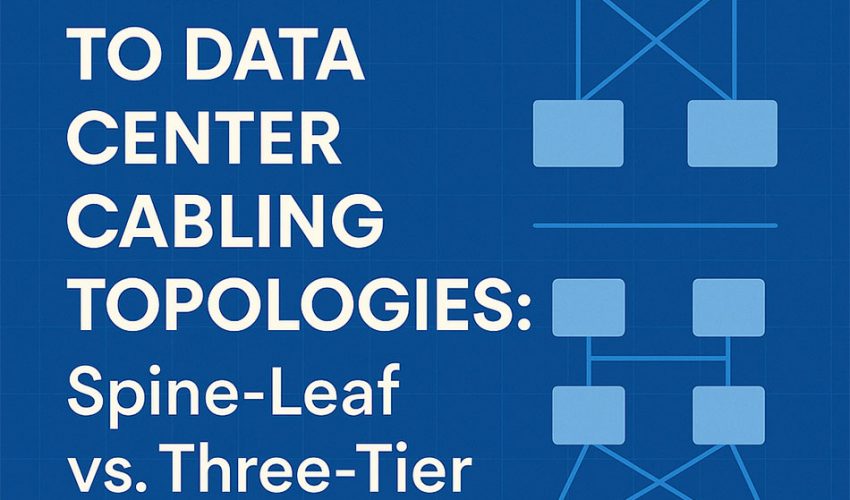
In the era of cloud, AI, and hyper-scale computing, your data center’s underlying cabling topology is not just plumbing—it’s the strategic foundation for performance, scalability, and agility. This guide demystifies the two dominant architectural paradigms: the modern Spine-Leaf (Clos Network) and the legacy Three-Tier (Hierarchical) Core-Aggregation-Access model. We provide a comprehensive, vendor-agnostic analysis to help architects, network engineers, and IT leaders make future-proof decisions.
1. The Foundational Shift: Why Topology Matters More Than Ever

The move from client-server to east-west traffic, driven by virtualization, containers, microservices, and distributed storage (like hyper-converged infrastructure), has fundamentally changed network demands. Modern applications talk between servers far more than they talk to a central core. This shift renders older, north-south optimized models inefficient and costly.
Key Drivers Forcing Topology Evolution:
- East-West Traffic Dominance: Often exceeding 80% in modern clouds and virtualized environments.
- Low Latency & Predictability: Critical for HPC, AI/ML clusters, financial trading, and real-time analytics.
- Non-Blocking Fabrics: The requirement for any server to communicate with any other server at full line rate.
- Scale-Out vs. Scale-Up: Adding capacity horizontally with commodity switches versus vertically with massive, expensive chassis.
- Automation & DevOps: The need for standardized, repeatable configurations enabled by uniform switch roles.
2. The Legacy Workhorse: Three-Tier Architecture (Core-Aggregation-Access)

The traditional hierarchical model, dominant for decades, is designed around the assumption that most traffic flows north-south (to/from the internet or a central core).
2.1 The Three Layers Explained
- Access Layer: Where servers and end devices connect. Features high port density, often with basic Layer 2 (VLAN) functionality.
- Aggregation Layer (Distribution): Aggregates access switches. Provides policy enforcement, routing (Layer 3), security (ACLs, firewalling), and service modules (SLB, SSL offload). Often implemented as redundant chassis for high availability.
- Core Layer: The high-speed backbone. Provides fast transport between aggregation blocks, data center interconnects (DCI), and enterprise WAN/internet edges. Designed for maximum throughput and reliability.
2.2 Cabling Patterns & Technologies
- Traditional Cabling: A hierarchical “tree” with oversubscription at each layer. Common cabling runs from Access -> Aggregation (typically 10/25/40GbE) and Aggregation -> Core (40/100GbE).
- Protocols: Relies heavily on Spanning Tree Protocol (STP) to block redundant links and prevent loops, leading to wasted bandwidth. Modern implementations may use MLAG (Multi-Chassis Link Aggregation) or vPC (Virtual PortChannel) to create logical active-active uplinks from Access to Aggregation.
- Common Scale Limits: Becomes complex and bottlenecked beyond a certain scale. Adding pods often requires re-architecting the core.
2.3 Modern Relevance & Use Cases
Not dead, but niche.
- Small to Mid-Sized Enterprises with predominantly north-south traffic.
- Legacy Applications that cannot be easily refactored.
- Cost-Sensitive Environments where existing chassis-based infrastructure is already amortized.
- Edge Data Centers with simple requirements.
3. The Modern Standard: Spine-Leaf Architecture (Clos Network)
Born in telecom and perfected by cloud giants (Google, Facebook), the Spine-Leaf is a scale-out, non-blocking fabric ideal for east-west traffic. Every Leaf switch connects to every Spine switch, creating a predictable, low-latency mesh.
3.1 Core Principles & Components
- Leaf Layer (ToR – Top of Rack): The access point for servers, storage, firewalls, and load balancers. Every Leaf performs Layer 3 routing. Every server is only one hop from any other server (via a Spine).
- Spine Layer: The pure backbone. Spine switches only connect to Leaf switches (and other Spines for inter-fabric links). They provide consistent, high-bandwidth forwarding.
- Super-Spine Layer: For scaling beyond the initial fabric. Connects multiple Spine blocks, typically in massive data centers.
3.2 Cabling Patterns & Modern Technologies
This is where the magic happens. The cabling is uniform and repeatable.
- Fundamental Rule: Every Leaf is cabled to every Spine. This creates
(Number of Leafs) x (Number of Spines)equal-cost paths. - Cabling Technologies:
- Intra-Fabric (Leaf-Spine): Dominated by 100GbE (QSFP28) today, rapidly moving to 400GbE (QSFP-DD/OSFP) for AI/ML and high-performance clusters. 200GbE and 800GbE are on the horizon.
- Server-to-Leaf: 25GbE (SFP28) is the current sweet spot. 50GbE (SFP56) and 100GbE to the server are growing for GPU servers and all-flash storage arrays.
- Breakout Cabling: A key efficiency play. A single 400GbE port (QSFP-DD) on a Spine can be “broken out” via a fan-out cable to four 100GbE (QSFP28) ports on a Leaf, optimizing cost and density.
- Protocols & Overlays:
- Routing Protocol: BGP (Border Gateway Protocol) – EVPN is the undisputed king for control plane scalability and policy. OSPF/IS-IS are also used.
- Overlay Virtualization: VXLAN (Virtual Extensible LAN) with EVPN control plane. This decouples the physical network (the underlay) from the logical network (the overlay), allowing massive multi-tenancy and seamless VM/container mobility across Layer 3 boundaries.
- No STP: Loop prevention is handled at Layer 3 (routing), utilizing all links actively.
3.3 Benefits & The “Modern Data Center” Fit
- Predictable Performance: Consistent, low latency (typically < 5µs hop) between any two endpoints.
- Non-Blocking Fabric: Oversubscription can be designed out (e.g., with sufficient Spine bandwidth).
- Linear, Painless Scalability: Add capacity by inserting new Leafs (more servers) or new Spines (more fabric bandwidth). No rip-and-replace.
- Operational Simplicity: Uniform device roles enable automation via tools like Ansible, Terraform, and model-driven programmability (gNMI).
- Vendor Flexibility: Mix-and-match Leaf/Spine switches more easily than in a tightly coupled three-tier chassis system.
4. Head-to-Head Comparison Matrix (2024)
| Feature | Three-Tier (Core-Agg-Access) | Spine-Leaf (Clos Fabric) |
|---|---|---|
| Traffic Pattern | North-South Optimized | East-West Optimized |
| Scalability | Vertical (Scale-Up), Limited | Horizontal (Scale-Out), Nearly Unlimited |
| Latency | Variable (2-5 hops) | Predictable & Low (2 hops) |
| Oversubscription | Common at Aggregation Layer | Can be Designed to 1:1 |
| Cabling Complexity | Moderate, Hierarchical | High Uniformity, Full-Mesh (Leaf-Spine) |
| Protocol Foundation | STP, MLAG/vPC (Layer 2 Focus) | BGP/OSPF/IS-IS, VXLAN-EVPN (Layer 3 Focus) |
| Fault Domain | Larger (STP reconvergence) | Smaller (Routing reconvergence) |
| Automation Friendliness | Lower (heterogeneous roles) | High (uniform, repeatable units) |
| Typical Use Case | Legacy Enterprise, Edge DC | Cloud, HCI, AI/ML, Private Cloud, Modern Apps |
| Cost Model | High Capex (chassis), Lower Opex? | Lower Capex per unit, Potentially Higher Opex at scale |
5. Emerging Trends & The Next Frontier
- Co-Packaged Optics (CPO): Moving optics into the switch ASIC to reduce power and increase density for 800GbE+.
- Network Digital Twin & AIOps: Using real-time telemetry (via streaming protocols) to model and predict network behavior before changes.
- Disaggregation & SONiC: The shift towards disaggregated network operating systems (like Microsoft’s SONiC) running on commodity hardware, enabling full control and customization.
- Compute Express Link (CXL): A new interconnect for memory pooling and sharing, which will influence rack-level topology and cabling for composable infrastructure.
- Sustainability Focus: Topology choices impact power (e.g., fewer chassis vs. more small switches) and cooling. Spine-leaf’s use of fixed-form-factor switches can be more efficient per gigabit.
6. Decision Framework: Which Topology is Right For You?

Choose THREE-TIER if:
- Your traffic is >60% north-south.
- You have a stable, well-understood workload with limited growth projections.
- You are heavily invested in and skilled with traditional chassis and STP/MLAG environments.
- Your applications are latency-insensitive.
Choose SPINE-LEAF if:
- Your traffic is >40% east-west (virtualization, containers, storage replication).
- You are building a private cloud, deploying HCI, or have AI/ML workloads.
- Scalability, automation, and predictable performance are top priorities.
- You are designing a new greenfield data center or pod.
Hybrid Approach: A common modern pattern is a spine-leaf fabric for server/storage clusters (the data plane) with a collapsed core/aggregation layer for north-south services (firewalls, load balancers, internet edge).
7. Implementation & Cabling Best Practices (Spine-Leaf Focus)
- Start with a POD Design: Design a self-contained spine-leaf pod (e.g., 4 Spines, 48 Leafs). Scale by adding pods.
- Plan for Growth: Use modular, high-density cabling (MPO/MTP trunks) in overhead trays or under-floor channels. Label everything meticulously.
- Embrace Breakout Cabling: Use 400GbE-to-4x100GbE or 100GbE-to-4x25GbE breakout cables to maximize port utility and reduce cost.
- Automate from Day One: Treat your network as code. Use templates for switch configurations (Leaf vs. Spine).
- Standardize on a Single Optics Vendor: For critical links, use coded optics from a reputable supplier to ensure compatibility and simplify troubleshooting.
FAQ & Key Takeaways
Q: Is spine-leaf more expensive?
A: Often, the Capex per gigabit is lower. You buy many small switches instead of few large chassis. Total cost of ownership (TCO) is frequently lower due to easier scaling and automation.
Q: Can I migrate from three-tier to spine-leaf?
A: Yes, gradually. A common strategy is to build a new spine-leaf fabric as a “pod” alongside the existing network and migrate applications over time. Use a common overlay (VXLAN) to extend networks between fabrics.
Q: What about storage networking (SAN)?
A: Convergence is the trend. Modern spine-leaf fabrics with RDMA over Converged Ethernet (RoCE) or NVMe over Fabrics (NVMe-oF) over TCP are replacing dedicated Fibre Channel SANs, running storage and data traffic on the same Ethernet fabric.
The spine-leaf architecture is the de facto standard for modern, scalable, and automated data centers. While the three-tier model still has its place, the industry’s trajectory is clear: towards layer-3 fabrics, scale-out design, and software-defined operations. Your cabling topology is the foundational blueprint—investing in a spine-leaf design today is an investment in agility, performance, and innovation for the next decade.
Final Pro Tip: Design your cabling plant to last 10-15 years, but assume your active gear (switches, optics) will refresh every 3-5 years. Choose structured cabling and pathways that can support 400GbE and beyond.