
Every week, a business owner somewhere in the Greater Toronto Area walks into a big-box electronics store, purchases a $200 consumer camera kit, and believes their premises are now secure. It is an understandable choice — the packaging looks impressive, the price is attractive, and the setup takes less than an hour.
What that business owner does not yet know is that within 12 to 18 months, they will likely face one or more of the following: blurry, unusable footage during an insurance claim, a camera that disconnects from Wi-Fi during a critical incident, storage that fills up within days, or a system with no ability to expand as the business grows.
This guide exists to end that confusion. Written for GTA business owners, property managers, retail operators, warehouse supervisors, and commercial real estate developers, this comprehensive resource draws on industry data, hardware specifications, Ontario privacy law, and real-world installation experience to explain — clearly and technically — exactly why commercial-grade CCTV systems are fundamentally different from consumer security cameras, and why that difference matters enormously to your business.
| Key Takeaway: Consumer cameras are designed for convenience. Commercial CCTV systems are engineered for evidence, reliability, scalability, and compliance. For any business operating in the GTA, the gap between these two categories is not marketing language — it is a technical and legal reality. |
Understanding the Two Categories
1.1 What Is a Consumer Security Camera?
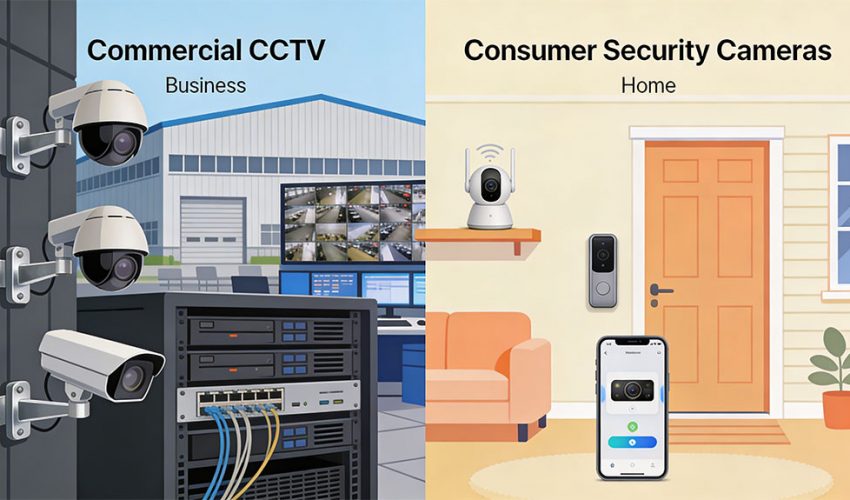
Consumer security cameras — products sold under brand names like Ring, Nest, Arlo, Wyze, Reolink, and TP-Link Tapo — are designed and engineered for residential environments. They are optimized for three things: ease of installation, low cost, and smartphone integration.
These cameras typically connect to a home Wi-Fi network, store footage either locally on a microSD card or in the cloud via a paid subscription, and are managed through a mobile application. They are intended for a homeowner who wants to see who is at the front door or receive a motion alert when the backyard gate opens.
Their hardware is built to consumer-grade tolerances: moderate operating temperature ranges, plastic housings with basic weather resistance, limited processing power, and compressed video streams that reduce storage at the cost of image detail.
1.2 What Is a Commercial-Grade CCTV System?
Commercial CCTV systems — deployed under brands such as Axis Communications, Avigilon, Hanwha Techwin, Bosch, Hikvision Pro Series, and Dahua Pro — are engineered for continuous, demanding, business-critical operation.
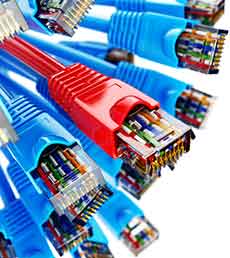
A properly designed commercial system consists of several integrated components: IP cameras (or PoE cameras) connected via structured Cat 6 or fiber cabling, a Network Video Recorder (NVR) or Video Management Software (VMS) platform, PoE switches that deliver power and data over a single Ethernet cable, redundant on-site and optional off-site storage, and a centralized management interface accessible via desktop, browser, or secured mobile application.
These systems are built to operate 24 hours a day, 7 days a week, 365 days a year — without interruption, without manual intervention, and with a legally defensible chain of custody for recorded footage.
The Technical Comparison — Category by Category
The table below provides a structured technical comparison across the most important criteria business owners should evaluate when selecting a surveillance system.
| Feature | Consumer Camera (Ring, Arlo, Wyze, Nest) | Commercial CCTV System (Axis, Avigilon, Hikvision Pro) |
| Resolution | 720p to 2K (some 4K). Compression artifacts reduce usable detail. | 2MP to 12MP (4K). True 4K with H.265+ compression; faces and license plates identifiable. |
| Frame Rate | 15–20 fps typical. Motion can appear choppy. | 25–60 fps standard. Smooth, broadcast-quality playback. |
| Connection | Wi-Fi. Subject to interference, bandwidth congestion, and dropouts. | PoE Ethernet over Cat 6/fiber. Dedicated, stable, interference-resistant. |
| Night Vision | Infrared LED: 5–15m range. Colour washout in mixed lighting. | True WDR, Starlight, or full-colour low-light technology: 30–100m+ range. |
| Storage | Cloud subscription ($5–$30/month) or 32GB microSD. | Local NVR with 1TB–16TB+ HDD. No subscription fees. |
| Uptime | Depends on home Wi-Fi router stability. Not monitored. | Dedicated PoE switch. System health monitored 24/7. |
| Scalability | Add cameras individually, no central management. | Add cameras to NVR or VMS. Centrally managed across unlimited sites. |
| Build / IP Rating | IP44–IP55. Not suited for industrial, outdoor harsh, or extreme temperatures. | IP66–IP68, IK10 vandal resistance. Rated for -40°C to +60°C. |
| Cybersecurity | Shared cloud infrastructure. Firmware updates irregular. | Encrypted streams (SSL/TLS), VLAN support, Active Directory integration. |
| AI Analytics | Basic motion zones. High false alarm rate. | People counting, facial recognition-ready, license plate capture, heat mapping. |
| Warranty | 1 year limited. | 3–5 years with enterprise support options. |
| PIPEDA Compliance | No built-in compliance tools. Data stored on US servers. | Configurable data retention, Canadian server options, audit log support. |
| Cost Per Camera | $30–$250 (hardware only, plus subscription). | $300–$1,500 hardware; no monthly fees for local storage. |
Deep Dive — Why Each Difference Matters
3.1 Resolution and Image Quality: The Evidence Standard
Resolution is perhaps the most misunderstood specification in surveillance. A camera labelled as “1080p” on a consumer box and “1080p” on a commercial specification sheet can produce dramatically different image quality in real-world conditions.
The reason lies in how manufacturers handle compression, bitrate, and sensor size. Consumer cameras aggressively compress video streams to reduce cloud storage costs, which directly degrades the fine detail needed to identify a face, read a license plate, or distinguish between a staff member and an intruder.
Commercial cameras use higher bitrates with intelligent compression (H.265+ or H.265 Smart Codec), larger image sensors, and wider dynamic range (WDR) technology. Wide Dynamic Range is the camera’s ability to simultaneously capture detail in both bright and dark areas of the same frame — critical for a front door camera where sunlight floods the entrance from one direction while the interior remains dark.
| Real-World Example: A retail store in Scarborough installed consumer cameras at $180 each. After a shoplifting incident, police reviewed the footage but could not extract a usable facial image — the compression artifacts and low sensor quality made identification impossible. An insurance adjuster declined the claim. The store replaced their entire system with commercial IP cameras six months later, at three times the original cost. |
3.2 Connection Technology: PoE vs. Wi-Fi
This is the single most important infrastructural difference between consumer and commercial systems, and it is the primary reason business owners should always work with a professional cabling installer.
Consumer cameras rely entirely on Wi-Fi. In a residential home with one router and four cameras, this works reasonably well. In a commercial environment — a warehouse with metal shelving, a multi-floor office building, a retail location near a busy street — Wi-Fi is inherently unreliable. Radio frequency interference from neighbouring businesses, building materials that attenuate the 2.4GHz and 5GHz bands, and shared bandwidth between cameras, point-of-sale systems, and employee devices all degrade performance.
More critically: if the Wi-Fi router goes down, the cameras go offline. The moment of a break-in is precisely the time most likely to involve interference with your network.
Power over Ethernet (PoE) technology eliminates all of these variables. In a PoE system, each camera connects via a single Cat 6 Ethernet cable that simultaneously delivers 15.4W to 90W of electrical power (IEEE 802.3af/at/bt standards) and transmits high-bitrate video data back to the NVR. The connection is physically direct, not wireless, which means it cannot be jammed, cannot be affected by radio interference, and does not depend on a shared wireless network.
For businesses operating in the GTA’s dense urban and industrial environments, PoE over Cat 6 or fiber cabling is not optional — it is the professional standard.
3.3 Storage Architecture: Subscriptions vs. On-Site NVR
Consumer cameras are fundamentally designed around cloud subscriptions. The camera hardware is sold at a low margin or at a loss; the recurring subscription revenue is the business model. Ring’s 24/7 Recording plan, Arlo’s Secure Plus subscription, and Google Nest Aware all require ongoing monthly or annual fees to access historical footage beyond a 24-48 hour window.
For a small business with five cameras, this can add up to $300 to $600 per year — indefinitely — with no return on that investment beyond accessing footage you have already paid for through the hardware purchase.
Commercial systems store footage on a local Network Video Recorder (NVR) with enterprise-grade hard drives (2TB to 16TB+), providing weeks or months of continuous recording at no ongoing cost. The business owns the hardware, owns the data, and retains full control over who can access the footage. This is also critical for PIPEDA compliance, as discussed in Section 5.
Advanced NVR platforms support RAID configurations for redundancy, remote encrypted access for authorized personnel, and event-based bookmarking so that relevant footage is instantly retrievable during an insurance claim or police investigation.
3.4 Night Vision and Low-Light Performance
The vast majority of security incidents — break-ins, vandalism, theft, assault — occur at night or in low-light conditions. This is the single most demanding performance scenario for any camera, and it is where the gap between consumer and commercial systems is most stark.
Consumer cameras use basic infrared (IR) LEDs that cast a monochrome glow up to 10 to 15 metres. In practical terms, this means that anyone approaching your building from beyond that range is invisible, and that colours — clothing, vehicle paint, physical descriptors — are entirely lost.
Commercial cameras offer several advanced technologies:
-
- Starlight Technology: Ultra-sensitive image sensors that produce full-colour video at illumination levels as low as 0.001 lux — equivalent to a moonless overcast night.
- True WDR (Wide Dynamic Range): Simultaneously captures detail in high-contrast scenes, such as a loading dock with bright overhead lights and a dark doorway.
- Smart IR: IR LEDs that automatically adjust intensity based on the distance of the subject, preventing the “blown out” white image common with basic IR systems.
- White Light + IR Hybrid: Activates visible white light upon motion detection, providing full-colour evidence capture while also deterring intruders.
3.5 Build Quality and Environmental Durability
IP (Ingress Protection) ratings define a camera’s resistance to dust and water. Consumer cameras typically carry IP44 or IP55 ratings, meaning limited protection against dust and water spray. These ratings are sufficient for a sheltered residential doorbell position.
In a GTA commercial context, cameras are routinely installed in parking lots, loading docks, rooftop positions, refrigerated warehouses, manufacturing floors, and car washes — all environments that would damage or destroy consumer-grade hardware within one Canadian winter season. GTA temperatures regularly reach -25°C in January; consumer cameras are often rated only to -10°C.
Commercial cameras carry IP66 (dust-tight and protected against heavy rain jets), IP67 (submersible to 1 metre), or IP68 ratings. Equally important is the IK10 vandal-resistance rating — a standard that certifies the camera housing can withstand a 20-joule impact (the equivalent of a 5kg mass dropped from 40cm) — essential for any camera within reach of a person.
3.6 AI-Powered Video Analytics
Modern commercial CCTV systems have evolved far beyond passive recording. AI video analytics — processed either on the camera itself (“edge computing”) or on the NVR/VMS server — transform cameras from passive recording devices into active, intelligent security tools.
According to security industry data, AI-powered monitoring reduces false alarms by up to 90%, slashing the number of irrelevant motion alerts that lead to alert fatigue among staff. For a business that previously ignored 95% of motion notifications because they were triggered by shadows, passing cars, or birds, AI analytics means the 5% of genuine alerts actually receive attention.
Commercial AI analytics capabilities include:
-
- People counting and occupancy monitoring — critical for retail analytics and post-COVID compliance
- Virtual perimeter “tripwire” detection — alerts triggered only when a person crosses a defined line, not by ambient motion
- License plate recognition (LPR) — identifies vehicle plates to within 140 feet, even at speeds up to 35 mph
- Loitering detection — flags individuals who remain stationary in a sensitive area beyond a defined time threshold
- Facial recognition readiness — cameras pre-positioned and configured for future biometric integration where permitted
- Smart video search — search recorded footage by keyword such as “red jacket” or “blue van” rather than scrubbing through hours of footage
3.7 Cybersecurity and Network Hardening
This dimension of the comparison is rarely discussed in consumer-facing marketing but is critically important for any business handling customer data, financial records, or proprietary information.
Consumer cameras broadcast video data to cloud servers, frequently located in the United States, over shared infrastructure. Firmware updates on popular consumer brands have often been delayed by months or years, leaving known vulnerabilities unpatched. Several major consumer camera brands have experienced significant data breaches in recent years, with hackers accessing live feeds of thousands of camera systems simultaneously.
Commercial systems are designed with network security as a first principle:
-
- Video streams are encrypted using SSL/TLS at the camera level — the stream cannot be intercepted in transit
- Cameras operate on a dedicated VLAN (Virtual Local Area Network), completely isolated from your business’s data network
- User access is controlled via Active Directory integration, with role-based permissions and full audit logging of who accessed which footage and when
- Firmware updates are managed and tested by enterprise IT teams, not released directly to consumer app stores
- On-premise NVR storage means your footage never leaves your building without explicit authorization
| For GTA businesses in healthcare, legal, financial services, or any regulated industry: the cybersecurity gap between consumer and commercial cameras is not a preference — it is a compliance requirement. |
Camera Types in Commercial Systems
Understanding commercial camera form factors helps business owners make informed decisions about placement and coverage. The four primary types used in GTA commercial installations are:
Dome Cameras
Installed flush to a ceiling or wall, dome cameras are vandal-resistant (IK10-rated), compact, and discreet. Their form factor makes it difficult for an observer to determine which direction the lens is pointed, providing a psychological deterrent. Ideal for: retail floors, lobby areas, corridors, offices.
Bullet Cameras
Long, cylindrical cameras with an adjustable mounting arm, offering extended range and motorized optical zoom capability. Ideal for: parking lots, building perimeters, loading docks, long corridors, license plate capture positions.
PTZ Cameras (Pan-Tilt-Zoom)
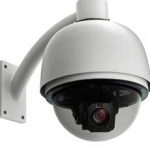
Motorized cameras that can rotate 360 degrees, tilt vertically, and zoom optically up to 30x — all remotely controlled through the NVR or VMS. One PTZ camera can cover the area that would otherwise require three to five fixed cameras. Ideal for: large parking areas, warehouse floors, construction sites, stadiums, and properties where active monitoring is conducted.
Fisheye / Panoramic Cameras
A single lens covering up to 360 degrees of a space with dewarping technology that produces a usable, flat image from the circular raw feed. Ideal for: open-plan offices, retail floors, reception areas — anywhere a single camera must cover a complete room without blind spots.
PIPEDA Compliance — Ontario Businesses and Surveillance Law
Canadian businesses operating surveillance cameras are subject to the Personal Information Protection and Electronic Documents Act (PIPEDA) — federal privacy legislation that governs the collection, use, and disclosure of personal information, including video footage.
This is an area where the difference between consumer and commercial systems has direct legal and financial consequences for GTA business owners.
5.1 What PIPEDA Requires of Ontario Businesses
The Office of the Privacy Commissioner of Canada has established clear guidelines for overt video surveillance by private sector organizations. Under PIPEDA, Ontario businesses using security cameras must:
-
- Post clear, visible signage notifying individuals that video surveillance is in operation, including the purpose of surveillance and a contact person for questions
- Limit collection to what is necessary — cameras must not be placed in areas where individuals have a reasonable expectation of privacy, including washrooms, change rooms, or private office spaces
- Store footage securely with access limited to authorized personnel, using password-protected, encrypted systems
- Define and document a data retention policy — typically 30 days is standard for retail and small commercial operations
- Obtain implicit or explicit consent for any use of footage beyond the originally stated security purpose
- Provide individuals with access to footage containing their image upon request, subject to privacy of third parties in the same footage
5.2 Why Consumer Cameras Create PIPEDA Compliance Risks
Consumer camera systems present significant PIPEDA compliance challenges for businesses:
-
- Cloud storage on U.S. servers: Most consumer cameras store footage on American servers. Canadian privacy law generally requires that footage be accessible for review and deletion by the organization at all times — a right that may conflict with U.S. cloud provider terms of service and data retention practices.
- No audit logging: Consumer systems do not record who accessed footage, when, or for what purpose — a fundamental requirement of the accountability principle under PIPEDA.
- Undefined retention periods: Consumer cloud platforms retain footage according to their subscription tier, not your business’s documented retention policy.
- Audio recording concerns: Many consumer cameras include microphones and record audio by default. In Canada, recording a private conversation without consent of all parties may violate Section 184 of the Criminal Code — a risk that a professional commercial installer will configure around by disabling audio recording where required.
5.3 How Commercial Systems Support Compliance
Professional commercial CCTV systems are designed with compliance in mind:
-
- Local NVR storage keeps footage within your premises and under your direct control
- Configurable automatic retention policies — footage is automatically overwritten after your defined retention period
- Full access audit logs document every user who viewed, exported, or deleted footage
- Camera placement planning by a certified installer ensures no camera is positioned in a prohibited area
- Encrypted transmission ensures footage cannot be intercepted in transit on your network
| Important Notice: This section provides general information about PIPEDA and is not legal advice. GTA businesses with specific compliance questions should consult a qualified Canadian privacy law practitioner. Your commercial CCTV installer should also conduct a camera placement review prior to installation. |
Total Cost of Ownership — The Real Financial Picture
One of the most persistent myths in commercial security is that consumer cameras “save money.” A rigorous total cost of ownership (TCO) analysis over three to five years reveals a more complex picture.
| Cost Category | 8-Camera Consumer System (3-Year) | 8-Camera Commercial IP System (3-Year) |
| Hardware (cameras + hub) | $800 – $1,600 | $4,000 – $8,000 |
| Cloud subscription (3 yrs) | $900 – $1,800 | $0 (local NVR) |
| Professional installation | $0 (DIY) | $1,500 – $3,500 |
| Cabling infrastructure | $0 (Wi-Fi) | $1,000 – $2,500 (Cat 6) |
| Replacement / repairs | $600 – $1,200 | $200 – $500 |
| Downtime / incident costs* | $2,000 – $10,000+ | Significantly reduced |
| 3-Year Total (estimated) | $4,300 – $14,600 | $6,700 – $14,500 |
| Residual system value | Low (obsolete) | High (scalable platform) |
*Downtime and incident costs include: insurance claims denied due to unusable footage, police investigations that could not proceed, employee theft incidents that were not detectable, and the reputational cost of a security breach.
Which Businesses in the GTA Need Commercial CCTV?
The short answer is: virtually all of them. But the following business categories have the highest risk exposure and the greatest need for professional commercial surveillance:
Retail and Restaurant
Shoplifting, employee theft, slip-and-fall liability claims, after-hours break-ins. Facial recognition-ready commercial cameras at entry points, POS coverage cameras, and perimeter cameras covering parking areas are the standard installation for retail in the GTA.
Warehouses and Logistics
High-value inventory, large footprint, shift work, loading dock access control. Commercial cameras with long-range bullet optics, PTZ cameras for floor coverage, and license plate recognition at gate access points.
Office Buildings and Multi-Tenant Commercial Properties
Shared lobby and elevator access, parking structures, after-hours access. Dome cameras with vandal resistance throughout common areas, PTZ cameras in parking structures, and intercoms integrated with access control.
Medical, Dental, and Healthcare Clinics
Drug storage security, patient privacy considerations, regulatory compliance. Commercial cameras with strict PIPEDA-compliant placement, audio recording disabled, retention policies documented.
Cannabis Retail and Licensed Facilities
Cannabis retailers in Ontario are subject to strict Alcohol and Gaming Commission of Ontario (AGCO) regulations requiring specific camera coverage, minimum resolution standards, and defined footage retention periods. Consumer cameras do not meet these requirements.
Schools, Daycares, and Community Organizations
Entry control, yard monitoring, after-hours deterrence. Commercial cameras with wide-angle coverage, remote monitoring capability, and vandal-resistant housing throughout exterior areas.
Construction Sites
Equipment theft is a significant cost for GTA contractors. Solar-powered commercial cameras with LTE backhaul, AI-powered perimeter detection, and remote monitoring provide construction site security without permanent infrastructure.
What to Expect from a Professional Commercial CCTV Installation
A qualified commercial CCTV installer in the GTA does far more than run cable and mount cameras. Here is the end-to-end process a professional installation should follow:
-
- Site Survey and Security Assessment: A licensed installer walks the property, identifies vulnerabilities, entry points, blind spots, and lighting conditions before a single camera is specified.
- Camera Layout and Coverage Mapping: Using floor plans and site photographs, the installer designs a coverage map showing every camera position, field of view, cable run, and NVR location.
- Structured Cabling Installation: Cat 6 or fiber cable is run from each camera position to the NVR/PoE switch location, typically in a server room or secure telecommunications closet. All cable runs are labelled, documented, and warranted.
- Hardware Mounting and Configuration: Cameras are mounted, levelled, focused, and configured with IP addresses, compression settings, and AI analytics parameters.
- NVR Programming and Network Integration: The NVR is configured with retention schedules, user access roles, encrypted remote viewing credentials, and optional VPN access for off-site management.
- PIPEDA Compliance Review: The installer reviews camera placements against Ontario privacy law guidelines and advises on required signage placement.
- Client Training and Documentation: A full system walkthrough, user manual, and as-built drawing package are provided to the business owner.
Questions to Ask Your Commercial CCTV Installer
Before hiring any security installer in the GTA, ask these specific questions to ensure you are working with a qualified professional:
-
- Are you licensed as a security installer under the Ontario Private Security and Investigative Services Act?
- What cabling standard do you use for IP camera runs — Cat 6, Cat 6A, or fiber, and will you provide an as-built cable drawing?
- Which NVR or VMS platform do you recommend and why is it appropriate for my site?
- What is the camera manufacturer’s warranty and how is it serviced in Canada?
- Can you demonstrate PIPEDA-compliant camera placement on my site plan before installation begins?
- Do your cameras support PoE (Power over Ethernet) — and what is your PoE switch specification?
- What cybersecurity measures are included — VLAN isolation, SSL/TLS encryption, firmware update policy?
- What is your structured cabling warranty and does it cover both labour and materials?
- Can this system scale — can I add cameras without replacing the NVR or rewiring?
- Do you carry errors and omissions insurance and general liability coverage for commercial installations?
The choice between a consumer security camera and a commercial CCTV system is not a question of budget versus quality. It is a question of purpose.
Consumer cameras serve the purpose they were designed for — providing a homeowner with basic awareness of their front porch or backyard. They are excellent products, within the context for which they were engineered.
A commercial business in the Greater Toronto Area operates in a different context entirely: one defined by higher asset values, greater foot traffic, more complex physical environments, legal obligations under PIPEDA, insurance requirements for admissible footage, and the absolute need for a system that continues recording during the exact moments when it is most needed.
When a break-in occurs at 2:47 a.m., when an employee files a fraudulent workers’ compensation claim, when a shoplifter disputes footage with their lawyer, or when an insurer demands submissible evidence — the question will not be “how much did the cameras cost?” It will be “can we actually see what happened?”
A professionally designed and installed commercial CCTV system, built on PoE over structured Cat 6 cabling, managed by a commercial NVR platform, and installed by a licensed GTA security professional, provides the answer your business needs.
| Ready to protect your GTA business with a professional commercial CCTV system? Contact us today for a free, no-obligation site survey. We design, supply, and install commercial IP camera systems throughout Toronto, Mississauga, Brampton, Markham, Vaughan, Richmond Hill, and the surrounding GTA. As specialists in data cabling and fiber infrastructure, every camera system we install is built on a properly designed structured cabling foundation — giving you the reliability and performance your business demands. |