

The modern manufacturing plant or warehouse is a beast of a different nature. Unlike quiet office corridors or retail stores, your facility is alive with the clang of machinery, the hum of forklifts, and the hustle of logistics. For an IT Manager, Warehouse Manager, or Operations Manager in Toronto, ensuring security and operational efficiency in this environment requires a specialized approach.
Standard, off-the-shelf cameras simply aren’t built for the job. They succumb to dust, shake loose from vibration, and get blinded by the contrast between sun-drenched loading docks and dark storage aisles.
This guide explores the critical aspects of CCTV for manufacturing plants, focusing on the rugged requirements of industrial surveillance. We will cover how modern systems overcome challenges like dust and vibration, leverage Wide Dynamic Range (WDR), and ultimately transform security from a cost center into a tool for operational excellence.
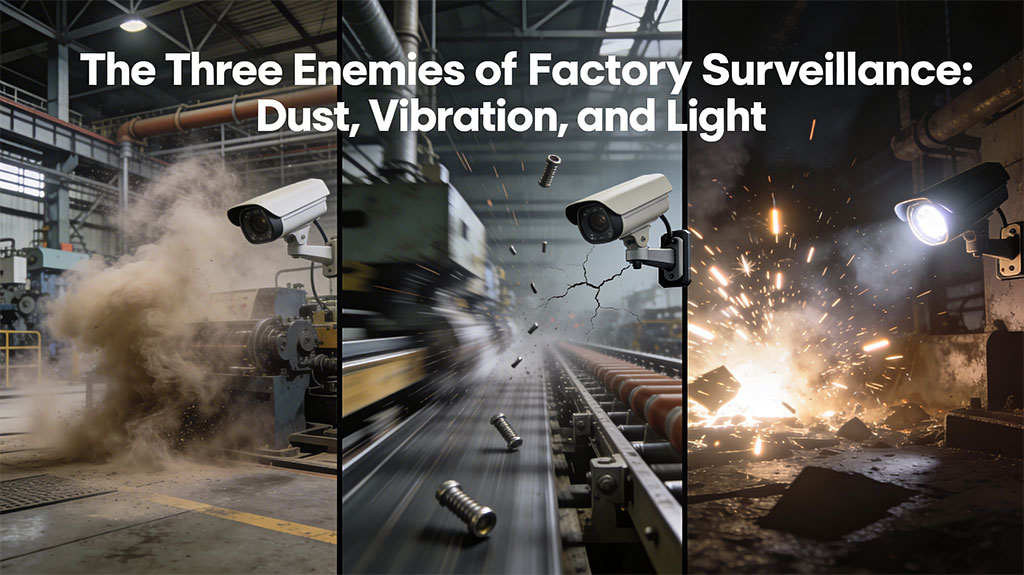
The Three Enemies of Factory Surveillance: Dust, Vibration, and Light
Before selecting cameras, it is vital to understand the unique environmental stressors present in industrial settings. Ignoring these factors is the primary reason surveillance systems fail prematurely .
1. Combatting Dust and Particulates
Manufacturing environments—whether woodworking, metal fabrication, or packaging—generate airborne particulates. These particles settle on camera lenses, obscuring details, and can seep into housings, destroying sensitive electronics .
The Solution: You must look for cameras with a robust Ingress Protection (IP) rating. Specifically, an IP66 or IP67 rating is the industry standard for manufacturing. An IP66-rated camera is “dust tight” (completely protected against dust ingress) and protected against powerful water jets, making it suitable for washdown areas . For volatile environments like chemical plants, explosion-proof housings with specialized seals are mandatory .
2. Neutralizing Vibration
Heavy machinery, stamping presses, and constant conveyor belt movement create constant, low-grade vibrations. Over time, this vibration loosens internal components and causes autofocus motors to wear out prematurely. More immediately, it results in blurry, unusable “jello” footage .
The Solution: Industrial-grade cameras feature ruggedized internal components. However, the installation method is just as critical. Cameras should be mounted using heavy-duty, shock-absorbent brackets specifically designed to dampen vibration . During installation, technicians must use lock washers and thread-locking compounds to ensure screws don’t back out over time .
3. Taming Harsh Light with Wide Dynamic Range
Perhaps the most common technical failure in warehouse CCTV is the “silhouette effect.” A camera pointed at a person standing in a dark aisle looking out toward a bright, sunlit loading dock will typically render the person as a black shadow . Standard cameras cannot process the bright light and the dark shadow simultaneously.
The Solution: Wide Dynamic Range (WDR) technology. WDR allows a camera to capture details in both the brightest and darkest parts of the image simultaneously . When evaluating cameras for your plant, ensure they feature true WDR (or HDR) . This is non-negotiable for entrances, loading docks, and exterior views where lighting conditions fluctuate wildly throughout the day.
| Environmental Challenge | Industrial-Grade Solution | Benefit to Facility |
|---|---|---|
| Dust & Debris | IP66/IP67-rated housing (dust-tight) | Prevents equipment failure and lens obstruction. |
| Constant Vibration | Ruggedized components & shock-mount brackets | Eliminates blurry “jello” footage; extends camera life. |
| Harsh Lighting | Wide Dynamic Range (WDR) technology | Identifies subjects entering/exiting dark vs. bright areas. |
Strategic Camera Placement: Eliminating the Blind Spots
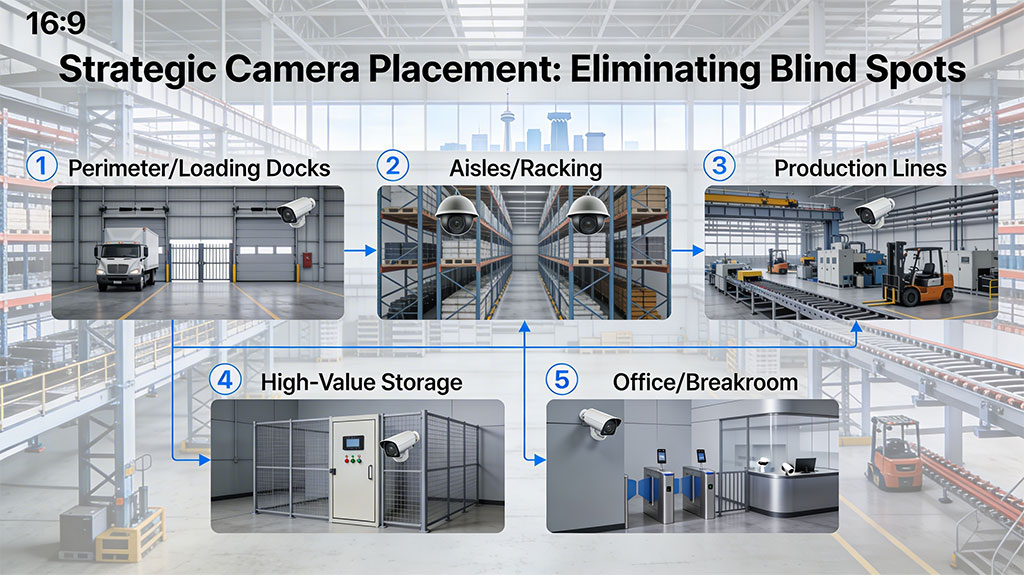
Once you have the hardware rated for the environment, the next step is strategy. In a sprawling warehouse or multi-level plant, you cannot just put a camera in the corner and hope for the best. A pre-installation site assessment is crucial .
-
- Perimeter and Loading Docks: These are high-risk entry points for theft. Use bullet-style cameras for long-range focus on gates and dock doors . Position cameras to capture the area where trucks seal/unseal, not just the dock plate.
-
- Aisles and Racking: To monitor activity in narrow aisles, use dome cameras with sufficient resolution (4MP or higher) to read labels on boxes at the top of racks . Consider mounting cameras on ends of racks to look down aisles rather than across them.
-
- Production Lines: Here, the goal shifts from security to process monitoring. Place cameras to oversee critical machinery. If a machine jams or malfunctions, reviewable footage helps engineers diagnose the root cause without standing on the floor .
-
- High-Value Storage (Cage/C.O.D.): For areas housing expensive inventory or high-value returns, dedicate a fixed, high-resolution camera (4K) with IR night vision pointed directly at the access door .
Beyond Security: The Rise of AI Analytics
Modern CCTV for manufacturing plants is no longer just about recording theft; it is about generating data. By integrating Video Management Software (VMS) with AI analytics, your cameras become operational tools .
-
- Safety Compliance (PPE Detection): AI can be trained to detect if employees on the floor are wearing required safety gear—hard hats, vests, or harnesses. If a violation is detected, the system can send a real-time alert to the floor manager, preventing accidents before they happen .
-
- Line Crossing and Intrusion: For safety, you can set virtual “tripwires” around dangerous machinery. If an operator enters a hazardous zone while the machine is active, an alarm triggers .
-
- Heat Mapping: In a warehouse, cameras can track traffic flow. This data helps operations managers understand bottlenecks in the picking and packing process, allowing for better workflow optimization .
Why Toronto Businesses Need Local Expertise
Installing CCTV in an industrial facility is vastly different from a residential or small office setup. It involves working at heights, running cabling through HVAC systems, and integrating with existing network infrastructure.
A Toronto-based installer brings specific value:
-
- Understanding Local Compliance: Ontario’s privacy laws, particularly regarding employee monitoring, are strict. Employees must be notified if surveillance is taking place, and areas like bathrooms and break rooms are strictly off-limits . A local expert ensures your signage and system configuration meet Canadian privacy standards .
-
- Network Integration: Modern IP camera systems run on your Local Area Network (LAN). An installer with IT infrastructure knowledge (like a network integrator) ensures that your network switch can handle the Power over Ethernet (PoE) load and that your bandwidth is sufficient to prevent video lag .
-
- Scalability and Support: Your plant may expand. A professionally designed system uses a scalable Video Management System (VMS) that allows you to add cameras without overhauling the entire setup, with ongoing maintenance support available locally in the GTA .
Implementing a surveillance solution in a manufacturing or warehouse environment is a complex but critical investment. By prioritizing industrial-grade hardware that is resistant to dust and vibration, utilizing WDR technology to conquer lighting challenges, and leveraging AI analytics for safety, you protect more than just assets—you protect your people and your productivity.
For managers in Toronto, the key takeaway is this: don’t settle for a generic security system. Seek a partner who understands the industrial landscape and can design a future-ready, compliant system tailored to the unique rhythm of your facility.
- Guide to Corning Fiber Equipment: UniCam Connectors, CCH Panels, and Enterprise Termination
- Why Is My 1 Gbps Internet Only 200–300 Mbps on Ethernet?
- Plenum vs Riser vs Direct Burial: The Ultimate Cable Selection Guide
- US Bans Foreign-Made Consumer Routers — What Canadian Businesses Need to Know
- CCTV for Liability Protection: How Businesses Use Footage in Insurance Claims

How to Secure a CCTV Network Against Cyber Threats
In today’s connected business environment, commercial CCTV systems are no longer standalone. They are part of your IT network. That means they face the same cyber risks as your email, firewalls, and servers. For any business that depends on video surveillance for safety and compliance, securing the CCTV network is essential. This guide explains how [...]
SecureCCTV: Hardening IP Surveillance Networks Against Cyber Threats
Learn how to protect commercial CCTV networks from cyber threats using VLANs, port isolation, and NVR lockdown strategies. Expert guide on securing IP cameras & surveillance systems.