

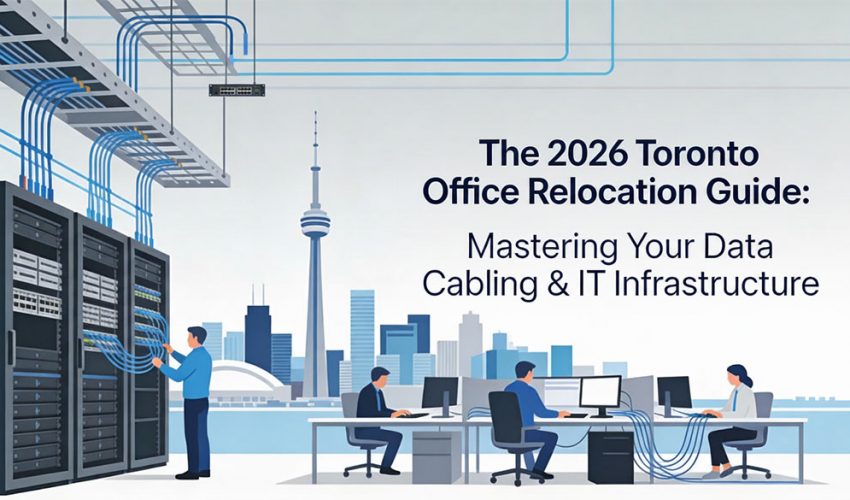
Relocating an office in the Greater Toronto Area (GTA) has undergone a massive paradigm shift. As we enter 2026, the “plug-and-play” office is a relic of the past. Today, a move is a high-stakes migration of a digital ecosystem.
With Toronto’s “Flight to Quality” trend filling premium towers in the Financial District and tech hubs in Liberty Village, the infrastructure behind the walls is now your company’s most valuable asset. If your network fails on Monday morning, your relocation isn’t just delayed—it’s a catastrophic loss of billable hours. This comprehensive guide is the definitive manual for Toronto facility managers and IT directors navigating the complexities of 2026 structured cabling.
The 2026 Connectivity Landscape
Why 2026 is the Year of “High-Density”
In 2026, Toronto offices are collaboration engines. The widespread adoption of WiFi 7 and AI-integrated video conferencing means that average bandwidth requirement per square foot has tripled since 2023.
- The WiFi 7 Bottleneck: WiFi 7 access points (APs) now deliver speeds exceeding 30Gbps. If your new office is wired with legacy Cat6, your expensive hardware will be “throttled” by a 1Gbps bottleneck at the wall. WiFi 7 requires 10Gbps backhaul to perform as advertised.
- The 2026 Ontario Fire Code Amendments: Effective January 1, 2026, Ontario has harmonized with the 2020 National Fire Code. This introduces stricter “fire stop” (formerly fire-stop) flap requirements and more rigorous testing for integrated life safety systems. In Toronto high-rises, failing a fire inspection due to non-compliant plenum cabling or improper fire-stopping can delay your occupancy permit for weeks.
The 6-Month “Lead Time” Countdown
The ISP “Grand Canyon” Gap
In the GTA, the longest delay isn’t the furniture—it’s the fiber.
- ISP Reality Check: Bringing a new dedicated fiber circuit into a building like the Southcore Financial Centre or a Vaughan business park can take 90 to 120 days.
- Action Item: Contact providers (Bell, Rogers, Zayo, or Telus) the moment your LOI (Letter of Intent) is signed. In 2026, “standard” installation windows are frequently pushed back due to the massive demand for 5G small-cell backhaul construction across Toronto.
The Site Audit: What’s Under the Floorboards?
Don’t trust the “As-Built” drawings provided by the landlord.
- Abandoned Cable Removal: Section 800.2 of the updated codes now strictly enforces the removal of “abandoned” cable. This is a massive hidden cost if you don’t audit it early.
- EMI Sources: Identify nearby elevator motors or heavy electrical transformers—common in older Toronto buildings—that could cause Electromagnetic Interference (EMI) in your data lines.
Designing Your 2026 Infrastructure
Why Cat6A is the New Baseline
In 2026, we no longer recommend Cat6 for new Toronto office builds. Cat6A (Augmented) is the mandatory standard for high-performance firms.
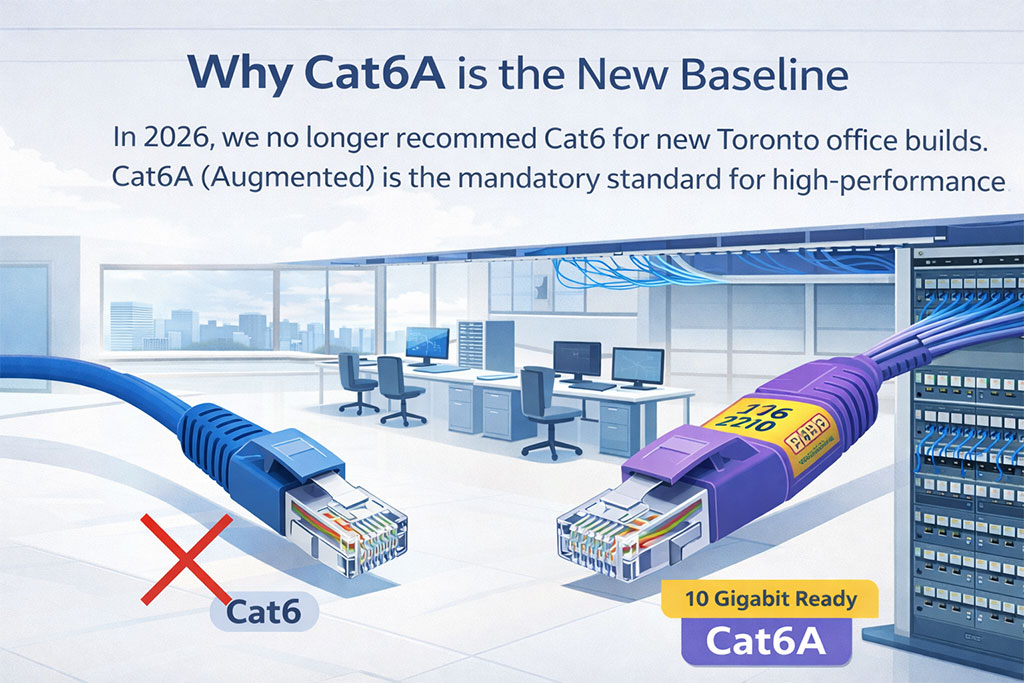
- 10-Gigabit Performance: Supports 10Gbps up to the full 100-meter channel. Cat6 only supports this speed up to 55 meters (or less in high-crosstalk environments).
- PoE++ Compatibility: 2026 office tech—including smart lighting and high-end AV—uses PoE++ (Type 4), delivering up to 90W. Cat6A’s thicker 23AWG gauge handles the heat dissipation of these loads without signal degradation.
Fiber Optics: The Office Backbone
For multi-floor offices or large industrial spaces in Mississauga, OM4 or OM5 Multimode Fiber is required to link your Main Distribution Frame (MDF) to your Intermediate Distribution Frames (IDFs).
The 2026 Relocation Checklist (Step-by-Step)

Phase 1: Planning (24 Weeks Out)
- Assemble the Task Force: Include your cabling contractor, IT manager, and the interior designer.
- Redundancy Planning: In 2026, a single internet line is a single point of failure. Plan for a secondary “failover” circuit using a different ISP (e.g., Bell Fiber as primary, Rogers Coax/Fiber as backup).
Phase 2: Infrastructure Design (16 Weeks Out)
- Create a “Heat Map”: Work with your cabling partner to conduct a predictive wireless site survey. Ensure no “dead zones” in high-traffic areas like boardrooms.
- Security Integration: Map out your CCTV and Access Control points. In 2026, these are all IP-based and run on the same structured cabling system.
Phase 3: The “Rough-In” (8 Weeks Out)
- The Pull: Ensure cables are supported by J-hooks every 4–5 feet. Never allow data cables to rest directly on ceiling tiles or HVAC ducts.
- Compliance: Every penetration through a fire-rated wall must be sealed with UL-listed fire-stop materials to meet the new 2026 standards.
Phase 4: Termination & Testing (4 Weeks Out)
- Fluke Certification: Demand a printed report for every drop. Level IIIe certification at 500 MHz is the standard for Cat6A.
- Labeling (TIA-606-C): Use the industry-standard alphanumeric scheme (Example: 1F-B12 = 1st Floor, Panel B, Port 12). Proper labeling reduces future troubleshooting time by 80%.
AI-Ready Server Rooms & Edge Computing
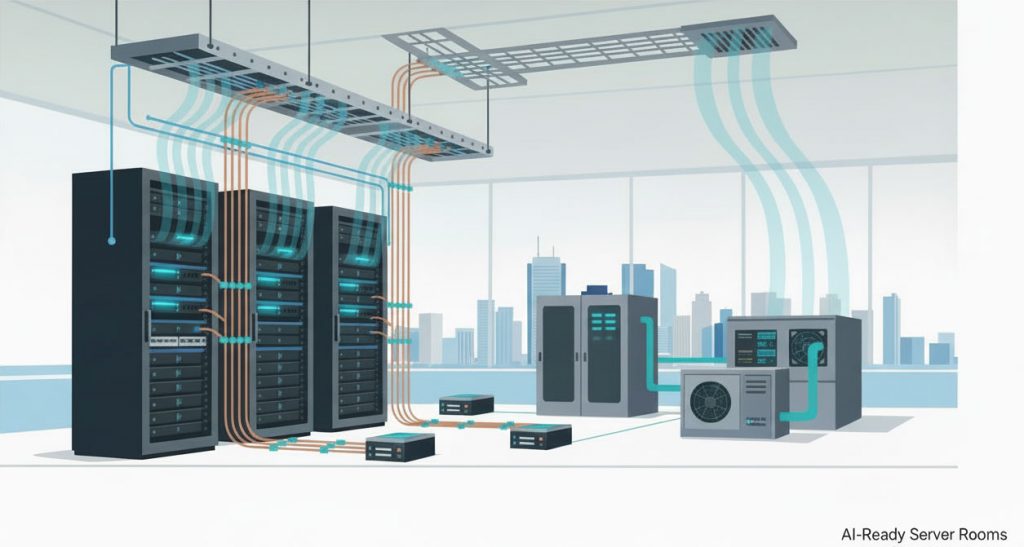
In 2026, many Toronto firms are keeping “Inference” servers on-site for data privacy.
- High-Density Racks: AI workloads require specialized racks with improved airflow.
- Active Copper Solutions: For short-reach connections (under 7 meters), active copper cables offer power advantages over optical options in high-density AI clusters.
- Cooling Requirements: Ensure your MDF has dedicated HVAC. A standard storage closet will cause 2026-era GPUs to overheat and fail.
Build Your 2026 Backbone Today
An office relocation is more than a change of address; it is the moment you decide how fast your business can grow. In 2026, your cabling isn’t just “wires”—it is the nervous system of your company.
Don’t Leave Your Move to Chance
We have helped hundreds of Toronto businesses navigate the complexities of office relocations. Whether you’re in Mississauga, Markham, or the Downtown Core, we specialize in high-stakes infrastructure.
Would you like a free “2026 Office Readiness Audit” for your new space? Contact our Toronto cabling experts today and let’s ensure your first day in the new office is a success.
Finalizing Your 2026 Tech Strategy
Choosing the wrong cable today means paying for a retrofit in 2028. In the competitive Toronto real estate market, a “Certified 10G Ready” office is a significant asset that increases the value of your leasehold improvements.
Summary Checklist for a Successful 2026 Move:
- 180 Days Out: Order Fiber Internet (Bell/Rogers).
- 120 Days Out: Finalize floor plans and “Heat Maps.”
- 90 Days Out: Select between UTP or STP based on a site EMI audit.
- 30 Days Out: Run cables and perform Fluke Certification.
- 7 Days Out: Move servers and test “Day One” connectivity.
Does your current office move plan account for Toronto’s high-interference environments?
Pro-Tip for Toronto Businesses: Don’t let a “broken” network be the first thing your team experiences in their new home. We specialize in zero-downtime office relocation moves across the GTA.