


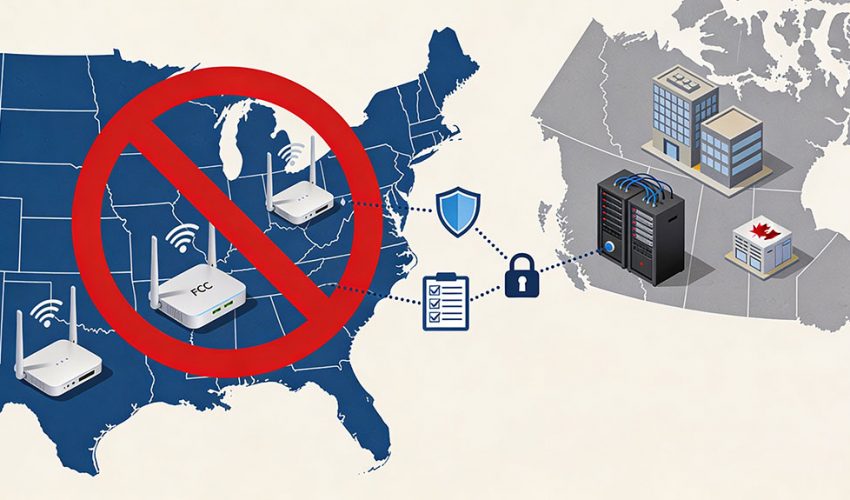
On March 23, 2026, the U.S. Federal Communications Commission made one of the most consequential decisions in networking history. The FCC updated its national security “Covered List” to include all consumer-grade routers produced in foreign countries — effectively banning any new foreign-made router models from entering the U.S. market. Without FCC equipment authorization, a device cannot be legally imported, marketed, or sold in the United States.
This ruling didn’t just shake up Silicon Valley. It sent a clear message to businesses and IT professionals across North America: the era of treating network hardware as a cheap, disposable commodity is over. And for businesses in Toronto, Mississauga, Brampton, and across the GTA, the implications are closer to home than you might expect.
html
This guide explains what the FCC router ban means, which brands are affected, why Canadian businesses are directly impacted, and what practical steps GTA businesses should take to protect their network infrastructure. It is not legal or regulatory advice.
html
What Exactly Did the FCC Do?
The FCC’s Covered List is maintained under Section 2 of the U.S. Secure Networks Act. Any device placed on this list is deemed to pose an “unacceptable risk to U.S. national security” and is barred from receiving new FCC equipment authorizations — cutting off its legal pathway into the American market entirely.
This action followed a formal determination by a White House-convened interagency panel involving the Department of Homeland Security, the Department of War, and other executive agencies with national security expertise. The panel concluded that foreign-produced routers introduce supply chain vulnerabilities that could disrupt critical infrastructure and national defense, and that the risk was unacceptable.
FCC Chairman Brendan Carr stated that foreign-produced routers posed “an unacceptable national security risk” and that the Commission was pleased to act on the Executive Branch’s determination.
One important clarification: this ban does not require you to throw away your current router. Previously authorized models can still be sold by retailers and used by consumers. Existing devices remain eligible for software updates through at least March 1, 2027. The ban applies exclusively to new device models seeking FCC authorization going forward.
The Security Threats That Triggered the Ban
This ruling didn’t come out of nowhere. Two major state-sponsored hacking campaigns were central to the FCC’s determination — and understanding them matters for any Canadian business owner thinking about their own network security posture.
Volt Typhoon
This Chinese state-backed hacking group systematically compromised small office and home office routers across the United States, building persistent hidden backdoors inside critical infrastructure including energy grids, water systems, and transportation networks. The intrusions went undetected for years precisely because the attack vector was the router itself — a device most businesses never scrutinize.
Salt Typhoon
A separate but related campaign, Salt Typhoon targeted U.S. telecommunications providers and was linked to the interception of sensitive government communications. Again, compromised network hardware served as the primary entry point. The scale and sophistication of these operations alarmed national security officials at the highest levels of the U.S. government.
“Recently, malicious state and non-state sponsored cyber attackers have increasingly leveraged the vulnerabilities in small and home office routers produced abroad to carry out direct attacks against American civilians in their homes. From disrupting network connectivity to enabling local networking espionage and intellectual property theft, foreign-produced routers present unacceptable risks to Americans.”
— FCC National Security Determination, March 2026
Which Router Brands Are Affected?
Here is the most disruptive aspect of this ruling: virtually every major consumer router brand manufactures its products overseas. This is not limited to Chinese-owned companies like TP-Link. Even iconic American-headquartered companies are caught by the ban.
| Brand | Headquarters | Manufacturing Location | Status Under New Rules |
|---|---|---|---|
| TP-Link | China | China / Vietnam | New models banned |
| Netgear | USA | Taiwan / Thailand | New models banned |
| Google Nest WiFi | USA | Taiwan / Vietnam | New models banned |
| Amazon Eero | USA | Taiwan | New models banned |
| Asus | Taiwan | Taiwan / China | New models banned |
| Linksys / Belkin | USA | Asia | New models banned |
Companies can apply for a “Conditional Approval” exemption through the Department of Homeland Security or the Department of War. However, the process requires full disclosure of management structure, supply chain details, and — most significantly — a concrete plan to move manufacturing to the United States. As of today, no major consumer router brand manufactures in America. Industry observers widely expect legal challenges from affected manufacturers given the sweeping scope of the ruling.
What This Means for Canadian Businesses
You might be thinking this is a U.S. regulatory matter with no direct relevance in Canada. It isn’t — and here’s why GTA businesses should be paying close attention right now.
Supply Chain Disruption Will Hit Canada Immediately
Canada and the U.S. share tightly integrated technology supply chains. The same router brands that dominate shelves at Best Buy and Staples in the U.S. are the same ones dominating shelves in Canada. As new model approvals dry up, manufacturing volume drops and factories retool, availability will tighten and prices will rise north of the border. Expect constraints on new router models within months.
The Same Security Vulnerabilities Exist on Canadian Networks
The state-sponsored hacking groups that targeted U.S. infrastructure — Volt Typhoon, Salt Typhoon, and others — do not confine their operations to American networks. Canadian businesses with cross-border operations, intellectual property, financial data, or any connection to critical industries face identical risks from the same compromised hardware. The Canadian Centre for Cyber Security has repeatedly flagged supply chain attacks on network hardware as a top-tier threat to Canadian organizations.
Canadian Regulation Is Likely to Follow
History shows that when the U.S. acts on cybersecurity threats, Canada follows. The Huawei 5G equipment ban in Canada came after the U.S. moved first. The same pattern is a credible near-term possibility for consumer networking hardware. Businesses that build their infrastructure on certified, professionally installed wired cabling now will be ahead of whatever regulatory curve arrives next.
Why Wired Network Infrastructure Is the Right Response
The FCC ruling is a powerful signal for businesses across the GTA to reassess their networking strategy from the ground up. Much of the vulnerability in consumer and small-business networks stems from over-reliance on wireless routers as the central nervous system of connectivity. When a router is compromised — through a firmware backdoor, a zero-day exploit, or a supply chain attack — every device on the Wi-Fi network is potentially exposed.
A professionally installed network cabling infrastructure eliminates that central vulnerability. Wired networks are physically isolated, cannot be wirelessly intercepted, and are not dependent on the firmware of a single consumer device that may have been assembled in a factory with questionable oversight.
Cat6 Cabling — The Commercial Standard
Cat6 cabling is the current standard for commercial network installations, delivering gigabit and multi-gigabit performance with significant headroom for growth. Unlike consumer routers, every run in a structured cabling system is professionally tested, certified, and documented — giving your IT team full visibility and control over your network with no dependence on foreign-manufactured consumer hardware.
Fiber Optic — The Gold Standard for Security and Performance
For businesses that demand the highest levels of performance and security, fiber optic cabling offers capabilities no consumer router can approach. Fiber transmits light rather than electrical signals, making it physically immune to electromagnetic interception. Tapping a fiber cable requires physically severing it — which immediately triggers network alerts. For backbone connections between floors or buildings, fiber is unmatched in both security and longevity.
Data Cabling Built to Last
Whether you’re running a small office in downtown Toronto or a multi-location operation across the GTA, professional data cabling provides the kind of scalable, certified infrastructure that a consumer router can never replicate. Every run is tested, labeled, and documented. For older installations, Cat5e cabling upgrades remain a cost-effective step up from legacy wiring that predates modern bandwidth demands.
Unlike consumer networking gear shipped from overseas factories with unknown firmware provenance, professionally installed cabling is physical infrastructure — verifiable, auditable, and entirely under your control. No firmware. No backdoors. No supply chain uncertainty. A properly installed structured cabling system will serve your business reliably for 15–20 years regardless of what happens to the consumer router market.
Consolidate Your Infrastructure in One Project
A network cabling installation is also the right time to address your physical security infrastructure. Cablify can integrate CCTV and security camera cabling and access control systems within the same project — reducing cost and ensuring all your infrastructure runs on consistent, certified cabling standards from day one.
Common Network Infrastructure Mistakes GTA Businesses Make — And How to Fix Them
Running the Whole Office on a Single Consumer Router
A single consumer router serving an entire office is a single point of failure for both performance and security. It is also the exact device class now identified as a national security risk by the highest levels of U.S. government. A structured cabling approach distributes connectivity through tested runs and managed switches — eliminating the single-point-of-failure problem entirely.
Fix: Have a certified network cabling specialist assess your current layout and design a proper structured cabling system sized for your space and user count.
Decade-Old Cabling That Predates Gigabit Requirements
Many Toronto commercial premises are still running on Cat5 or early Cat5e installations from the early 2000s. These cables are the bottleneck limiting your network performance regardless of what router or ISP speed you add on top. They also lack the headroom to support modern VoIP, cloud applications, and high-density Wi-Fi access points properly.
Fix: A cabling audit will identify which runs are underperforming. In most cases, a targeted Cat6 upgrade of the highest-traffic runs delivers the most immediate performance gain at the lowest cost.
No Documented Cabling Layout
Without a documented cabling plan — showing which cable runs where, what each port connects to, and where patch panels and consolidation points are located — every network change, fault diagnosis, and expansion becomes a time-consuming guessing game. This is one of the most common problems we encounter in GTA commercial properties that have been through several rounds of ad-hoc cable additions.
Fix: Professional installation includes full documentation of every run, port, and panel. If your existing infrastructure lacks this, Cablify can audit and document your current cabling as a standalone service.
Treating Fiber as a Future Upgrade Rather Than a Current Option
Many GTA businesses assume fiber optic cabling is prohibitively expensive or only relevant for large enterprises. In reality, fiber optic installation for backbone and inter-floor connections is often cost-competitive with high-grade copper — and the performance, security, and longevity advantages are significant. Fusion splicing and fiber termination services are available across the GTA at pricing that makes fiber accessible to mid-size commercial operations.
Frequently Asked Questions
Does the FCC ban affect Canada directly?
The FCC ban is a U.S. regulatory action and does not carry direct legal force in Canada. However, because the Canadian consumer router market is supplied by the same global manufacturers affected by the ban, supply availability and pricing in Canada will be significantly impacted. The underlying cybersecurity threats that motivated the ban are equally relevant to Canadian networks, and Canadian regulatory action along similar lines is possible.
Can I still buy my current router model?
Yes, for now. Previously authorized models can still be imported, sold, and used. Retailers can continue selling existing stock. The ban applies only to new models that have not yet received FCC authorization. As existing stock depletes and no new models can be authorized, availability will tighten considerably.
Is wired cabling genuinely more secure than Wi-Fi?
Yes, fundamentally. A wired connection cannot be intercepted without physical access to the cable. It is not dependent on router firmware, which is where the vulnerabilities exploited by state-sponsored hackers reside. For any business handling sensitive data, client records, financial information, or intellectual property, a wired network backbone is a baseline security requirement — not a luxury.
How long does a professional cabling installation take?
A small office with 10 to 20 drops can typically be completed in one to two days. Larger commercial installations across multiple floors may take a week or more. Cablify works around your schedule to minimize business disruption. Contact us for a free, no-obligation quote.
Does this ruling affect enterprise-grade networking equipment?
The FCC ruling specifically covers consumer-grade networking devices intended for residential use, as defined by NIST. Enterprise-grade commercial switches, routers, and firewalls are not covered by this specific ruling. However, security professionals recommend applying the same scrutiny to enterprise networking hardware — vetting manufacturer transparency, supply chain documentation, and firmware provenance regardless of regulatory requirements.
What GTA Businesses Should Do Right Now
Start by auditing every consumer-grade router currently operating across your business locations. Document the manufacturer, model, and firmware version. Pay particular attention to any TP-Link, Huawei, or older Netgear hardware flagged in previous security advisories.
Get a professional assessment of your existing cabling infrastructure. Many businesses are running on decade-old wiring that predates modern gigabit requirements. A certified network cabling specialist can identify gaps and map the most efficient upgrade path for your space and budget.
If a full upgrade isn’t immediately feasible, ensure every networking device on your premises is running the latest available firmware. The FCC has confirmed existing authorized devices remain eligible for updates through at least March 2027 — use that window to keep current hardware as secure as possible while planning your longer-term infrastructure investment.
For businesses across Mississauga, Brampton, Oakville, and Hamilton and Burlington, the same principles apply — and Cablify’s certified team serves all of these areas with the same standards we bring to every Toronto installation.
— Cablify network cabling team, Toronto
The Bottom Line
The FCC’s decision to ban all new foreign-made consumer routers is a historic acknowledgment, at the highest levels of government, that the networking hardware sitting in millions of homes and businesses represents a genuine national security vulnerability. State-sponsored actors have exploited these devices at scale. The evidence was compelling enough to prompt the most sweeping action against consumer networking hardware in U.S. telecommunications history.
For Canadian businesses, the message is clear: invest in certified, professionally installed, physically secure wired network infrastructure. It eliminates the attack surface that consumer routers create, insulates your business from the supply disruption now unfolding in the router market, and positions you ahead of the regulatory developments that are likely to follow in Canada.
Cablify has been helping Toronto and GTA businesses build exactly this kind of infrastructure for over 18 years. Certified, insured, and trusted across the region — we’re here when you’re ready to talk.
Ready to Build a Network Infrastructure That Doesn’t Depend on Foreign Consumer Hardware?
Get a free, no-obligation quote from Cablify’s certified network cabling team. Serving Toronto, Mississauga, Brampton, Oakville, Hamilton, and across the GTA.
📞 647-846-1925 · info@cablify.ca · Mon–Sat 8am–8pm