
Plenum vs Riser vs Direct Burial:
The Ultimate Cable Selection Guide
Choosing the wrong cable jacket isn’t a minor mistake — it’s a fire code violation, a failed inspection, and a network that has to be completely re-pulled. Here is exactly which cable to use in every environment.
Of all the variables in a network infrastructure project — the brand of the switch, the speed of the transceiver, the configuration of the firewall — the single most consistently overlooked is the cable jacket. Pick the wrong one and you’re not just dealing with a performance problem. You’re dealing with a fire code violation that fails inspection, an insurance liability, and a remediation bill that’s typically three to five times the original installation cost.
This guide covers every environment where low voltage copper and fiber optic cable gets installed: plenum air-handling spaces, riser shafts, outdoor aerial runs, direct burial, underwater crossings, and in-conduit applications. For each one, we’ll tell you the correct cable rating, why it matters technically and legally, the most common mistake installers make, and how to handle the transition point where environments change.
Whether you’re a network engineer speccing a multi-floor office build-out in Toronto, a contractor trenching between buildings, or a facilities manager reviewing an existing installation — this is the reference you need.
The Foundation: Cable Jacket Ratings You Must Know
Before looking at where to install, you need to understand what you’re installing. The NEC (National Electrical Code) Article 800 in the US — and equivalent Canadian Electrical Code standards — mandate specific jacket ratings based on fire safety and mechanical durability. These are not suggestions. They are enforced by fire marshals, building inspectors, and insurance underwriters.
Here are the ratings that govern every copper and fiber installation decision in this guide:
| Rating | Full Name | Use | Key Property |
|---|---|---|---|
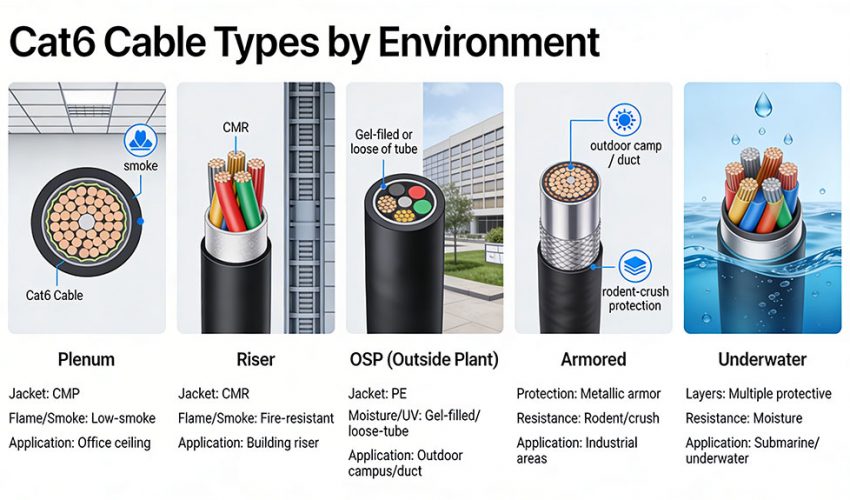
| CMP | Communications Multipurpose Plenum | Air-handling spaces, plenum ceilings | Low-smoke FEP jacket; self-extinguishing |
| CMR | Communications Multipurpose Riser | Vertical shafts between floors | Prevents vertical fire spread; no dripping |
| CM / CMG | Communications Multipurpose General | Single-floor indoor runs inside walls | Standard PVC; not rated for multi-floor |
| CMX | Communications Multipurpose Residential | Outdoor / direct burial (residential) | Must not enter building beyond 50 ft |
| OSP | Outside Plant | All commercial outdoor applications | UV-resistant PE jacket, water-blocked |
| Rating | Full Name | Copper Equivalent | Use |
|---|---|---|---|
| OFNP / OFCP | Optical Fiber Nonconductive/Conductive Plenum | CMP | Plenum ceilings, air-handling spaces |
| OFNR / OFCR | Optical Fiber Nonconductive/Conductive Riser | CMR | Vertical riser shafts between floors |
| OSP Loose Tube | Outside Plant Loose Tube Fiber | OSP | Outdoor aerial, direct burial, conduit |
Environment 1: Plenum Ceilings (Air-Handling Spaces)
In most commercial construction — especially the office towers and business parks that dominate the Toronto and GTA landscape — the space above the drop ceiling tiles is used as a “plenum” to return air to the HVAC system. This seemingly mundane architectural fact has enormous implications for cable selection.
If a fire starts in this space, a standard PVC cable jacket will release toxic hydrogen chloride gas. That gas gets pumped directly through the building’s air circulation system into every occupied room. This is not a hypothetical scenario. It is exactly why CMP (Plenum) rated cable is mandatory — not optional, not recommended, mandatory — in any air-handling space.
Plenum Ceiling — Required: CMP Copper or OFNP Fiber
CMP cables are constructed with a FEP (Fluorinated Ethylene Propylene) jacket — a fluoropolymer that chars and self-extinguishes rather than melting and spreading fire. When subjected to flame, it does not produce the toxic smoke of standard PVC. LSZH (Low Smoke Zero Halogen) with plenum rating is an alternative used in some jurisdictions.
Best use cases: Commercial office ceilings in Toronto high-rises and business parks, hospitals (strict fire codes), schools, any drop ceiling connected to HVAC return air.
The inspection reality: If a fire marshal finds CMR (riser) cable in a plenum space, they will fail the inspection. Remediation cost is typically 3–5× the original installation because every cable must be removed and re-pulled with the correct rating. We see this in GTA building retrofits regularly.
For plenum fiber runs, always specify OFNP-rated cable. Because fiber is non-conductive glass, it is often lighter and easier to pull than armored plenum copper. However, ensure any innerduct used is also plenum-rated — the jacket rating requirement extends to the conduit or raceway, not just the cable itself.
Environment 2: Riser Shafts (Vertical Between Floors)
You need to run backbone fiber from the server room on the first floor to the IDF closet on the third floor. The cable must travel through a vertical conduit or riser shaft that penetrates fire-rated floor assemblies. This is where CMR (Riser) rated cable — or its fiber equivalent OFNR — is required.
Riser cables are engineered to prevent vertical fire spread. In a fire scenario, a CMR jacket will not melt and drip burning plastic down the shaft — which would effectively carry the fire from floor to floor. The NEC is explicit: any cable that passes through a floor, even inside conduit, must be CMR or better.
CMP (Plenum) is a higher rating than CMR (Riser). You can use Plenum cable in a riser shaft legally and safely — it’s a higher-rated jacket used in a lower-rated environment. You cannot use Riser cable in a plenum space. In practice, only use Plenum in a riser if you have leftover plenum cable or if the riser shaft happens to share a plenum return-air path — which some buildings do have.
Best use cases: Multi-story office buildings and towers across the Toronto Financial District and GTA business parks, apartment complexes, backbone vertical fiber runs, elevator shafts.
Environment 3: Outdoor Aerial (Between Buildings)
Connecting two buildings on a campus. The cable will be exposed to UV radiation, temperature swings from –40°C to 50°C, and moisture. This environment demands OSP (Outside Plant) rated cable — not CMX residential, not indoor-rated cable, and certainly not any standard plenum or riser-rated copper.
Standard indoor cables, even plenum-rated, have a fatal flaw outdoors: they are not UV resistant, and they are not water-blocked. PVC exposed to direct sunlight becomes brittle and cracks within 6–12 months. Once the jacket cracks, moisture enters. In copper cable, moisture causes “water trees” — microscopic conductive paths that degrade signal integrity and eventually cause shorts. In fiber, moisture causes hydrogen corrosion and micro-bends that kill signal strength.
A standard indoor PVC-jacketed cable run outdoors — even just across an exterior wall to reach a rooftop access point — will show visible jacket cracking within 6–12 months in a Toronto climate. Once the jacket cracks, water ingress is immediate. The cable fails, often gradually and intermittently, which makes it extremely difficult to diagnose until it’s completely gone. Always use PE (polyethylene) outer jacket for any outdoor exposure.
Aerial Fiber — Self-Supporting vs. Messenger Wire
If the cable is strung on poles between buildings, it must be rated for self-support or use a messenger wire. Many OSP cables include an integrated steel messenger (figure-8 cable) that allows the cable to support its own weight between poles without sagging. For longer aerial spans or high-wind locations in Ontario, specify a separate steel messenger wire lashed to the fiber cable for maximum mechanical stability.
Environment 4: Direct Burial (Underground, No Conduit)
Burying cable directly in the earth — no conduit, no raceway — exposes it to one of the harshest environments in the installer’s world. Moisture under constant hydrostatic pressure. Rodents that actively chew through standard PVC. Rock and fill abrasion. Freeze-thaw ground movement. Ontario winters add a particularly aggressive freeze-thaw cycle that shifts soil significantly enough to snap poorly specced cable.
For direct burial, you need two things working together: water-blocking and armor.
Direct Burial — Required: Armored OSP Cable (Copper TEC or Armored Fiber)
Water blocking: Gel-filled tubes (the gold standard — gel repels water but is messy to terminate) or dry water-blocking tape using super-absorbent polymers (SAP) that swell when wet.
Armor: Corrugated Steel Tape Armor (CSTA) or Interlocked Aluminum Armor (IAA) for fiber. Heavy-duty polyethylene outer jacket. For copper, use TEC-rated cable with steel messenger or armor.
Critical warning for fiber: Armored fiber is conductive. If running between buildings with different electrical services (different ground potentials), you must use a ground isolation kit at the building entry to prevent a ground loop that can damage switching equipment.
When armored direct burial fiber connects two buildings with separate electrical services, the steel armor creates a conductive path between two different ground potentials. This can induce voltage onto the armor sufficient to damage connected equipment — and it’s an extremely common cause of mysterious switch port failures in campus environments. Ground the armor at one end only (the building with the main electrical service), or use all-dielectric fiber to eliminate the risk entirely.
Environment 5: Underwater and Submerged Installations
Camera systems at docks, sensors in retention ponds, fiber crossings under streams or drainage channels between GTA industrial campus buildings. Direct burial-rated cable is not sufficient for permanently submerged applications. Water creates constant hydrostatic pressure, and standard direct burial gel-filled cable — while rated for “soaking” — is not designed for continuous submersion, particularly in moving water with current or tidal forces.
For permanent underwater installations, the specification requirements tighten considerably:
- PE (Polyethylene) outer jacket — hydrophobic, excellent resistance to saltwater and chemicals, doesn’t absorb moisture over time
- E-Glass or aramid strength members — instead of steel, which corrodes in water over time
- Full water blocking per strand — every fiber or conductor surrounded by gel or water-blocking compound, not just the tube
- Strain relief — in moving water with current, use submarine-grade cable designed for dynamic loads; in static water (sealed conduit crossing a drainage channel), standard OSP armored is usually sufficient
For most inter-building fiber crossings under shallow features — a drainage channel, a landscaped creek, a parking lot catch basin — the correct and cost-effective solution is to run OSP armored fiber through sealed HDPE conduit. The conduit provides continuous mechanical protection; the OSP fiber handles any moisture that enters. This avoids the significant cost premium of true marine-grade cable for installations that don’t genuinely require it.
Environment 6: In Conduit — The Most Misunderstood Environment
This is where the most expensive mistakes happen. Conduit — PVC, HDPE, EMT — provides excellent mechanical protection. What it does not do is change the fire rating requirement of the cable inside it, and it does not waterproof the cable for underground runs.
Pulling Indoor CMR Cable Through Underground PVC Conduit
This is the single most common direct-burial mistake we see in GTA commercial installations. The logic seems reasonable: “The cable is in conduit, so it’s protected.” It is mechanically protected. It is not protected from water.
Underground conduits are not waterproof. They fill with water through joint seepage, end-seal failures, and condensation. Standard CMR (riser) cable is not water-blocked. Within months, the cable fails — typically through intermittent link drops that are nearly impossible to diagnose without a cable certifier. Always use OSP-rated, water-blocked cable in underground conduit. At the building entry point, transition to CMR or CMP to continue indoors.
Underground conduit acts as a chimney in a fire. If a fire starts in one building, it can travel through the conduit run to a second building if the cable is not fire-stopped at the building entry. At every point where outdoor conduit penetrates a building, install approved fire-stop material around the cable. This is an Ontario Building Code requirement and is regularly missed on GTA campus cabling projects.
Additionally, for fiber in conduit: even inside a well-sealed conduit system, use innerduct (corrugated tubing) to protect fiber from abrasion against the rough interior of PVC conduit during cable pulls and from long-term movement. Innerduct also makes future cable additions dramatically easier.
Fiber-Specific Considerations: Loose Tube vs. Tight Buffered
Fiber optic cable selection involves an additional variable that doesn’t exist with copper: the cable construction type. The jacket rating (OFNP, OFNR, OSP) tells you where the cable can be installed legally. The construction type tells you whether the glass fibers inside will actually survive the environment.
Fibers float in gel-filled tube
Outdoor, burial, extremes
Coating extruded on fiber
Indoor plenum, riser, short runs
Loose Tube: The glass fibers float in a tube larger than the fiber itself, typically filled with water-blocking gel. Because the fibers are mechanically decoupled from the jacket, they can expand and contract independently as temperature changes. This prevents micro-bends — the silent killer of fiber performance in cold environments. In Toronto winters, tight-buffered indoor fiber used outdoors will experience significant micro-bending from jacket shrinkage around the glass, causing measurable signal loss that worsens every winter. Always use loose tube for any outdoor or direct burial application.
Tight Buffered: The coating is extruded directly onto each fiber. Easier to terminate (no gel to clean), smaller diameter, lighter weight. The correct choice for indoor plenum and riser runs. Do not use outdoors.
If your installation crosses open ground in a lightning-prone area, or connects buildings with different electrical services, consider All-Dielectric Self-Supporting (ADSS) aerial fiber — no metal components whatsoever. ADSS fiber uses aramid yarn for strength instead of steel messenger wire, completely eliminating conductivity. It costs more than standard armored aerial fiber, but it removes all ground-loop and lightning-strike risk from the cabling system entirely.
Master Reference: Cable by Environment
| Environment | Copper Rating | Fiber Rating | Key Feature | Most Common Mistake |
|---|---|---|---|---|
| Plenum Ceiling | CMP | OFNP | Low-smoke FEP jacket; self-extinguishing | Using CMR to save money — fails fire inspection |
| Riser Shaft | CMR | OFNR | Prevents vertical fire spread; no drip | Using CM (general) through fire-rated floors |
| Outdoor Aerial | OSP | OSP Loose Tube | UV-resistant PE jacket; steel messenger | Using indoor PVC — UV destroys jacket in <1 year |
| Direct Burial | TEC/Armored | CSTA Armored | Gel-filled, corrugated steel armor | No armor — rodents and rocks destroy unarmored cable |
| Underwater | Marine Grade | Double Armored | PE jacket, full gel, high tensile strength | Using standard direct burial in moving water |
| Underground Conduit | OSP Water-Blocked | OSP Loose Tube | Lubricated jacket, water-blocking | Pulling indoor CMR through wet underground conduit |
| Indoor Walls | CM / CMR | OFNR | Standard PVC jacket | Using CMX (outdoor) indoors — high smoke toxicity |
The Transition Point: Where Outdoor Meets Indoor
One of the most commonly botched details in any outdoor-to-indoor cabling project is the Point of Entry (PoE) — the demarcation where outdoor cable transitions to indoor cable. Getting this wrong means either a fire code violation (outdoor jacket inside the building) or a premature cable failure (indoor jacket exposed to outdoor conditions).
The Correct Point of Entry Procedure
Step 1: Terminate the outdoor, armored, or direct burial cable in an enclosure at or just inside the building entry point. This is the transition point.
Step 2: Install a lightning protection unit (for copper) or a grounding block (for armored fiber) at this point. This protects equipment inside the building from voltage transients induced on outdoor cable runs.
Step 3: Transition to CMP (plenum) or CMR (riser) cable to continue indoors to the server room or IDF closet. Outdoor jacket (CMX or OSP) cannot extend more than 50 feet inside a building per NEC 800.113.
Step 4: Fire-stop the penetration. Any conduit or cable penetrating a fire-rated wall or floor at the building entry point must be sealed with approved fire-stop material. This is an Ontario Building Code requirement that is regularly omitted on otherwise well-executed installations.
“Air moves? Use Plenum. Floors separate? Use Riser. Water exists? Use Gel-Filled. Dirt exists? Use Armor. Sun exists? Use Polyethylene. When in doubt, go up one rating — the cost difference is pennies per foot versus thousands in remediation.”
— Structured cabling field guide, adapted for Canadian installations
The Bottom Line: Invest in the Jacket, Protect the Network
Network failures caused by environmental factors are among the most expensive and frustrating to diagnose and repair. A $1,500 switch can be replaced in an hour. A direct burial fiber cable that has been destroyed by groundwater requires a trenching crew, a backhoe, a fusion splice trailer, and thousands of dollars in labour to repair — often for a failure that could have been prevented by specifying armored gel-filled OSP cable in the first place.
The rules are straightforward once you know them. The challenge is that most building owners and facilities managers don’t know them — and some contractors prefer not to specify the more expensive correct cable because it makes their quote less competitive. Always ask your cabling contractor to specify the cable jacket rating in writing, in the quote, with the reason for that selection. If they can’t or won’t, that’s a significant red flag.
For GTA commercial projects — office build-outs, campus inter-building connections, industrial installations across Mississauga, Brampton, and Vaughan — Cablify’s structured cabling team specifies the correct cable for every environment as standard practice, with written documentation of the reasoning. We don’t cut corners on jacket ratings, and we certify every run with Fluke DSX equipment so you know what you’ve got.
Need Help Specifying the Right Cable for Your Project?
Cablify’s certified cabling team handles plenum, riser, outdoor, direct burial, and fiber installations across Toronto, Mississauga, Brampton, Oakville, and the GTA. Free onsite consultation and quote.
📞 647-846-1925 · info@cablify.ca · Mon–Sat 8am–8pm