<?xml version="1.0" encoding="UTF-8"?><rss version="2.0"
	xmlns:content="http://purl.org/rss/1.0/modules/content/"
	xmlns:wfw="http://wellformedweb.org/CommentAPI/"
	xmlns:dc="http://purl.org/dc/elements/1.1/"
	xmlns:atom="http://www.w3.org/2005/Atom"
	xmlns:sy="http://purl.org/rss/1.0/modules/syndication/"
	xmlns:slash="http://purl.org/rss/1.0/modules/slash/"
	>

<channel>
	<title>PoE++ 802.3bt Archives - Cablify</title>
	<atom:link href="https://www.cablify.ca/tag/poe-802-3bt/feed/" rel="self" type="application/rss+xml" />
	<link>https://www.cablify.ca/tag/poe-802-3bt/</link>
	<description></description>
	<lastBuildDate>Fri, 01 May 2026 14:59:29 +0000</lastBuildDate>
	<language>en-CA</language>
	<sy:updatePeriod>
	hourly	</sy:updatePeriod>
	<sy:updateFrequency>
	1	</sy:updateFrequency>
	<generator>https://wordpress.org/?v=7.0</generator>
	<item>
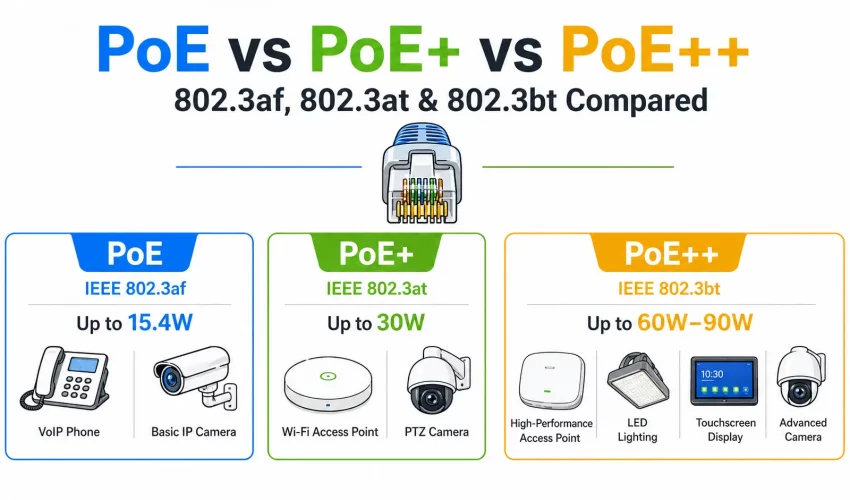
		<title>PoE vs PoE+ vs PoE++: 802.3af, 802.3at &#038; 802.3bt Compared</title>
		<link>https://www.cablify.ca/poe-vs-poe-plus-vs-poe-plus-plus-explained/</link>
		
		<dc:creator><![CDATA[HP]]></dc:creator>
		<pubDate>Wed, 29 Apr 2026 02:58:57 +0000</pubDate>
				<category><![CDATA[Networking]]></category>
		<category><![CDATA[802.3af vs 802.3at]]></category>
		<category><![CDATA[802.3bt Type 3]]></category>
		<category><![CDATA[802.3bt Type 4]]></category>
		<category><![CDATA[Cat6A PoE]]></category>
		<category><![CDATA[PoE budget calculator]]></category>
		<category><![CDATA[PoE cable requirements]]></category>
		<category><![CDATA[PoE vs PoE+]]></category>
		<category><![CDATA[PoE++ 802.3bt]]></category>
		<category><![CDATA[power over ethernet standards]]></category>
		<guid isPermaLink="false">https://www.cablify.ca/?p=8027</guid>

					<description><![CDATA[<p>Understand PoE, PoE+, and PoE++ in plain language. Complete comparison of 802.3af, 802.3at, and 802.3bt standards — power levels, cable requirements, supported devices, and a free interactive PoE budget calculator.</p>
<p>The post <a href="https://www.cablify.ca/poe-vs-poe-plus-vs-poe-plus-plus-explained/">PoE vs PoE+ vs PoE++: 802.3af, 802.3at &#038; 802.3bt Compared</a> appeared first on <a href="https://www.cablify.ca">Cablify</a>.</p>
]]></description>
										<content:encoded><![CDATA[<style>
@import url('https://fonts.googleapis.com/css2?family=JetBrains+Mono:wght@400;500&display=swap');
#cb-rbar{position:fixed;top:0;left:0;height:3px;width:0%;background:linear-gradient(90deg,#fbd232,#f5a623);z-index:99999;transition:width .1s linear}
.cb-wrap{color:#2b3340;line-height:1.75;max-width:100%}
.cb-wrap h2{font-size:26px;font-weight:700;color:#0d1117;margin:48px 0 16px;padding-top:40px;border-top:1px solid #e2e8f0;scroll-margin-top:80px}
.cb-wrap h2.first-h2{margin-top:0;padding-top:0;border-top:none}
.cb-wrap h3{font-size:19px;font-weight:600;color:#2b3340;margin:32px 0 12px}
.cb-wrap p{font-size:16px;line-height:1.8;color:#2b3340;margin-bottom:16px}
.cb-wrap ul,.cb-wrap ol{margin:14px 0 18px 22px}
.cb-wrap li{font-size:16px;line-height:1.75;color:#2b3340;margin-bottom:7px}
.cb-wrap a{color:#b8910a;text-decoration:underline;text-decoration-color:rgba(251,210,50,.5)}
.cb-stat-row{display:grid;grid-template-columns:repeat(auto-fit,minmax(130px,1fr));gap:10px;margin:28px 0 36px}
.cb-stat{background:#f7f9fc;border:1px solid #e2e8f0;border-radius:10px;padding:16px;border-left:4px solid #fbd232}
.cb-stat-val{font-size:28px;font-weight:700;color:#fbd232;line-height:1;margin-bottom:4px}
.cb-stat-val span{font-size:15px;color:#b8910a}
.cb-stat-lbl{font-size:11px;font-family:'JetBrains Mono',Consolas,monospace;letter-spacing:.06em;text-transform:uppercase;color:#718096}
.cb-toc{background:#f7f9fc;border:1px solid #e2e8f0;border-left:4px solid #fbd232;border-radius:8px;padding:22px 26px;margin:32px 0}
.cb-toc-title{font-size:12px;font-weight:700;letter-spacing:.1em;text-transform:uppercase;color:#4a5568;margin-bottom:14px}
.cb-toc ol{list-style:none;counter-reset:toc;margin:0;padding:0}
.cb-toc li{counter-increment:toc;margin-bottom:6px;font-size:14px}
.cb-toc li::before{content:counter(toc,decimal-leading-zero)'.';font-family:'JetBrains Mono',Consolas,monospace;font-size:11px;color:#fbd232;margin-right:8px}
.cb-toc a{color:#2b3340;text-decoration:none;font-weight:500}
.cb-toc a:hover{color:#b8910a}
.cb-callout{border-radius:12px;padding:20px 24px;margin:28px 0;border-left:4px solid}
.cb-blue{background:#fffce8;border-color:#fbd232}
.cb-orange{background:#fff4ef;border-color:#e05a1a}
.cb-green{background:#ecfdf5;border-color:#0d7c4e}
.cb-amber{background:#fffbeb;border-color:#b45309}
.cb-red{background:#fef2f2;border-color:#c0392b}
.cb-callout-lbl{font-family:'JetBrains Mono',Consolas,monospace;font-size:10px;font-weight:500;letter-spacing:.12em;text-transform:uppercase;margin-bottom:7px}
.cb-blue .cb-callout-lbl{color:#b8910a}
.cb-orange .cb-callout-lbl{color:#e05a1a}
.cb-green .cb-callout-lbl{color:#0d7c4e}
.cb-amber .cb-callout-lbl{color:#b45309}
.cb-red .cb-callout-lbl{color:#c0392b}
.cb-callout p{margin:0;font-size:15px}
.cb-table-wrap{overflow-x:auto;margin:24px 0;border-radius:12px;border:1px solid #e2e8f0;box-shadow:0 1px 3px rgba(0,0,0,.06)}
.cb-table{width:100%;border-collapse:collapse;font-size:13.5px}
.cb-table thead{background:#0d1117;color:#fff}
.cb-table thead th{font-weight:600;font-size:11.5px;letter-spacing:.06em;text-transform:uppercase;padding:12px 14px;text-align:left;white-space:nowrap}
.cb-table tbody tr{border-bottom:1px solid #e2e8f0;transition:background .15s}
.cb-table tbody tr:hover{background:#f7f9fc}
.cb-table tbody tr:last-child{border-bottom:none}
.cb-table tbody td{padding:12px 14px;font-size:13px;color:#2b3340;vertical-align:top}
.cb-table tbody td:first-child{font-weight:600;color:#0d1117}
.cb-mono{font-family:'JetBrains Mono',Consolas,monospace;font-size:12px;color:#b8910a;font-weight:500}
.cb-rec-row{background:#fffce8}
.cb-pill{display:inline-flex;align-items:center;justify-content:center;font-family:'JetBrains Mono',Consolas,monospace;font-size:11px;font-weight:500;padding:3px 10px;border-radius:100px;white-space:nowrap}
.cb-p-y{background:#fbd232;color:#111}
.cb-p-green{background:#0d7c4e;color:#fff}
.cb-p-orange{background:#e05a1a;color:#fff}
.cb-p-red{background:#c0392b;color:#fff}
.cb-faq-item{border-bottom:1px solid #e2e8f0}
.cb-faq-q{width:100%;background:none;border:none;padding:18px 0;text-align:left;cursor:pointer;display:flex;align-items:flex-start;justify-content:space-between;gap:14px;font-size:15px;font-weight:600;color:#0d1117;line-height:1.4;transition:color .2s}
.cb-faq-q:hover{color:#b8910a}
.cb-faq-icon{flex-shrink:0;width:22px;height:22px;border-radius:50%;background:#eef2f7;display:flex;align-items:center;justify-content:center;transition:background .2s,transform .3s;margin-top:1px;font-size:14px;color:#4a5568;font-weight:300}
.cb-faq-item.cb-open .cb-faq-icon{background:#fbd232;color:#111;transform:rotate(45deg)}
.cb-faq-a{overflow:hidden;max-height:0;transition:max-height .35s ease}
.cb-faq-item.cb-open .cb-faq-a{max-height:800px}
.cb-faq-a-inner{padding-bottom:18px;font-size:15px;color:#4a5568;line-height:1.75}
.cb-cta{background:linear-gradient(135deg,#111 0%,#1a1a1a 100%);border:1px solid rgba(251,210,50,0.3);border-radius:16px;padding:44px 40px;color:#fff;text-align:center;margin:48px 0 20px;position:relative;overflow:hidden}
.cb-cta::before{content:'';position:absolute;inset:0;background:repeating-linear-gradient(45deg,transparent,transparent 30px,rgba(251,210,50,0.03) 30px,rgba(251,210,50,0.03) 31px)}
.cb-cta h2{font-size:28px;font-weight:800;letter-spacing:-.01em;margin-bottom:12px;position:relative;color:#fff;border:none;padding:0;margin-top:0}
.cb-cta p{font-size:16px;color:rgba(255,255,255,.7);margin-bottom:24px;max-width:480px;margin-left:auto;margin-right:auto;position:relative}
.cb-cta-btns{display:flex;justify-content:center;flex-wrap:wrap;gap:10px;position:relative}
.cb-cta-btn1{background:#fbd232;color:#111;font-size:14px;font-weight:700;padding:13px 26px;border-radius:8px;text-decoration:none;display:inline-flex;align-items:center;gap:6px;transition:transform .15s,box-shadow .15s}
.cb-cta-btn1:hover{transform:translateY(-2px);box-shadow:0 8px 24px rgba(251,210,50,0.35);color:#111;text-decoration:none}
.cb-cta-btn2{background:rgba(255,255,255,.08);color:#fff;font-size:14px;font-weight:600;padding:13px 26px;border-radius:8px;text-decoration:none;border:1px solid rgba(255,255,255,.2);display:inline-flex;align-items:center;gap:6px;transition:background .15s}
.cb-cta-btn2:hover{background:rgba(255,255,255,.15);color:#fff;text-decoration:none}
.cb-author{display:flex;gap:18px;align-items:flex-start;background:#f7f9fc;border:1px solid #e2e8f0;border-radius:12px;padding:22px 26px;margin-top:40px}
.cb-author-av{width:52px;height:52px;border-radius:50%;background:#fbd232;display:flex;align-items:center;justify-content:center;font-size:18px;font-weight:700;color:#111;flex-shrink:0}
.cb-author-name{font-size:15px;font-weight:700;color:#0d1117;margin-bottom:2px}
.cb-author-title{font-family:'JetBrains Mono',Consolas,monospace;font-size:11px;letter-spacing:.06em;color:#b8910a;margin-bottom:8px}
.cb-author-bio{font-size:14px;color:#4a5568;line-height:1.65;margin:0}
.cb-divider{display:flex;align-items:center;gap:14px;margin:40px 0 24px;font-family:'JetBrains Mono',Consolas,monospace;font-size:11px;letter-spacing:.1em;text-transform:uppercase;color:#a0aec0}
.cb-divider::before,.cb-divider::after{content:'';flex:1;height:1px;background:#e2e8f0}
.cb-poe-card-grid{display:grid;grid-template-columns:repeat(auto-fit,minmax(210px,1fr));gap:14px;margin:28px 0}
.cb-poe-card{border-radius:12px;overflow:hidden;border:1px solid #e2e8f0}
.cb-poe-card-head{padding:18px 20px 14px;border-bottom:1px solid rgba(255,255,255,.1)}
.cb-poe-card-badge{font-family:'JetBrains Mono',Consolas,monospace;font-size:10px;font-weight:600;letter-spacing:.1em;text-transform:uppercase;margin-bottom:8px;opacity:.7}
.cb-poe-card-std{font-size:22px;font-weight:800;color:#fff;margin-bottom:2px}
.cb-poe-card-ieee{font-family:'JetBrains Mono',Consolas,monospace;font-size:11px;color:rgba(255,255,255,.5);letter-spacing:.06em}
.cb-poe-card-body{padding:16px 20px;background:#fff}
.cb-poe-card-power{font-family:'JetBrains Mono',Consolas,monospace;font-size:28px;font-weight:700;line-height:1;margin-bottom:2px}
.cb-poe-card-power-lbl{font-family:'JetBrains Mono',Consolas,monospace;font-size:10px;letter-spacing:.08em;text-transform:uppercase;color:#718096;margin-bottom:12px}
.cb-poe-card-detail{font-size:12.5px;color:#4a5568;line-height:1.5;margin-bottom:8px}
.cb-poe-card-detail strong{color:#0d1117;font-weight:600}
.cb-poe-card-tags{display:flex;flex-wrap:wrap;gap:4px;margin-top:10px}
.cb-poe-tag{font-family:'JetBrains Mono',Consolas,monospace;font-size:10px;padding:2px 7px;border-radius:3px;background:#f0f4f8;color:#4a5568}
@media(max-width:640px){.cb-cta{padding:32px 22px}.cb-cta h2{font-size:22px}.cb-author{flex-direction:column}.cb-poe-card-grid{grid-template-columns:1fr 1fr}}
</style>
<div id="cb-rbar" role="progressbar" aria-label="Reading progress"></div>
<div class="cb-wrap">
<div class="cb-stat-row">
<div class="cb-stat">
<div class="cb-stat-val">15.4<span>W</span></div>
<div class="cb-stat-lbl">PoE 802.3af</div>
</div>
<div class="cb-stat">
<div class="cb-stat-val">30<span>W</span></div>
<div class="cb-stat-lbl">PoE+ 802.3at</div>
</div>
<div class="cb-stat">
<div class="cb-stat-val">60<span>W</span></div>
<div class="cb-stat-lbl">PoE++ Type 3</div>
</div>
<div class="cb-stat">
<div class="cb-stat-val">100<span>W</span></div>
<div class="cb-stat-lbl">PoE++ Type 4</div>
</div>
</div>
<nav class="cb-toc" aria-label="Table of contents">
<div class="cb-toc-title">In This Guide</div>
<ol>
<li><a href="#cb-s1">How PoE Works: PSE, PD &amp; Powered Pairs</a></li>
<li><a href="#cb-s2">The 4 Standards at a Glance</a></li>
<li><a href="#cb-s3">802.3af &#8212; PoE (15.4W)</a></li>
<li><a href="#cb-s4">802.3at &#8212; PoE+ (30W)</a></li>
<li><a href="#cb-s5">802.3bt Type 3 &#8212; PoE++ (60W)</a></li>
<li><a href="#cb-s6">802.3bt Type 4 &#8212; PoE++ (100W)</a></li>
<li><a href="#cb-s7">Free Interactive PoE Budget Calculator</a></li>
<li><a href="#cb-s8">Cable Requirements &amp; Thermal Considerations</a></li>
<li><a href="#cb-s9">Which PoE Standard Do You Need?</a></li>
<li><a href="#cb-s10">7 Common PoE Planning Mistakes</a></li>
<li><a href="#cb-s11">Frequently Asked Questions</a></li>
</ol>
</nav>
<h2 class="first-h2" id="cb-s1">How PoE Works: PSE, PD &amp; Powered Pairs Explained</h2>
<p>Power over Ethernet lets a single Cat5e/Cat6/Cat6A cable carry both network data and electrical power simultaneously &#8212; eliminating the separate power adapter at every networked device.</p>
<p>The system operates through two roles defined in the IEEE 802.3 standard family:</p>
<ul>
<li><strong>PSE (Power Sourcing Equipment):</strong> The device that supplies power &#8212; a PoE-capable network switch or a standalone PoE injector. The PSE detects whether the connected device supports PoE before delivering any power.</li>
<li><strong>PD (Powered Device):</strong> The device that receives power &#8212; an IP camera, VoIP phone, wireless access point, access control reader, or any device built to consume PoE.</li>
</ul>
<div class="cb-callout cb-blue">
<div class="cb-callout-lbl">Critical Safety Mechanism</div>
<p>IEEE 802.3 requires every PSE to perform a <strong>detection and classification handshake</strong> before delivering power. The PSE sends a low-voltage probe; if no valid PD signature is detected, no power is delivered. Standard ethernet devices plugged into a PoE port receive data only &#8212; they cannot be damaged by a compliant PSE.</p>
</div>
<h3>How Power Is Delivered: 2-Pair vs. 4-Pair</h3>
<ul>
<li><strong>Mode A:</strong> Power on data pairs (1/2 and 3/6). DC power is superimposed via centre-tap transformer. Used by 802.3af and 802.3at.</li>
<li><strong>Mode B:</strong> Power on spare pairs (4/5 and 7/8). Also used by 802.3af and 802.3at.</li>
<li><strong>4-Pair (802.3bt):</strong> All four pairs carry power simultaneously, enabling 60W and 100W. This is why Cat6A is mandatory for PoE++ &#8212; the cable must handle power on all 4 pairs without thermal or signal degradation.</li>
</ul>
<h3>PD Classification: How the Switch Allocates Power per Port</h3>
<div class="cb-table-wrap">
<table class="cb-table">
<thead>
<tr>
<th>Class</th>
<th>Standard</th>
<th>Max PD Power</th>
<th>Max PSE Output</th>
<th>Typical Use</th>
</tr>
</thead>
<tbody>
<tr>
<td>Class 0</td>
<td class="cb-mono">Default</td>
<td>12.95W</td>
<td>15.4W</td>
<td>Legacy / unclassified</td>
</tr>
<tr>
<td>Class 1</td>
<td class="cb-mono">802.3af</td>
<td>3.84W</td>
<td>4W</td>
<td>Low-power sensors</td>
</tr>
<tr>
<td>Class 2</td>
<td class="cb-mono">802.3af</td>
<td>6.49W</td>
<td>7W</td>
<td>IP phones, basic cameras</td>
</tr>
<tr class="cb-rec-row">
<td>Class 3</td>
<td class="cb-mono">802.3af</td>
<td>12.95W</td>
<td>15.4W</td>
<td>Most cameras, phones</td>
</tr>
<tr>
<td>Class 4</td>
<td class="cb-mono">802.3at</td>
<td>25.5W</td>
<td>30W</td>
<td>WAPs, PTZ cameras</td>
</tr>
<tr>
<td>Class 5</td>
<td class="cb-mono">802.3bt</td>
<td>40W</td>
<td>45W</td>
<td>Smart lighting, video conf</td>
</tr>
<tr>
<td>Class 6</td>
<td class="cb-mono">802.3bt</td>
<td>51W</td>
<td>60W</td>
<td>High-power WAPs</td>
</tr>
<tr>
<td>Class 7</td>
<td class="cb-mono">802.3bt</td>
<td>62W</td>
<td>75W</td>
<td>Displays, advanced APs</td>
</tr>
<tr>
<td>Class 8</td>
<td class="cb-mono">802.3bt</td>
<td>71.3W</td>
<td>100W</td>
<td>LCD panels, workstations</td>
</tr>
</tbody>
</table>
</div>
<h2 id="cb-s2">The 4 Standards at a Glance</h2>
<div class="cb-table-wrap">
<table class="cb-table">
<thead>
<tr>
<th>Specification</th>
<th>PoE</th>
<th>PoE+</th>
<th>PoE++ Type 3</th>
<th>PoE++ Type 4</th>
</tr>
</thead>
<tbody>
<tr>
<td>IEEE Standard</td>
<td class="cb-mono">802.3af</td>
<td class="cb-mono">802.3at</td>
<td class="cb-mono">802.3bt-2018</td>
</tr>
<tr>
<td>Year Ratified</td>
<td>2003</td>
<td>2009</td>
<td>2018</td>
<td>2018</td>
</tr>
<tr>
<td>Max PSE Output</td>
<td><span class="cb-pill cb-p-green">15.4W</span></td>
<td><span class="cb-pill cb-p-y">30W</span></td>
<td><span class="cb-pill cb-p-orange">60W</span></td>
<td><span class="cb-pill cb-p-red">100W</span></td>
</tr>
<tr>
<td>Max PD Usable Power</td>
<td>12.95W</td>
<td>25.5W</td>
<td>51W</td>
<td>71.3W</td>
</tr>
<tr>
<td>Powered Pairs</td>
<td>2 pairs</td>
<td>2 pairs</td>
<td>4 pairs</td>
<td>4 pairs</td>
</tr>
<tr>
<td>Max Current per Pair</td>
<td>350mA</td>
<td>600mA</td>
<td>600mA</td>
<td>960mA</td>
</tr>
<tr class="cb-rec-row">
<td>Min Cable Grade</td>
<td>Cat3</td>
<td>Cat5e</td>
<td><strong>Cat6 (Cat6A preferred)</strong></td>
<td><strong>Cat6A mandatory</strong></td>
</tr>
<tr>
<td>Backward Compatible?</td>
<td>Baseline</td>
<td>Yes &#8212; with 802.3af PDs</td>
<td>Yes &#8212; all prior standards</td>
</tr>
<tr>
<td>Switch Budget Impact</td>
<td>Low</td>
<td>Moderate</td>
<td>High</td>
<td>Very High</td>
</tr>
</tbody>
</table>
</div>
<div style="background:#0f1117;border:1px solid rgba(251,210,50,0.25);border-radius:14px;overflow:hidden;margin:32px 0">
<div style="display:flex;align-items:center;gap:12px;padding:14px 24px;background:rgba(251,210,50,0.07);border-bottom:1px solid rgba(251,210,50,0.15)">
    <span style="font-family:'JetBrains Mono',monospace;font-size:10px;font-weight:600;letter-spacing:.1em;padding:4px 10px;border-radius:4px;background:rgba(251,210,50,0.15);color:#fbd232;border:1px solid rgba(251,210,50,0.35);text-transform:uppercase">Power Budget</span><br />
    <span style="font-size:13px;font-weight:600;color:rgba(255,255,255,0.65);font-family:Poppins,sans-serif">Power Loss Across a 100m Cable Run (PSE &#8594; PD)</span>
  </div>
<div style="display:grid;grid-template-columns:repeat(4,1fr)">
<div style="padding:22px 20px;border-right:1px solid rgba(255,255,255,0.07)">
<div style="font-family:'JetBrains Mono',monospace;font-size:10px;color:rgba(251,210,50,0.5);letter-spacing:.1em;margin-bottom:7px">802.3af</div>
<div style="font-family:'JetBrains Mono',monospace;font-size:24px;font-weight:700;color:#fbd232;margin-bottom:3px">15.4W</div>
<div style="font-family:'JetBrains Mono',monospace;font-size:11px;color:rgba(255,255,255,0.3);margin-bottom:12px">PSE output</div>
<div style="margin-bottom:10px;padding:10px 12px;background:rgba(0,0,0,0.4);border-radius:6px">
<div style="font-family:'JetBrains Mono',monospace;font-size:11px;color:rgba(255,255,255,0.4);margin-bottom:4px">Cable loss</div>
<div style="font-family:'JetBrains Mono',monospace;font-size:14px;color:#fb923c">&#8722;2.45W</div></div>
<div style="font-family:'JetBrains Mono',monospace;font-size:16px;font-weight:700;color:#34d399">12.95W</div>
<div style="font-size:11px;color:rgba(255,255,255,0.4);font-family:Poppins,sans-serif">at PD</div></div>
<div style="padding:22px 20px;border-right:1px solid rgba(255,255,255,0.07);background:rgba(251,210,50,0.04)">
<div style="font-family:'JetBrains Mono',monospace;font-size:10px;color:rgba(251,210,50,0.5);letter-spacing:.1em;margin-bottom:7px">802.3at</div>
<div style="font-family:'JetBrains Mono',monospace;font-size:24px;font-weight:700;color:#fbd232;margin-bottom:3px">30W</div>
<div style="font-family:'JetBrains Mono',monospace;font-size:11px;color:rgba(255,255,255,0.3);margin-bottom:12px">PSE output</div>
<div style="margin-bottom:10px;padding:10px 12px;background:rgba(0,0,0,0.4);border-radius:6px">
<div style="font-family:'JetBrains Mono',monospace;font-size:11px;color:rgba(255,255,255,0.4);margin-bottom:4px">Cable loss</div>
<div style="font-family:'JetBrains Mono',monospace;font-size:14px;color:#fb923c">&#8722;4.5W</div></div>
<div style="font-family:'JetBrains Mono',monospace;font-size:16px;font-weight:700;color:#34d399">25.5W</div>
<div style="font-size:11px;color:rgba(255,255,255,0.4);font-family:Poppins,sans-serif">at PD</div></div>
<div style="padding:22px 20px;border-right:1px solid rgba(255,255,255,0.07)">
<div style="font-family:'JetBrains Mono',monospace;font-size:10px;color:rgba(251,210,50,0.5);letter-spacing:.1em;margin-bottom:7px">802.3bt T3</div>
<div style="font-family:'JetBrains Mono',monospace;font-size:24px;font-weight:700;color:#fbd232;margin-bottom:3px">60W</div>
<div style="font-family:'JetBrains Mono',monospace;font-size:11px;color:rgba(255,255,255,0.3);margin-bottom:12px">PSE output</div>
<div style="margin-bottom:10px;padding:10px 12px;background:rgba(0,0,0,0.4);border-radius:6px">
<div style="font-family:'JetBrains Mono',monospace;font-size:11px;color:rgba(255,255,255,0.4);margin-bottom:4px">Cable loss</div>
<div style="font-family:'JetBrains Mono',monospace;font-size:14px;color:#fb923c">&#8722;9W</div></div>
<div style="font-family:'JetBrains Mono',monospace;font-size:16px;font-weight:700;color:#34d399">51W</div>
<div style="font-size:11px;color:rgba(255,255,255,0.4);font-family:Poppins,sans-serif">at PD</div></div>
<div style="padding:22px 20px">
<div style="font-family:'JetBrains Mono',monospace;font-size:10px;color:rgba(251,210,50,0.5);letter-spacing:.1em;margin-bottom:7px">802.3bt T4</div>
<div style="font-family:'JetBrains Mono',monospace;font-size:24px;font-weight:700;color:#fbd232;margin-bottom:3px">100W</div>
<div style="font-family:'JetBrains Mono',monospace;font-size:11px;color:rgba(255,255,255,0.3);margin-bottom:12px">PSE output</div>
<div style="margin-bottom:10px;padding:10px 12px;background:rgba(0,0,0,0.4);border-radius:6px">
<div style="font-family:'JetBrains Mono',monospace;font-size:11px;color:rgba(255,255,255,0.4);margin-bottom:4px">Cable loss</div>
<div style="font-family:'JetBrains Mono',monospace;font-size:14px;color:#fb923c">&#8722;20.7W</div></div>
<div style="font-family:'JetBrains Mono',monospace;font-size:16px;font-weight:700;color:#34d399">71.3W</div>
<div style="font-size:11px;color:rgba(255,255,255,0.4);font-family:Poppins,sans-serif">at PD</div></div></div>
</div>
<h2 id="cb-s3">802.3af &#8212; PoE (15.4W): The Original Standard</h2>
<p>Ratified by IEEE in <strong>2003</strong>, 802.3af was the first standardized Power over Ethernet specification. It defined the fundamental framework all subsequent standards build upon &#8212; the detection handshake, the classification system, and the 2-pair power delivery model.</p>
<div class="cb-poe-card-grid">
<div class="cb-poe-card">
<div class="cb-poe-card-head" style="background:#1a1a2e">
<div class="cb-poe-card-badge" style="color:rgba(251,210,50,.7)">802.3af</div>
<div class="cb-poe-card-std">PoE</div>
<div class="cb-poe-card-ieee">IEEE 802.3af &#8212; 2003</div></div>
<div class="cb-poe-card-body">
<div class="cb-poe-card-power" style="color:#0d7c4e">15.4W</div>
<div class="cb-poe-card-power-lbl">Max PSE Output / 12.95W at PD</div>
<div class="cb-poe-card-detail"><strong>Pairs used:</strong> 2 (Mode A or B)</div>
<div class="cb-poe-card-detail"><strong>Min cable:</strong> Cat3 (Cat5e recommended)</div>
<div class="cb-poe-card-detail"><strong>Current limit:</strong> 350mA per pair</div>
<div class="cb-poe-card-detail"><strong>Voltage range:</strong> 44&#8211;57V DC</div>
<div class="cb-poe-card-tags"><span class="cb-poe-tag">IP cameras</span><span class="cb-poe-tag">VoIP phones</span><span class="cb-poe-tag">access control</span><span class="cb-poe-tag">IoT sensors</span></div></div></div>
</div>
<div class="cb-callout cb-green">
<div class="cb-callout-lbl">Still Relevant in 2025</div>
<p>Despite being over 20 years old, 802.3af covers the majority of deployed PoE devices: basic IP cameras (5&#8211;12W), all standard VoIP phones (3&#8211;8W), access control readers (2&#8211;5W), and IoT sensors. Don&#8217;t over-specify &#8212; a 30W PoE+ port wasted on a 6W camera is unnecessary switch budget cost.</p>
</div>
<h3>Real-World Power at 802.3af</h3>
<ul>
<li><strong>IP camera (fixed, 1080p):</strong> 5&#8211;9W</li>
<li><strong>IP camera (fixed, 4K):</strong> 10&#8211;13W</li>
<li><strong>VoIP phone (basic):</strong> 3&#8211;5W</li>
<li><strong>VoIP phone (color display):</strong> 6&#8211;9W</li>
<li><strong>Access control reader:</strong> 2&#8211;5W</li>
<li><strong>IoT/environmental sensor:</strong> 1&#8211;4W</li>
<li><strong>Basic WAP (single-band):</strong> 8&#8211;12W</li>
</ul>
<h2 id="cb-s4">802.3at &#8212; PoE+ (30W): The Commercial Sweet Spot</h2>
<p>The 802.3at amendment, ratified in <strong>2009</strong>, doubled the available power to 30W by increasing the current limit from 350mA to 600mA per pair. It maintains full backward compatibility with 802.3af &#8212; every PoE+ port can power any 802.3af device without reconfiguration.</p>
<div class="cb-poe-card-grid">
<div class="cb-poe-card">
<div class="cb-poe-card-head" style="background:#1a2e1a">
<div class="cb-poe-card-badge" style="color:rgba(251,210,50,.7)">802.3at</div>
<div class="cb-poe-card-std">PoE+</div>
<div class="cb-poe-card-ieee">IEEE 802.3at &#8212; 2009</div></div>
<div class="cb-poe-card-body">
<div class="cb-poe-card-power" style="color:#b8910a">30W</div>
<div class="cb-poe-card-power-lbl">Max PSE Output / 25.5W at PD</div>
<div class="cb-poe-card-detail"><strong>Pairs used:</strong> 2 (Mode A or B)</div>
<div class="cb-poe-card-detail"><strong>Min cable:</strong> Cat5e (Cat6 recommended)</div>
<div class="cb-poe-card-detail"><strong>Current limit:</strong> 600mA per pair</div>
<div class="cb-poe-card-detail"><strong>Voltage range:</strong> 50&#8211;57V DC</div>
<div class="cb-poe-card-tags"><span class="cb-poe-tag">enterprise WAPs</span><span class="cb-poe-tag">PTZ cameras</span><span class="cb-poe-tag">video conf</span><span class="cb-poe-tag">thin clients</span></div></div></div>
</div>
<p>PoE+ is the dominant standard in modern commercial deployments. It powers enterprise-grade wireless access points (15&#8211;25W), PTZ security cameras, video conferencing endpoints, and thin-client terminals. For any new office switch deployment today, PoE+ on all ports is the professional standard recommendation.</p>
<div class="cb-callout cb-amber">
<div class="cb-callout-lbl">Specifier Note</div>
<p>Many switches advertise &#8220;PoE+&#8221; but have a limited <strong>total PoE budget</strong> that can&#8217;t deliver 30W on all ports simultaneously. A 24-port PoE+ switch with a 185W budget can only sustain full 30W on about 6 ports at once. Always check the total switch PoE budget &#8212; not just the per-port maximum.</p>
</div>
<h3>Real-World Power at 802.3at</h3>
<ul>
<li><strong>Dual-band enterprise WAP (802.11ac):</strong> 15&#8211;22W</li>
<li><strong>Tri-band enterprise WAP (Wi-Fi 6E):</strong> 20&#8211;25W</li>
<li><strong>PTZ IP camera (1080p):</strong> 18&#8211;24W</li>
<li><strong>Video conferencing endpoint (small):</strong> 18&#8211;25W</li>
<li><strong>Thin client terminal:</strong> 20&#8211;25W</li>
<li><strong>VoIP conference phone:</strong> 12&#8211;18W</li>
</ul>
<h2 id="cb-s5">802.3bt Type 3 &#8212; PoE++ (60W): High-Power Devices</h2>
<p>Ratified in <strong>2018</strong>, 802.3bt represents the most significant architectural change in PoE history. By utilizing all <strong>4 cable pairs simultaneously</strong> for power delivery, it delivers up to 60W (Type 3) or 100W (Type 4) &#8212; enabling PoE for smart building infrastructure, LED lighting, and high-performance wireless equipment.</p>
<div class="cb-poe-card-grid">
<div class="cb-poe-card">
<div class="cb-poe-card-head" style="background:#2e1a00">
<div class="cb-poe-card-badge" style="color:rgba(251,210,50,.7)">802.3bt Type 3</div>
<div class="cb-poe-card-std">PoE++</div>
<div class="cb-poe-card-ieee">IEEE 802.3bt &#8212; 2018</div></div>
<div class="cb-poe-card-body">
<div class="cb-poe-card-power" style="color:#e05a1a">60W</div>
<div class="cb-poe-card-power-lbl">Max PSE Output / 51W at PD</div>
<div class="cb-poe-card-detail"><strong>Pairs used:</strong> 4 (all pairs)</div>
<div class="cb-poe-card-detail"><strong>Min cable:</strong> Cat6 (Cat6A mandatory for thermal safety in bundles)</div>
<div class="cb-poe-card-detail"><strong>Current limit:</strong> 600mA per pair</div>
<div class="cb-poe-card-detail"><strong>Voltage range:</strong> 50&#8211;57V DC</div>
<div class="cb-poe-card-tags"><span class="cb-poe-tag">smart lighting</span><span class="cb-poe-tag">high-power WAPs</span><span class="cb-poe-tag">LED drivers</span><span class="cb-poe-tag">video conf</span></div></div></div>
</div>
<div class="cb-callout cb-red">
<div class="cb-callout-lbl">Cable Requirement &#8212; Non-Negotiable</div>
<p>802.3bt Type 3 running at 60W on 4 pairs generates significant heat in cable bundles. <strong>Cat6A is the mandatory professional specification.</strong> Cat6A&#8217;s 23 AWG conductors produce less DC resistance and less heat per metre than Cat6&#8217;s 24 AWG. Using Cat6 is technically within spec at short, isolated runs &#8212; but thermal derating applies in any bundled pathway and will cause channel certification failures.</p>
</div>
<h3>Real-World Power at 802.3bt Type 3</h3>
<ul>
<li><strong>Wi-Fi 6/6E enterprise AP (multi-radio):</strong> 30&#8211;50W</li>
<li><strong>IP PoE LED light fixture:</strong> 30&#8211;55W</li>
<li><strong>Cisco Catalyst video conferencing:</strong> 40&#8211;51W</li>
<li><strong>Industrial PoE display panel:</strong> 35&#8211;50W</li>
<li><strong>High-performance thin client:</strong> 30&#8211;45W</li>
</ul>
<h2 id="cb-s6">802.3bt Type 4 &#8212; PoE++ (100W): Maximum Power</h2>
<div class="cb-poe-card-grid">
<div class="cb-poe-card">
<div class="cb-poe-card-head" style="background:#2e0000">
<div class="cb-poe-card-badge" style="color:rgba(251,210,50,.7)">802.3bt Type 4</div>
<div class="cb-poe-card-std">PoE++</div>
<div class="cb-poe-card-ieee">IEEE 802.3bt &#8212; 2018</div></div>
<div class="cb-poe-card-body">
<div class="cb-poe-card-power" style="color:#c0392b">100W</div>
<div class="cb-poe-card-power-lbl">Max PSE Output / 71.3W at PD</div>
<div class="cb-poe-card-detail"><strong>Pairs used:</strong> 4 (all pairs)</div>
<div class="cb-poe-card-detail"><strong>Min cable:</strong> Cat6A &#8212; mandatory, no exceptions</div>
<div class="cb-poe-card-detail"><strong>Current limit:</strong> 960mA per pair</div>
<div class="cb-poe-card-detail"><strong>Voltage range:</strong> 52&#8211;57V DC</div>
<div class="cb-poe-card-tags"><span class="cb-poe-tag">LCD displays</span><span class="cb-poe-tag">digital signage</span><span class="cb-poe-tag">laptops</span><span class="cb-poe-tag">workstations</span></div></div></div>
</div>
<p>At 71.3W usable at the device, Type 4 can power small laptops, large digital signage displays, and compact workstations entirely over ethernet &#8212; a single Cat6A cable carrying both 10Gbps data and full workstation power. The trade-off is infrastructure cost: Type 4 switches are significantly more expensive per port and require substantial PoE budgets. Currently deployed selectively for high-value endpoints.</p>
</div>
<div style="background:#0f1117;border:1px solid rgba(251,210,50,0.25);border-radius:14px;overflow:hidden;margin:48px 0" id="cb-s7">
<div style="display:flex;align-items:center;gap:12px;padding:14px 24px;background:rgba(251,210,50,0.07);border-bottom:1px solid rgba(251,210,50,0.15)">
    <span style="font-family:'JetBrains Mono',monospace;font-size:10px;font-weight:600;letter-spacing:.1em;padding:4px 10px;border-radius:4px;background:rgba(251,210,50,0.15);color:#fbd232;border:1px solid rgba(251,210,50,0.35);text-transform:uppercase">&#9889; Interactive Tool</span><br />
    <span style="font-size:14px;font-weight:700;color:#fff;font-family:Poppins,sans-serif">Free PoE Budget Calculator</span>
  </div>
<div style="padding:28px 28px 20px">
<p style="font-size:14px;color:rgba(255,255,255,0.55);margin:0 0 24px;font-family:Poppins,sans-serif">Enter your switch total PoE budget and device mix. The calculator shows if your power budget is sufficient and how much headroom remains.</p>
<div style="display:grid;grid-template-columns:1fr 1fr;gap:20px">
<div>
<div style="background:rgba(255,255,255,0.05);border:1px solid rgba(255,255,255,0.1);border-radius:12px;padding:22px;margin-bottom:14px">
<div style="font-family:'JetBrains Mono',monospace;font-size:11px;font-weight:600;letter-spacing:.08em;text-transform:uppercase;color:#fbd232;margin-bottom:16px">Switch Settings</div>
<p>          <label style="display:block;font-size:12px;font-weight:500;color:rgba(255,255,255,0.65);margin-bottom:6px;font-family:Poppins,sans-serif" for="poe-budget">Total Switch PoE Budget (Watts)</label><br />
          <input id="poe-budget" type="number" value="370" min="30" max="3000" oninput="poeCalc()" style="width:100%;background:rgba(0,0,0,0.35);border:1px solid rgba(255,255,255,0.15);border-radius:8px;color:#fff;font-family:'JetBrains Mono',monospace;font-size:16px;padding:10px 14px;outline:none;margin-bottom:14px;box-sizing:border-box"><br />
          <label style="display:block;font-size:12px;font-weight:500;color:rgba(255,255,255,0.65);margin-bottom:6px;font-family:Poppins,sans-serif" for="poe-ports">Total Switch Ports</label><br />
          <input id="poe-ports" type="number" value="24" min="1" max="96" oninput="poeCalc()" style="width:100%;background:rgba(0,0,0,0.35);border:1px solid rgba(255,255,255,0.15);border-radius:8px;color:#fff;font-family:'JetBrains Mono',monospace;font-size:16px;padding:10px 14px;outline:none;box-sizing:border-box">
        </div>
<div style="background:rgba(255,255,255,0.05);border:1px solid rgba(255,255,255,0.1);border-radius:12px;padding:22px">
<div style="font-family:'JetBrains Mono',monospace;font-size:11px;font-weight:600;letter-spacing:.08em;text-transform:uppercase;color:#fbd232;margin-bottom:16px">Connected Devices</div>
<div class="poe-dev-row" style="display:grid;grid-template-columns:1fr 56px 54px;gap:8px;align-items:center;margin-bottom:10px">
            <span style="font-size:13px;color:rgba(255,255,255,0.75);font-family:Poppins,sans-serif">&#128247; IP Cameras (PoE, ~9W)</span><br />
            <input type="number" class="poe-qty" data-w="9" value="8" min="0" max="100" oninput="poeCalc()" style="background:rgba(0,0,0,0.35);border:1px solid rgba(255,255,255,0.15);border-radius:6px;color:#fff;font-family:'JetBrains Mono',monospace;font-size:14px;padding:6px 8px;outline:none;text-align:center;width:100%;box-sizing:border-box"><br />
            <span class="poe-row-w" style="font-family:'JetBrains Mono',monospace;font-size:12px;color:rgba(255,255,255,0.4);text-align:right">72W</span>
          </div>
<div class="poe-dev-row" style="display:grid;grid-template-columns:1fr 56px 54px;gap:8px;align-items:center;margin-bottom:10px">
            <span style="font-size:13px;color:rgba(255,255,255,0.75);font-family:Poppins,sans-serif">&#128222; VoIP Phones (PoE, ~6W)</span><br />
            <input type="number" class="poe-qty" data-w="6" value="12" min="0" max="100" oninput="poeCalc()" style="background:rgba(0,0,0,0.35);border:1px solid rgba(255,255,255,0.15);border-radius:6px;color:#fff;font-family:'JetBrains Mono',monospace;font-size:14px;padding:6px 8px;outline:none;text-align:center;width:100%;box-sizing:border-box"><br />
            <span class="poe-row-w" style="font-family:'JetBrains Mono',monospace;font-size:12px;color:rgba(255,255,255,0.4);text-align:right">72W</span>
          </div>
<div class="poe-dev-row" style="display:grid;grid-template-columns:1fr 56px 54px;gap:8px;align-items:center;margin-bottom:10px">
            <span style="font-size:13px;color:rgba(255,255,255,0.75);font-family:Poppins,sans-serif">&#128225; Enterprise WAPs (PoE+, ~22W)</span><br />
            <input type="number" class="poe-qty" data-w="22" value="4" min="0" max="100" oninput="poeCalc()" style="background:rgba(0,0,0,0.35);border:1px solid rgba(255,255,255,0.15);border-radius:6px;color:#fff;font-family:'JetBrains Mono',monospace;font-size:14px;padding:6px 8px;outline:none;text-align:center;width:100%;box-sizing:border-box"><br />
            <span class="poe-row-w" style="font-family:'JetBrains Mono',monospace;font-size:12px;color:rgba(255,255,255,0.4);text-align:right">88W</span>
          </div>
<div class="poe-dev-row" style="display:grid;grid-template-columns:1fr 56px 54px;gap:8px;align-items:center;margin-bottom:10px">
            <span style="font-size:13px;color:rgba(255,255,255,0.75);font-family:Poppins,sans-serif">&#128274; Access Control (~4W)</span><br />
            <input type="number" class="poe-qty" data-w="4" value="4" min="0" max="100" oninput="poeCalc()" style="background:rgba(0,0,0,0.35);border:1px solid rgba(255,255,255,0.15);border-radius:6px;color:#fff;font-family:'JetBrains Mono',monospace;font-size:14px;padding:6px 8px;outline:none;text-align:center;width:100%;box-sizing:border-box"><br />
            <span class="poe-row-w" style="font-family:'JetBrains Mono',monospace;font-size:12px;color:rgba(255,255,255,0.4);text-align:right">16W</span>
          </div>
<div class="poe-dev-row" style="display:grid;grid-template-columns:1fr 56px 54px;gap:8px;align-items:center">
            <span style="font-size:13px;color:rgba(255,255,255,0.75);font-family:Poppins,sans-serif">&#128161; PoE++ Lighting (Type 3, ~40W)</span><br />
            <input type="number" class="poe-qty" data-w="40" value="0" min="0" max="100" oninput="poeCalc()" style="background:rgba(0,0,0,0.35);border:1px solid rgba(255,255,255,0.15);border-radius:6px;color:#fff;font-family:'JetBrains Mono',monospace;font-size:14px;padding:6px 8px;outline:none;text-align:center;width:100%;box-sizing:border-box"><br />
            <span class="poe-row-w" style="font-family:'JetBrains Mono',monospace;font-size:12px;color:rgba(255,255,255,0.4);text-align:right">0W</span>
          </div></div></div>
<div style="background:rgba(251,210,50,0.07);border:1px solid rgba(251,210,50,0.2);border-radius:12px;padding:24px;display:flex;flex-direction:column">
<div style="text-align:center;padding-bottom:20px;border-bottom:1px solid rgba(255,255,255,0.08);margin-bottom:20px">
<div id="poe-total-w" style="font-family:'JetBrains Mono',monospace;font-size:56px;font-weight:800;color:#fbd232;line-height:1;margin-bottom:4px">248</div>
<div style="font-family:'JetBrains Mono',monospace;font-size:10px;letter-spacing:.1em;text-transform:uppercase;color:rgba(255,255,255,0.4)">Total Watts Required</div></div>
<div style="margin-bottom:18px">
<div style="display:flex;justify-content:space-between;align-items:center;margin-bottom:8px">
            <span style="font-size:12px;color:rgba(255,255,255,0.5);font-family:Poppins,sans-serif">Budget used</span><br />
            <span id="poe-pct-lbl" style="font-family:'JetBrains Mono',monospace;font-size:13px;font-weight:600;color:#fbd232">67%</span>
          </div>
<div style="background:rgba(0,0,0,0.4);border-radius:6px;height:10px;overflow:hidden">
<div id="poe-bar" style="height:100%;border-radius:6px;transition:width .3s;background:linear-gradient(90deg,#0d7c4e,#fbd232);width:67%"></div></div></div>
<div style="display:flex;flex-direction:column;gap:10px;flex:1">
<div style="display:flex;justify-content:space-between;padding:10px 14px;background:rgba(0,0,0,0.3);border-radius:8px">
            <span style="font-size:13px;color:rgba(255,255,255,0.6);font-family:Poppins,sans-serif">Switch PoE Budget</span><br />
            <span id="poe-budget-disp" style="font-family:'JetBrains Mono',monospace;font-size:14px;font-weight:600;color:#fff">370W</span>
          </div>
<div style="display:flex;justify-content:space-between;padding:10px 14px;background:rgba(0,0,0,0.3);border-radius:8px">
            <span style="font-size:13px;color:rgba(255,255,255,0.6);font-family:Poppins,sans-serif">Total Devices</span><br />
            <span id="poe-total-dev" style="font-family:'JetBrains Mono',monospace;font-size:14px;font-weight:600;color:#fff">28</span>
          </div>
<div style="display:flex;justify-content:space-between;padding:10px 14px;background:rgba(0,0,0,0.3);border-radius:8px">
            <span style="font-size:13px;color:rgba(255,255,255,0.6);font-family:Poppins,sans-serif">Headroom Remaining</span><br />
            <span id="poe-headroom" style="font-family:'JetBrains Mono',monospace;font-size:14px;font-weight:600;color:#34d399">122W</span>
          </div>
<div style="display:flex;justify-content:space-between;padding:10px 14px;background:rgba(0,0,0,0.3);border-radius:8px">
            <span style="font-size:13px;color:rgba(255,255,255,0.6);font-family:Poppins,sans-serif">Ports Used / Available</span><br />
            <span id="poe-ports-disp" style="font-family:'JetBrains Mono',monospace;font-size:14px;font-weight:600;color:#fff">28 / 24</span>
          </div></div>
<div id="poe-verdict" style="margin-top:18px;padding:14px 16px;border-radius:10px;background:rgba(13,124,78,0.2);border:1px solid rgba(13,124,78,0.35)">
<div id="poe-verdict-icon" style="font-size:18px;margin-bottom:4px">&#10003;</div>
<div id="poe-verdict-text" style="font-size:13px;font-weight:600;color:#34d399;font-family:Poppins,sans-serif">Budget OK &#8212; sufficient headroom for growth.</div></div>
<p>        <a href="https://www.cablify.ca/contact/" style="margin-top:16px;display:block;width:100%;background:#fbd232;color:#111;font-size:14px;font-weight:700;padding:13px;border:none;border-radius:8px;cursor:pointer;text-align:center;text-decoration:none;font-family:Poppins,sans-serif;box-sizing:border-box">Get a PoE Infrastructure Quote &#8594;</a>
      </div></div></div>
</div>
<div class="cb-wrap">
<h2 id="cb-s8">Cable Requirements &amp; Thermal Considerations</h2>
<p>PoE introduces DC current through the same conductors carrying data. This current generates heat &#8212; and heat degrades both cable performance and longevity over time.</p>
<div style="background:#0f1117;border:1px solid rgba(251,210,50,0.2);border-radius:14px;overflow:hidden;margin:28px 0">
<div style="display:flex;align-items:center;gap:12px;padding:14px 24px;background:rgba(251,210,50,0.07);border-bottom:1px solid rgba(251,210,50,0.15)">
    <span style="font-family:'JetBrains Mono',monospace;font-size:10px;font-weight:600;letter-spacing:.1em;padding:4px 10px;border-radius:4px;background:rgba(251,210,50,0.15);color:#fbd232;border:1px solid rgba(251,210,50,0.35);text-transform:uppercase">Thermal &amp; Cable Spec</span><br />
    <span style="font-size:13px;font-weight:600;color:rgba(255,255,255,0.65);font-family:Poppins,sans-serif">Cable Grade vs. PoE Standard</span>
  </div>
<div style="display:grid;grid-template-columns:repeat(4,1fr)">
<div style="padding:20px;border-right:1px solid rgba(255,255,255,0.07)">
<div style="font-family:'JetBrains Mono',monospace;font-size:10px;color:rgba(251,210,50,0.5);letter-spacing:.1em;margin-bottom:7px">802.3af</div>
<div style="font-family:'JetBrains Mono',monospace;font-size:16px;font-weight:700;color:#34d399;margin-bottom:10px">Cat5e+</div>
<div style="font-size:12px;color:rgba(255,255,255,0.45);line-height:1.55;font-family:Poppins,sans-serif">At 350mA max, heat generation is minimal. Cat5e is technically spec&#8217;d but Cat6 is always preferred for future flexibility.</div></div>
<div style="padding:20px;border-right:1px solid rgba(255,255,255,0.07);background:rgba(251,210,50,0.03)">
<div style="font-family:'JetBrains Mono',monospace;font-size:10px;color:rgba(251,210,50,0.5);letter-spacing:.1em;margin-bottom:7px">802.3at</div>
<div style="font-family:'JetBrains Mono',monospace;font-size:16px;font-weight:700;color:#fbd232;margin-bottom:10px">Cat6 rec.</div>
<div style="font-size:12px;color:rgba(255,255,255,0.45);line-height:1.55;font-family:Poppins,sans-serif">600mA increases thermal load. In bundled pathways &gt;24 cables, TIA-568 derating applies. Cat6 handles this well; Cat5e requires careful bundle management.</div></div>
<div style="padding:20px;border-right:1px solid rgba(255,255,255,0.07)">
<div style="font-family:'JetBrains Mono',monospace;font-size:10px;color:rgba(251,210,50,0.5);letter-spacing:.1em;margin-bottom:7px">802.3bt T3</div>
<div style="font-family:'JetBrains Mono',monospace;font-size:16px;font-weight:700;color:#fb923c;margin-bottom:10px">Cat6A req.</div>
<div style="font-size:12px;color:rgba(255,255,255,0.45);line-height:1.55;font-family:Poppins,sans-serif">4-pair power at 600mA/pair. 23 AWG conductors in Cat6A are essential. Bundled Cat6 with PoE++ will fail channel certification under thermal derating rules.</div></div>
<div style="padding:20px">
<div style="font-family:'JetBrains Mono',monospace;font-size:10px;color:rgba(251,210,50,0.5);letter-spacing:.1em;margin-bottom:7px">802.3bt T4</div>
<div style="font-family:'JetBrains Mono',monospace;font-size:16px;font-weight:700;color:#ef4444;margin-bottom:10px">Cat6A only</div>
<div style="font-size:12px;color:rgba(255,255,255,0.45);line-height:1.55;font-family:Poppins,sans-serif">960mA per pair generates serious heat. Cat6A only, full-stop. Plenum-rated CMP Cat6A for any air-handling space. Keep bundles small.</div></div></div>
</div>
<h3>The TIA-568 Temperature Derating Rule</h3>
<p>TIA-568-C.1 specifies cable performance at a maximum of <strong>60&#176;C (140&#176;F)</strong>. In a typical commercial building, ambient temperature in a cable pathway is 20&#8211;25&#176;C. PoE current in a large bundle can add 5&#8211;15&#176;C &#8212; pushing cables toward or past their thermal ceiling. For every 1&#176;C above the rated baseline, the maximum supported cable length must decrease. This is why large PoE deployments mandate Cat6A &#8212; its lower DC resistance generates less heat per metre.</p>
<h2 id="cb-s9">Which PoE Standard Do You Actually Need?</h2>
<div class="cb-table-wrap">
<table class="cb-table">
<thead>
<tr>
<th>Device</th>
<th>Typical Draw</th>
<th>Minimum Standard</th>
<th>Recommended</th>
<th>Cable</th>
</tr>
</thead>
<tbody>
<tr>
<td>IP camera (fixed, up to 4K)</td>
<td>5&#8211;13W</td>
<td><span class="cb-pill cb-p-green">PoE 802.3af</span></td>
<td>PoE (802.3af)</td>
<td>Cat6</td>
</tr>
<tr>
<td>VoIP phone</td>
<td>3&#8211;8W</td>
<td><span class="cb-pill cb-p-green">PoE 802.3af</span></td>
<td>PoE (802.3af)</td>
<td>Cat6</td>
</tr>
<tr>
<td>Access control reader</td>
<td>2&#8211;6W</td>
<td><span class="cb-pill cb-p-green">PoE 802.3af</span></td>
<td>PoE (802.3af)</td>
<td>Cat5e/Cat6</td>
</tr>
<tr class="cb-rec-row">
<td>Enterprise WAP (Wi-Fi 6/6E dual/tri-band)</td>
<td>15&#8211;25W</td>
<td><span class="cb-pill cb-p-y">PoE+ 802.3at</span></td>
<td>PoE+ (802.3at)</td>
<td>Cat6</td>
</tr>
<tr class="cb-rec-row">
<td>PTZ security camera</td>
<td>15&#8211;25W</td>
<td><span class="cb-pill cb-p-y">PoE+ 802.3at</span></td>
<td>PoE+ (802.3at)</td>
<td>Cat6</td>
</tr>
<tr class="cb-rec-row">
<td>VoIP conference phone</td>
<td>12&#8211;20W</td>
<td><span class="cb-pill cb-p-y">PoE+ 802.3at</span></td>
<td>PoE+ (802.3at)</td>
<td>Cat6</td>
</tr>
<tr>
<td>High-perf WAP (Wi-Fi 6E multi-radio)</td>
<td>25&#8211;50W</td>
<td><span class="cb-pill cb-p-orange">PoE++ T3</span></td>
<td>PoE++ Type 3</td>
<td>Cat6A</td>
</tr>
<tr>
<td>PoE LED lighting system</td>
<td>30&#8211;55W</td>
<td><span class="cb-pill cb-p-orange">PoE++ T3</span></td>
<td>PoE++ Type 3</td>
<td>Cat6A</td>
</tr>
<tr>
<td>Digital signage display</td>
<td>35&#8211;65W</td>
<td><span class="cb-pill cb-p-red">PoE++ T4</span></td>
<td>PoE++ Type 4</td>
<td>Cat6A</td>
</tr>
<tr>
<td>Laptop / thin workstation</td>
<td>40&#8211;65W</td>
<td><span class="cb-pill cb-p-red">PoE++ T4</span></td>
<td>PoE++ Type 4</td>
<td>Cat6A</td>
</tr>
</tbody>
</table>
</div>
<h2 id="cb-s10">7 Common PoE Planning Mistakes</h2>
<h3>Mistake #1: Confusing Port Power with Switch Budget</h3>
<p>A switch rated &#8220;30W PoE+ per port&#8221; with a 185W total budget cannot deliver 30W on all 24 ports simultaneously &#8212; only about 6. Always calculate your aggregate device load against the total switch PoE budget.</p>
<h3>Mistake #2: Assuming All &#8220;PoE Switches&#8221; Are IEEE Compliant</h3>
<p>Budget PoE switches often have inflated port-power ratings and no LLDP/CDP for proper classification. Cisco, Aruba, Netgear ProAV, and Ubiquiti use proper IEEE-compliant detection. Budget switches may not &#8212; causing intermittent device issues, brownouts, or phantom power under load.</p>
<h3>Mistake #3: Running PoE++ on Cat6 in Bundled Pathways</h3>
<p>It may work initially &#8212; but it will fail channel certification under thermal derating rules once the cable temperature rises. PoE++ on Cat6 in bundles is a latent compliance issue. Use Cat6A from day one.</p>
<h3>Mistake #4: Ignoring Injector Standard Compatibility</h3>
<p>A PoE injector must match the standard of the PD. Using an 802.3af injector for an 802.3at device will under-power it, causing crashes or brownouts. Always match injector output class to device requirement.</p>
<h3>Mistake #5: Not Planning for Switch Budget Growth</h3>
<p>You install 12 cameras today at 8W each = 96W on a 185W switch. Fine. Next year you add 6 enterprise WAPs at 22W each = 132W more. Budget exceeded. Always size switch PoE budgets to at least 150% of current load.</p>
<h3>Mistake #6: Using PoE Splitters Instead of Native PoE Devices</h3>
<p>PoE splitters introduce additional failure points, heat, and conversion losses. Where possible, spec native PoE devices rather than adding splitters to non-PoE equipment. The reliability difference is significant over a 5-year horizon.</p>
<h3>Mistake #7: Forgetting Cable Distance and Voltage Drop</h3>
<p>Longer runs mean higher resistance and greater voltage drop. A PoE++ device drawing maximum power at the end of a 90m run may brownout where the same device on a 30m run performs perfectly. For power-hungry devices on long runs, shorten cable runs or use switches with 57V output vs. 54V.</p>
<h2 id="cb-s11">Frequently Asked Questions</h2>
<div  >
<div class="cb-faq-item"   >
    <button class="cb-faq-q" onclick="cbFaq(this)" aria-expanded="false"><span >Is PoE+ backward compatible with PoE devices?</span><span class="cb-faq-icon" aria-hidden="true">+</span></button></p>
<div class="cb-faq-a"   >
<div class="cb-faq-a-inner" >Yes. Full backward compatibility is built into the IEEE 802.3 standard family. A PoE+ (802.3at) switch port powers any 802.3af device at the lower wattage without reconfiguration. Similarly, 802.3bt (PoE++) switch ports correctly power 802.3af and 802.3at devices. The detection and classification handshake ensures the PSE always delivers only what the PD requests.</div>
</div></div>
<div class="cb-faq-item"   >
    <button class="cb-faq-q" onclick="cbFaq(this)" aria-expanded="false"><span >What is the difference between PoE and PoE+?</span><span class="cb-faq-icon" aria-hidden="true">+</span></button></p>
<div class="cb-faq-a"   >
<div class="cb-faq-a-inner" >PoE (802.3af) delivers up to 15.4W per port with 12.95W usable at the device. PoE+ (802.3at) delivers up to 30W per port with 25.5W usable &#8212; exactly double. Both use 2 cable pairs for power delivery. The practical difference is that PoE+ covers modern enterprise WAPs, PTZ cameras, and video conferencing endpoints that exceed PoE&#8217;s power envelope.</div>
</div></div>
<div class="cb-faq-item"   >
    <button class="cb-faq-q" onclick="cbFaq(this)" aria-expanded="false"><span >Do I need Cat6A cable for PoE++?</span><span class="cb-faq-icon" aria-hidden="true">+</span></button></p>
<div class="cb-faq-a"   >
<div class="cb-faq-a-inner" >Yes &#8212; for any production installation. 802.3bt PoE++ uses all 4 cable pairs for power delivery, generating significantly more heat in bundled pathways. Cat6A&#8217;s 23 AWG conductors have lower DC resistance, producing less heat per metre. TIA-568 thermal derating rules make Cat6 marginal in bundled PoE++ pathways &#8212; Cat6A is the mandatory professional specification for any code-compliant, certifiable PoE++ installation.</div>
</div></div>
<div class="cb-faq-item"   >
    <button class="cb-faq-q" onclick="cbFaq(this)" aria-expanded="false"><span >What happens if a PoE switch runs out of budget?</span><span class="cb-faq-icon" aria-hidden="true">+</span></button></p>
<div class="cb-faq-a"   >
<div class="cb-faq-a-inner" >When a PoE switch&#8217;s total power budget is exhausted, newly connected devices receive data connectivity but no power &#8212; they simply won&#8217;t turn on. On managed switches, port-level PoE priority settings control which devices are denied first. Always size switch PoE budget to at least 150% of calculated device load.</div>
</div></div>
<div class="cb-faq-item"   >
    <button class="cb-faq-q" onclick="cbFaq(this)" aria-expanded="false"><span >Can PoE damage non-PoE devices?</span><span class="cb-faq-icon" aria-hidden="true">+</span></button></p>
<div class="cb-faq-a"   >
<div class="cb-faq-a-inner" >No &#8212; not if the PSE is IEEE 802.3-compliant. The standard mandates a detection handshake before delivering power. A laptop or PC plugged into a PoE port receives data connectivity only &#8212; no power damage risk. However, non-compliant &#8220;passive PoE&#8221; products (common in budget CCTV systems) do not perform detection and will damage non-PoE equipment. Always use IEEE 802.3-compliant active PoE equipment.</div>
</div></div>
<div class="cb-faq-item"   >
    <button class="cb-faq-q" onclick="cbFaq(this)" aria-expanded="false"><span >What PoE standard do enterprise WiFi access points require?</span><span class="cb-faq-icon" aria-hidden="true">+</span></button></p>
<div class="cb-faq-a"   >
<div class="cb-faq-a-inner" >Most enterprise Wi-Fi 5 and Wi-Fi 6 access points require PoE+ (802.3at, 30W) at minimum. High-performance tri-band Wi-Fi 6E and Wi-Fi 7 APs with multiple radios are increasingly requiring PoE++ Type 3 (802.3bt, 60W). Always check the manufacturer datasheet &#8212; power class varies significantly even within a single vendor&#8217;s product line.</div>
</div></div>
</div>
<div class="cb-cta" role="complementary">
<h2>Designing a PoE Infrastructure for Your Building?</h2>
<p>Cablify designs and installs TIA-568 compliant PoE cabling systems across Toronto and the GTA. Cat6A structured cabling, certified channel testing, and full PoE budget planning &#8212; done right the first time.</p>
<div class="cb-cta-btns">
    <a href="https://www.cablify.ca/contact/" class="cb-cta-btn1">&#9889; Get a PoE Cabling Quote</a><br />
    <a href="https://www.cablify.ca/commercial-network-cabling/" class="cb-cta-btn2">Our Cabling Services &#8594;</a>
  </div>
</div>
<div class="cb-divider">Related Resources</div>
<ul>
<li><a href="https://www.cablify.ca/how-many-network-drops-per-room-the-complete-planning-guide/">How Many Network Drops Per Room? The Complete Planning Guide</a></li>
<li><a href="https://www.cablify.ca/speeds-of-cat5e-cat6-cat6a-cat7-and-cat8-cables-compared/">Cat5e vs Cat6 vs Cat6A vs Cat7 vs Cat8 &#8212; Speeds Compared</a></li>
<li><a href="https://www.cablify.ca/mdf-vs-idf-rooms-key-differences-in-network-design/">MDF vs. IDF Rooms: Key Differences in Network Design</a></li>
<li><a href="https://www.cablify.ca/conduit-fill-guide-for-data-cables/">Conduit Fill Guide for Data Cables</a></li>
<li><a href="https://www.cablify.ca/how-much-power-do-security-cameras-use/">How Much Power Do Security Cameras Use?</a></li>
</ul>
<div class="cb-author">
<div class="cb-author-av">CT</div>
<div>
<div class="cb-author-name">Cablify Technical Team</div>
<div class="cb-author-title">Commercial Cabling Specialists &#8212; Toronto &amp; GTA</div>
<p class="cb-author-bio">Cablify designs and installs commercial network cabling, fiber optic, CCTV, and PoE infrastructure across Toronto, Mississauga, Brampton, and the Greater Toronto Area. All structured cabling installations are ANSI/TIA-568 compliant with full channel certification reporting at Cat6 or Cat6A performance.</p>
</p></div>
</div>
</div>
<p><script>
window.addEventListener('scroll',function(){var d=document.documentElement,s=d.scrollTop||document.body.scrollTop,t=d.scrollHeight-d.clientHeight,b=document.getElementById('cb-rbar');if(b)b.style.width=(t>0?s/t*100:0)+'%';});
function cbFaq(btn){var item=btn.closest('.cb-faq-item'),open=item.classList.contains('cb-open');document.querySelectorAll('.cb-faq-item.cb-open').forEach(function(el){el.classList.remove('cb-open');el.querySelector('.cb-faq-q').setAttribute('aria-expanded','false');});if(!open){item.classList.add('cb-open');btn.setAttribute('aria-expanded','true');}}
function poeCalc(){
  var budget=parseInt(document.getElementById('poe-budget').value)||370;
  var ports=parseInt(document.getElementById('poe-ports').value)||24;
  var rows=document.querySelectorAll('.poe-dev-row');
  var totalW=0,totalDev=0;
  rows.forEach(function(row){
    var inp=row.querySelector('.poe-qty');
    var watt=parseFloat(inp.getAttribute('data-w'))||0;
    var qty=parseInt(inp.value)||0;
    totalW+=watt*qty;totalDev+=qty;
    var wSpan=row.querySelector('.poe-row-w');
    if(wSpan)wSpan.textContent=Math.round(watt*qty)+'W';
  });
  var pct=Math.min(100,Math.round(totalW/budget*100));
  var headroom=budget-totalW;
  document.getElementById('poe-total-w').textContent=Math.round(totalW);
  document.getElementById('poe-pct-lbl').textContent=pct+'%';
  document.getElementById('poe-budget-disp').textContent=budget+'W';
  document.getElementById('poe-total-dev').textContent=totalDev;
  document.getElementById('poe-headroom').textContent=(headroom>=0?'+':'')+Math.round(headroom)+'W';
  document.getElementById('poe-ports-disp').textContent=totalDev+' / '+ports;
  var bar=document.getElementById('poe-bar');
  var verdict=document.getElementById('poe-verdict');
  var vt=document.getElementById('poe-verdict-text');
  var vi=document.getElementById('poe-verdict-icon');
  var he=document.getElementById('poe-headroom');
  if(pct>=100){bar.style.background='#c0392b';bar.style.width='100%';verdict.style.background='rgba(192,57,43,0.2)';verdict.style.borderColor='rgba(192,57,43,0.4)';vt.style.color='#ef4444';vt.textContent='Over budget! Reduce devices or upgrade switch.';vi.textContent='!';he.style.color='#ef4444';}
  else if(pct>=80){bar.style.background='linear-gradient(90deg,#b45309,#e05a1a)';bar.style.width=pct+'%';verdict.style.background='rgba(180,83,9,0.2)';verdict.style.borderColor='rgba(180,83,9,0.4)';vt.style.color='#fb923c';vt.textContent='Tight &#8212; limited headroom for additions.';vi.textContent='!';he.style.color='#fb923c';}
  else{bar.style.background='linear-gradient(90deg,#0d7c4e,#fbd232)';bar.style.width=pct+'%';verdict.style.background='rgba(13,124,78,0.2)';verdict.style.borderColor='rgba(13,124,78,0.35)';vt.style.color='#34d399';vt.textContent='Budget OK &#8212; sufficient headroom for growth.';vi.textContent='&#10003;';he.style.color='#34d399';}
}
document.addEventListener('DOMContentLoaded',function(){poeCalc();});
if(document.readyState==='complete'||document.readyState==='interactive'){poeCalc();}
</script></p>
<p><script type="application/ld+json">
{
  "@context": "https://schema.org",
  "@type": "FAQPage",
  "mainEntity": [
    {
      "@type": "Question",
      "name": "Is PoE+ backward compatible with PoE devices?",
      "acceptedAnswer": {
        "@type": "Answer",
        "text": "Yes. A PoE+ switch port powers any 802.3af device at the lower wattage. The detection handshake ensures only the requested power is delivered."
      }
    },
    {
      "@type": "Question",
      "name": "What is the difference between PoE and PoE+?",
      "acceptedAnswer": {
        "@type": "Answer",
        "text": "PoE (802.3af) delivers up to 15.4W per port with 12.95W usable at the device. PoE+ (802.3at) delivers up to 30W per port with 25.5W usable — exactly double. Both use 2 cable pairs for power delivery."
      }
    },
    {
      "@type": "Question",
      "name": "Do I need Cat6A cable for PoE++?",
      "acceptedAnswer": {
        "@type": "Answer",
        "text": "Yes. 802.3bt uses all 4 cable pairs and generates more heat. Cat6A 23 AWG conductors are mandatory for compliant PoE++ installations."
      }
    },
    {
      "@type": "Question",
      "name": "What happens if a PoE switch runs out of budget?",
      "acceptedAnswer": {
        "@type": "Answer",
        "text": "Newly connected devices receive data connectivity but no power. On managed switches, port-level PoE priority settings control which devices are denied first. Always size switch PoE budget to at least 150% of calculated device load."
      }
    },
    {
      "@type": "Question",
      "name": "Can PoE damage non-PoE devices?",
      "acceptedAnswer": {
        "@type": "Answer",
        "text": "No, if the PSE is IEEE 802.3-compliant. The detection handshake prevents power delivery to non-PoE devices. Only passive PoE products that skip detection can cause damage."
      }
    },
    {
      "@type": "Question",
      "name": "What PoE standard do enterprise WiFi access points require?",
      "acceptedAnswer": {
        "@type": "Answer",
        "text": "Most enterprise Wi-Fi 5 and Wi-Fi 6 APs require PoE+ (802.3at, 30W). High-performance tri-band Wi-Fi 6E and Wi-Fi 7 APs increasingly require PoE++ Type 3 (802.3bt, 60W). Always check the manufacturer datasheet."
      }
    }
  ]
}
</script></p>
<p>The post <a href="https://www.cablify.ca/poe-vs-poe-plus-vs-poe-plus-plus-explained/">PoE vs PoE+ vs PoE++: 802.3af, 802.3at &#038; 802.3bt Compared</a> appeared first on <a href="https://www.cablify.ca">Cablify</a>.</p>
]]></content:encoded>


			</item>
	</channel>
</rss>