<?xml version="1.0" encoding="UTF-8"?><rss version="2.0"
	xmlns:content="http://purl.org/rss/1.0/modules/content/"
	xmlns:wfw="http://wellformedweb.org/CommentAPI/"
	xmlns:dc="http://purl.org/dc/elements/1.1/"
	xmlns:atom="http://www.w3.org/2005/Atom"
	xmlns:sy="http://purl.org/rss/1.0/modules/syndication/"
	xmlns:slash="http://purl.org/rss/1.0/modules/slash/"
	>

<channel>
	<title>cable management Archives - Cablify</title>
	<atom:link href="https://www.cablify.ca/tag/cable-management/feed/" rel="self" type="application/rss+xml" />
	<link>https://www.cablify.ca/tag/cable-management/</link>
	<description></description>
	<lastBuildDate>Sun, 30 Nov 2025 17:48:06 +0000</lastBuildDate>
	<language>en-CA</language>
	<sy:updatePeriod>
	hourly	</sy:updatePeriod>
	<sy:updateFrequency>
	1	</sy:updateFrequency>
	<generator>https://wordpress.org/?v=7.0</generator>
	<item>
		<title>Cable Tray Systems: A Complete Guide to Types &#038; Installation</title>
		<link>https://www.cablify.ca/cable-tray-systems-a-complete-guide-to-types-installation/</link>
		
		<dc:creator><![CDATA[HP]]></dc:creator>
		<pubDate>Sun, 30 Nov 2025 17:06:42 +0000</pubDate>
				<category><![CDATA[Electrical Services]]></category>
		<category><![CDATA[cable ladder tray]]></category>
		<category><![CDATA[cable management]]></category>
		<category><![CDATA[cable tray installation]]></category>
		<category><![CDATA[Cable Tray Systems]]></category>
		<category><![CDATA[cable tray types]]></category>
		<category><![CDATA[data center cable management]]></category>
		<category><![CDATA[electrical cable support]]></category>
		<category><![CDATA[industrial cable tray]]></category>
		<category><![CDATA[wire mesh tray]]></category>
		<guid isPermaLink="false">https://www.cablify.ca/?p=7187</guid>

					<description><![CDATA[<p>In the hidden pathways of commercial buildings, industrial plants, and data centers, a silent network forms the circulatory system for power and data. Managing this complex web of cables requires a robust, flexible, and safe solution. This is the role of the cable tray system—a structured framework designed to support and organize insulated electrical cables, [&#8230;]</p>
<p>The post <a href="https://www.cablify.ca/cable-tray-systems-a-complete-guide-to-types-installation/">Cable Tray Systems: A Complete Guide to Types &#038; Installation</a> appeared first on <a href="https://www.cablify.ca">Cablify</a>.</p>
]]></description>
										<content:encoded><![CDATA[
<p class="wp-block-paragraph">In the hidden pathways of commercial buildings, industrial plants, and data centers, a silent network forms the circulatory system for power and data. Managing this complex web of cables requires a robust, flexible, and safe solution. This is the role of the cable tray system—a structured framework designed to support and organize insulated electrical cables, control cables, and communication lines.</p>



<p class="wp-block-paragraph">Far superior to traditional conduit in many applications, cable tray systems offer unparalleled accessibility for maintenance, upgrades, and repairs, making them the preferred choice for modern infrastructure.</p>


<h2 class="wp-block-heading"><strong>What is a Cable Tray System?</strong></h2>


<p class="wp-block-paragraph">A cable tray system is a unit assembly of sections and fittings that forms a rigid structural system used to securely fasten or support cables and wiring. Think of it as a sophisticated &#8220;highway&#8221; for cables, keeping them organized, protected, and easily accessible.</p>


<h3 class="wp-block-heading"><strong>Key Components of a Cable Tray System</strong></h3>


<p class="wp-block-paragraph">A complete system is made up of several integral parts:</p>


<ol start="1" class="wp-block-list">
<li><strong>Straight Sections:</strong>&nbsp;The long, straight lengths of tray that form the main cable runs. They are available in various standard lengths.</li>


<li><strong>Fittings (Bends and Tees):</strong>&nbsp;These components allow the system to change direction and branch out.
<ul class="wp-block-list">
<li><strong>Horizontal Bends:</strong>&nbsp;Change direction on the same plane (e.g., 30°, 45°, 90°).</li>


<li><strong>Vertical Bends (Risers):</strong>&nbsp;Allow the tray to move from one elevation to another.</li>


<li><strong>Tees and Crosses:</strong>&nbsp;Create branches in the system to route cables to different areas.</li>
</ul>
</li>


<li><strong>Reducers:</strong>&nbsp;Used to connect trays of different widths, often when moving from a main run (wide) to a branch run (narrow).</li>


<li><strong>Accessories:</strong>
<ul class="wp-block-list">
<li><strong>Covers:</strong>&nbsp;Protect cables from falling debris, dust, moisture, and unauthorized access.</li>


<li><strong>Splice Plates:</strong>&nbsp;Connect straight sections of tray together securely.</li>


<li><strong>Hold-Down Clamps:</strong>&nbsp;Secure the covers to the tray base.</li>


<li><strong>Drop-Outs:</strong>&nbsp;Allow cables to exit the tray vertically to connect to equipment below.</li>
</ul>
</li>


<li><strong>Supporting Components:</strong>
<ul class="wp-block-list">
<li><strong>Cable Tray Supports:</strong>&nbsp;These include trapeze hangers, center-span supports, and wall brackets that anchor the entire system to the building structure (ceiling, wall, or floor).</li>
</ul>
</li>
</ol>


<p class="wp-block-paragraph"></p>


<p class="wp-block-paragraph"></p>


<h2 class="wp-block-heading"><strong>Common Types of Cable Trays and Their Applications</strong></h2>


<figure class="wp-block-image size-full"><img fetchpriority="high" decoding="async" width="1024" height="222" src="https://www.cablify.ca/wp-content/uploads/2025/11/Type-of-Cable-trays-1.jpg" alt="" class="wp-image-7194" srcset="https://www.cablify.ca/wp-content/uploads/2025/11/Type-of-Cable-trays-1.jpg 1024w, https://www.cablify.ca/wp-content/uploads/2025/11/Type-of-Cable-trays-1-300x65.jpg 300w, https://www.cablify.ca/wp-content/uploads/2025/11/Type-of-Cable-trays-1-768x167.jpg 768w" sizes="(max-width: 1024px) 100vw, 1024px" /></figure>


<figure class="wp-block-image size-full"><img decoding="async" width="1024" height="654" src="https://www.cablify.ca/wp-content/uploads/2025/11/Type-of-Cable-trays-2.jpg" alt="Types of Cable Trays" class="wp-image-7195" srcset="https://www.cablify.ca/wp-content/uploads/2025/11/Type-of-Cable-trays-2.jpg 1024w, https://www.cablify.ca/wp-content/uploads/2025/11/Type-of-Cable-trays-2-300x192.jpg 300w, https://www.cablify.ca/wp-content/uploads/2025/11/Type-of-Cable-trays-2-768x491.jpg 768w" sizes="(max-width: 1024px) 100vw, 1024px" /></figure>


<figure class="wp-block-image size-full"><img decoding="async" width="1024" height="626" src="https://www.cablify.ca/wp-content/uploads/2025/11/Type-of-Cable-trays-3.jpg" alt="Types of Cable Trays" class="wp-image-7196" srcset="https://www.cablify.ca/wp-content/uploads/2025/11/Type-of-Cable-trays-3.jpg 1024w, https://www.cablify.ca/wp-content/uploads/2025/11/Type-of-Cable-trays-3-300x183.jpg 300w, https://www.cablify.ca/wp-content/uploads/2025/11/Type-of-Cable-trays-3-768x470.jpg 768w" sizes="(max-width: 1024px) 100vw, 1024px" /></figure>


<p class="wp-block-paragraph">Selecting the right type of tray is critical for performance and safety.</p>


<ul class="wp-block-list">
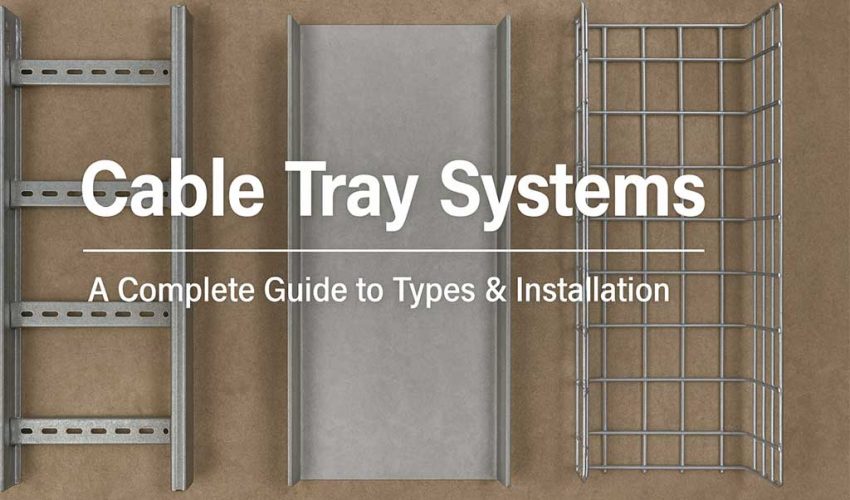
<li><strong>Ladder Type:</strong>&nbsp;The strongest design, featuring side rails and connecting rungs. Its open structure provides excellent cable ventilation, making it ideal for supporting large power cables in heavy industrial applications with long support spans.</li>


<li><strong>Solid Bottom Tray:</strong>&nbsp;Provides a continuous, solid surface that offers maximum protection to cables from dust, moisture, and physical interference. It is often used in commercial buildings for telecommunication and fiber-optic cables.</li>


<li><strong>Trough (Ventilated) Tray:</strong>&nbsp;Features a ventilated bottom, offering a balance between the strength of a ladder tray and the protection of a solid bottom. It provides good cable ventilation with more support than a ladder tray.</li>


<li><strong>Wire Mesh Tray:</strong>&nbsp;A lightweight and highly flexible solution made from welded steel wire. It allows for 360-degree cable access and is easy to modify on-site, making it perfect for data centers, office buildings, and control rooms where changes are frequent.</li>


<li><strong>Channel Type:</strong>&nbsp;Typically used for lighter cable loads in commercial and institutional applications. It is often used for backbone and horizontal distribution.</li>


<li><strong>Fiberglass (FRP) Tray:</strong>&nbsp;Manufactured from fiberglass-reinforced plastic, these trays are non-conductive and highly resistant to corrosion. They are essential in harsh environments like chemical plants, water treatment facilities, and coastal areas.</li>
</ul>


<p class="wp-block-paragraph"></p>


<h3 class="wp-block-heading"><strong>Essential Assembly and Installation Tips</strong></h3>


<p class="wp-block-paragraph">Proper installation is key to a safe and reliable system.</p>


<ol start="1" class="wp-block-list">
<li><strong>Plan the Route Meticulously:</strong>&nbsp;Before installation, create a detailed plan of the entire cable tray run, including all supports, bends, and tees. Ensure the route avoids interference with other utilities like pipes and ductwork.</li>


<li><strong>Select the Correct Tray and Load Rating:</strong>&nbsp;Always choose a tray system with a load rating (rung strength and side rail stiffness) that exceeds the total weight of all cables it will carry, including future additions.</li>


<li><strong>Secure Supports Properly:</strong>&nbsp;Supports must be anchored to the building structure at intervals specified by engineering standards and the manufacturer’s recommendations. The strength of the entire system relies on its supports.</li>


<li><strong>Ground the System Continuously:</strong>&nbsp;A cable tray system must be bonded and grounded as a continuous electrical conductor to ensure safety and protect against fault currents.</li>


<li><strong>Use Proper Fastening:</strong>&nbsp;Ensure all splice plates, connectors, and hardware are tightened to the specified torque. This maintains the mechanical and electrical continuity of the system.</li>


<li><strong>Maintain Bend Radius:</strong>&nbsp;When routing cables, the most critical rule is to never exceed the cable&#8217;s minimum bend radius. Sharp bends can damage cable insulation and impair performance.</li>


<li><strong>Implement Cable Management:</strong>&nbsp;Use accessories like cable ties, cleats, and straps within the tray to keep cables neatly organized, separated by voltage or signal type, and prevent stress on terminations.</li>


<li><strong>Consider Expansion Joints:</strong>&nbsp;In environments with significant temperature fluctuations, expansion joints should be installed to allow for thermal expansion and contraction of the tray, preventing stress and deformation.</li>
</ol>


<p class="wp-block-paragraph">A well-designed and installed <a href="https://www.cablify.ca/cable-tray-installation-toronto/">cable tray system</a> is more than just a support structure; it is a strategic investment in the safety, scalability, and longevity of a facility&#8217;s electrical and data infrastructure. By understanding the components, selecting the appropriate type for the environment, and adhering to best installation practices, you can create a robust cable management highway that will serve reliably for years to come.</p>
<p>The post <a href="https://www.cablify.ca/cable-tray-systems-a-complete-guide-to-types-installation/">Cable Tray Systems: A Complete Guide to Types &#038; Installation</a> appeared first on <a href="https://www.cablify.ca">Cablify</a>.</p>
]]></content:encoded>


			</item>
		<item>
		<title>Cable Management and Fire Safety in Commercial Installations</title>
		<link>https://www.cablify.ca/cable-management-and-fire-safety-in-commercial-installations/</link>
		
		<dc:creator><![CDATA[HP]]></dc:creator>
		<pubDate>Fri, 26 Sep 2025 22:12:07 +0000</pubDate>
				<category><![CDATA[Network Cabling]]></category>
		<category><![CDATA[cable derating]]></category>
		<category><![CDATA[cable management]]></category>
		<category><![CDATA[CMP cable]]></category>
		<category><![CDATA[CMR cable]]></category>
		<category><![CDATA[fire safety cabling]]></category>
		<category><![CDATA[NFPA cabling standards]]></category>
		<category><![CDATA[plenum-rated cabling]]></category>
		<category><![CDATA[structured cabling compliance]]></category>
		<guid isPermaLink="false">https://www.cablify.ca/?p=6949</guid>

					<description><![CDATA[<p>Compliance with NFPA, CMP vs CMR Jackets, Derating, and Plenum-Rated Solutions</p>
<p>The post <a href="https://www.cablify.ca/cable-management-and-fire-safety-in-commercial-installations/">Cable Management and Fire Safety in Commercial Installations</a> appeared first on <a href="https://www.cablify.ca">Cablify</a>.</p>
]]></description>
										<content:encoded><![CDATA[<div class="wpb-content-wrapper"><div class="vc_row wpb_row row"><div class="wpb_column vc_column_container col-sm-12"><div class="vc_column-inner"><div class="wpb_wrapper">
	<div class="wpb_text_column wpb_content_element" >
		<div class="wpb_wrapper">
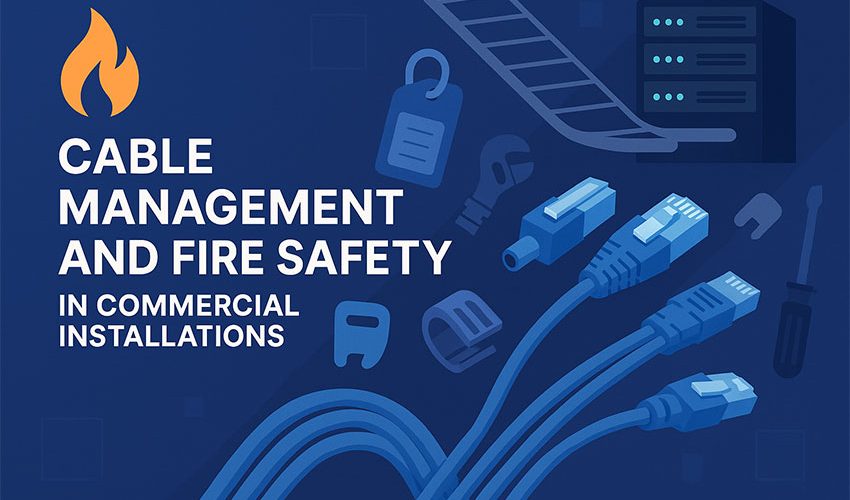
			<p>Fire safety in commercial installations is not only about sprinklers and alarms. The way cabling is designed, routed, and managed plays a direct role in preventing fire hazards, reducing smoke spread, and ensuring compliance with building codes. With thousands of low-voltage cables running through ceilings, risers, conduits, and plenum spaces, improper management can amplify risks during a fire event.</p>
<p>Regulatory bodies like the <strong>National Fire Protection Association (NFPA)</strong> establish strict guidelines, while cable manufacturers provide jacket ratings such as <strong>CMP (Plenum)</strong> and <strong>CMR (Riser)</strong> to ensure performance under fire conditions. Add to this the technical factors like ampacity derating, heat dissipation, and airflow restrictions, and the result is a highly complex area where engineering precision meets life safety.</p>
<p>This intersting article explores these requirements in detail, with a strong focus on <strong>NFPA standards</strong>, <strong>CMP vs CMR cable jackets</strong>, derating principles, and plenum-rated solutions for safe, compliant commercial cable installations.</p>

		</div>
	</div>
<div class="vc_empty_space"   style="height: 32px"><span class="vc_empty_space_inner"></span></div>
	<div class="wpb_text_column wpb_content_element" >
		<div class="wpb_wrapper">
			<p><img loading="lazy" decoding="async" class="aligncenter wp-image-6952 size-large" src="https://www.cablify.ca/wp-content/uploads/2025/09/Cable-Management-and-Fire-Safety-in-Commercial-Installations-683x1024.jpg" alt="Cable Management and Fire Safety in Commercial Installations" width="683" height="1024" srcset="https://www.cablify.ca/wp-content/uploads/2025/09/Cable-Management-and-Fire-Safety-in-Commercial-Installations-683x1024.jpg 683w, https://www.cablify.ca/wp-content/uploads/2025/09/Cable-Management-and-Fire-Safety-in-Commercial-Installations-200x300.jpg 200w, https://www.cablify.ca/wp-content/uploads/2025/09/Cable-Management-and-Fire-Safety-in-Commercial-Installations-768x1152.jpg 768w, https://www.cablify.ca/wp-content/uploads/2025/09/Cable-Management-and-Fire-Safety-in-Commercial-Installations.jpg 850w" sizes="auto, (max-width: 683px) 100vw, 683px" /></p>

		</div>
	</div>
<div class="vc_empty_space"   style="height: 32px"><span class="vc_empty_space_inner"></span></div>
	<div class="wpb_text_column wpb_content_element" >
		<div class="wpb_wrapper">
			<h3>NFPA Standards Governing Cable Installations</h3>
<p> Fire safety for cabling systems is not arbitrary; it is codified by the <strong>National Fire Protection Association (NFPA)</strong> through a series of interconnected standards. These standards define where specific cable ratings must be used, how fire testing is conducted, and how plenum and riser spaces are treated in commercial buildings. </p>
<h4>NFPA 70 – National Electrical Code (NEC)</h4>
<p>The <strong>National Electrical Code (NEC)</strong>, updated every three years, is the cornerstone of electrical safety in the United States. It establishes the requirements for safe electrical design, installation, and inspection to protect people and property from electrical hazards.</p>
<p>The articles most relevant to low-voltage and communication cabling include:</p>
<ul>
<li>
<p><strong>Article 725</strong> – Covers Class 1, 2, and 3 remote-control, signaling, and power-limited circuits. These are common in building automation, security systems, and access control.</p>
</li>
<li>
<p><strong>Article 770</strong> – Governs optical fiber cables and raceways, ensuring proper fire rating of fiber infrastructure.</p>
</li>
<li>
<p><strong>Article 800</strong> – Defines rules for general communication systems, including structured cabling for voice and data.</p>
</li>
<li>
<p><strong>Article 820</strong> – Applies to community antenna television and radio distribution systems (CATV).</p>
</li>
<li>
<p><strong>Article 830</strong> – Addresses network-powered broadband systems, where both power and data are delivered over a single infrastructure.</p>
</li>
</ul>
<p> &nbsp; </p>
<h3><strong>Key NEC principles for fire safety:</strong></h3>
<ul>
<li>
<p><strong>Listing and Marking</strong>: All cables must be UL-listed and clearly marked with their fire rating (CMP, CMR, CM, etc.).</p>
</li>
<li>
<p><strong>Plenum Spaces</strong>: Any cable installed in ducts, plenums, or air-handling areas must be CMP-rated to minimize smoke and flame spread.</p>
</li>
<li>
<p><strong>Riser Spaces</strong>: Vertical shafts that connect multiple floors require CMR-rated cables to prevent fire migration between stories.</p>
</li>
<li>
<p><strong>Fire Testing</strong>: Combustibility, smoke density, and flame propagation are the critical metrics tested before a cable can be classified for a specific environment.</p>
</li>
</ul>
<p> &nbsp; </p>
<p>By enforcing these rules, NEC ensures that cable systems do not become fire accelerants or sources of toxic smoke during emergencies.</p>

		</div>
	</div>

	<div class="wpb_text_column wpb_content_element" >
		<div class="wpb_wrapper">
			<h4>NFPA 90A – Air-Conditioning and Ventilating Systems</h4>
<p>NFPA 90A focuses on <strong>air-handling systems</strong> in buildings. It specifically regulates materials used in plenums—the spaces above suspended ceilings and below raised floors that often serve as air return paths for HVAC systems.</p>
<p>Why this matters for cabling:</p>
<ul>
<li>
<p>In the event of a fire, a plenum acts as a <strong>smoke highway</strong>, distributing toxic gases rapidly throughout a building.</p>
</li>
<li>
<p>Materials installed in these areas must be <strong>low-smoke and flame-resistant</strong> to reduce risks.</p>
</li>
<li>
<p>As a direct result, NEC references NFPA 90A when requiring <strong>CMP-rated cables</strong> for plenum spaces.</p>
</li>
</ul>
<p>In practice, this means any installer running data cabling in ceilings or raised floors used for air return must use CMP cable, even if it is more expensive than CMR or CM.</p>

		</div>
	</div>

	<div class="wpb_text_column wpb_content_element" >
		<div class="wpb_wrapper">
			<h4>NFPA 262 – Standard Method of Test for Flame Travel and Smoke of Wires and Cables</h4>
<p>NFPA 262 defines the <strong>Plenum Flame Test</strong>, also called the <strong>Steiner Tunnel Test</strong>. It is the benchmark for determining whether a cable qualifies as CMP-rated.</p>
<p>The test evaluates:</p>
<ul>
<li>
<p><strong>Flame Spread Distance</strong>: How far flames travel along a cable in a horizontal air-handling space.</p>
</li>
<li>
<p><strong>Smoke Density</strong>: How much smoke is produced, measured optically within the test chamber.</p>
</li>
<li>
<p><strong>Self-Extinguishing Properties</strong>: Whether the cable continues to burn once the ignition source is removed.</p>
</li>
</ul>
<p>&nbsp;</p>
<p>Only cables that pass NFPA 262 are permitted to carry the CMP designation. This ensures that plenum-installed cables will resist flame spread and produce minimal smoke, giving building occupants more time to evacuate and first responders a safer environment to operate in.</p>
<p>This trio of NFPA standards—<strong>NFPA 70 (NEC), NFPA 90A, and NFPA 262</strong>—forms the backbone of <strong>fire safety compliance in commercial cable installations</strong>. Together, they regulate how cables are rated, tested, and deployed across risers, plenums, and general spaces in a building.</p>

		</div>
	</div>
<div class="vc_empty_space"   style="height: 32px"><span class="vc_empty_space_inner"></span></div>
	<div class="wpb_text_column wpb_content_element" >
		<div class="wpb_wrapper">
			<h2 data-start="3558" data-end="3604">Cable Jacket Ratings: CMP vs CMR vs CM</h2>

		</div>
	</div>

	<div class="wpb_text_column wpb_content_element" >
		<div class="wpb_wrapper">
			<p><img loading="lazy" decoding="async" class="aligncenter size-large wp-image-6961" src="https://www.cablify.ca/wp-content/uploads/2025/09/CMP-vs-CMR-vs-CM-Cable-Jackets-683x1024.jpg" alt="CMP vs CMR vs CM Cable Jackets" width="640" height="960" srcset="https://www.cablify.ca/wp-content/uploads/2025/09/CMP-vs-CMR-vs-CM-Cable-Jackets-683x1024.jpg 683w, https://www.cablify.ca/wp-content/uploads/2025/09/CMP-vs-CMR-vs-CM-Cable-Jackets-200x300.jpg 200w, https://www.cablify.ca/wp-content/uploads/2025/09/CMP-vs-CMR-vs-CM-Cable-Jackets-768x1152.jpg 768w, https://www.cablify.ca/wp-content/uploads/2025/09/CMP-vs-CMR-vs-CM-Cable-Jackets.jpg 850w" sizes="auto, (max-width: 640px) 100vw, 640px" /></p>

		</div>
	</div>

	<div class="wpb_text_column wpb_content_element" >
		<div class="wpb_wrapper">
			<p>Cable jackets are the first line of defense in a fire, and their ratings—governed by <strong>Underwriters Laboratories (UL)</strong> and referenced in <strong>NFPA codes</strong> like the NEC—define exactly where and how they can be safely installed. Choosing the correct rating is critical for code compliance and life safety.</p>
<p>&nbsp;</p>
<h3><strong>CMP – Communications Plenum Cable</strong></h3>
<ul>
<li>
<p><strong>Location:</strong> Required in <strong>plenum spaces</strong>, which are areas used for environmental air circulation. This includes the space above suspended ceilings or below raised floors when used as an air return pathway, as well as in air-handling ducts.</p>
</li>
<li>
<p><strong>Fire Resistance &amp; Test Standard:</strong> Must meet the stringent <strong>UL 910/NFPA 262</strong> &#8220;Steiner Tunnel&#8221; test. This test measures flame spread and smoke density. CMP cable is engineered to have extremely <strong>low flame spread</strong> and produce <strong>minimal smoke</strong>, crucial for maintaining visibility and air quality during evacuation.</p>
</li>
<li>
<p><strong>Materials:</strong> Typically constructed with advanced materials like <strong>Fluorinated Ethylene Propylene (FEP)</strong> or specially formulated <strong>low-smoke polyvinyl chloride (PVC)</strong>.</p>
</li>
<li>
<p><strong>Cost:</strong> This is the <strong>most expensive</strong> option due to the high-grade materials and rigorous manufacturing standards required to pass the plenum test.</p>
</li>
</ul>
<p>&nbsp;</p>
<h3><strong>CMR – Communications Riser Cable</strong></h3>
<ul>
<li>
<p><strong>Location:</strong> Designed for installation in <strong>vertical riser shafts</strong> that run between floors of a building. Its primary function is to prevent a fire from rapidly spreading from one floor to another.</p>
</li>
<li>
<p><strong>Fire Resistance &amp; Test Standard:</strong> Must pass the <strong>UL 1666</strong> riser flame test. This test simulates a fire in a vertical shaft and is less stringent than the plenum test for smoke production.</p>
</li>
<li>
<p><strong>Materials:</strong> Generally uses standard <strong>PVC</strong> with added <strong>flame-retardant</strong> chemicals to inhibit vertical flame travel.</p>
</li>
<li>
<p><strong>Cost:</strong> Less expensive than CMP, but typically more costly than general-purpose CM cable.</p>
</li>
</ul>
<p>&nbsp;</p>
<h3><strong>CM – Communications General Purpose Cable</strong></h3>
<ul>
<li>
<p><strong>Location:</strong> Suitable for general <strong>horizontal, single-floor</strong> applications. It is intended for use in open office areas and cannot be run in vertical risers or plenum spaces.</p>
</li>
<li>
<p><strong>Fire Resistance &amp; Test Standard:</strong> Rated to pass the <strong>UL 1685</strong> vertical-tray flame test, which is the baseline standard for communications cable.</p>
</li>
<li>
<p><strong>Cost:</strong> This is the <strong>lowest-cost</strong> option.</p>
</li>
<li>
<p><strong>Key Limitation:</strong> <strong>CM cable cannot be substituted for CMP or CMR</strong> in their required areas, as it does not provide the necessary fire-blocking characteristics.</p>
</li>
</ul>
<p>&nbsp;</p>
<h3><strong>The Substitution Hierarchy: A Simple Rule</strong></h3>
<p>A key principle in cabling is the substitution hierarchy, which follows a &#8220;better is allowed&#8221; rule for safety:</p>
<ul>
<li>
<p><strong>CMP can be used to replace CMR or CM.</strong> You can always use a higher-rated cable in a less demanding application.</p>
</li>
<li>
<p><strong>CMR can replace CM but cannot replace CMP.</strong> Riser-rated cable is not safe for air-handling spaces due to its higher smoke production.</p>
</li>
<li>
<p><strong>CM cannot replace CMP or CMR.</strong> Using a general-purpose cable in a riser or plenum is a serious code violation and creates a significant fire hazard.</p>
</li>
</ul>

		</div>
	</div>
<div class="vc_separator wpb_content_element vc_separator_align_center vc_sep_width_100 vc_sep_pos_align_center vc_separator_no_text vc_sep_color_grey wpb_content_element  wpb_content_element" ><span class="vc_sep_holder vc_sep_holder_l"><span class="vc_sep_line"></span></span><span class="vc_sep_holder vc_sep_holder_r"><span class="vc_sep_line"></span></span>
</div>
	<div class="wpb_text_column wpb_content_element" >
		<div class="wpb_wrapper">
			<h2>Why Cable Fire Ratings Matter</h2>
<p>Cables are made of polymers that can become fuel during a fire. When non-rated or poorly rated cables burn:</p>
<ul>
<li>
<p>Flames travel faster through riser shafts, spreading between floors.</p>
</li>
<li>
<p>Toxic smoke fills plenum airspaces, spreading quickly through HVAC systems.</p>
</li>
<li>
<p>Occupants are exposed to carbon monoxide, hydrogen chloride, and other harmful gases.</p>
</li>
<li>
<p>First responders face reduced visibility and higher risk.</p>
</li>
</ul>
<p>&nbsp;</p>
<p>For example, a study by NIST (National Institute of Standards and Technology) found that toxic smoke from low-quality cabling was a leading factor in <strong>reduced survival times</strong> in commercial building fires.</p>

		</div>
	</div>
<div class="vc_separator wpb_content_element vc_separator_align_center vc_sep_width_100 vc_sep_pos_align_center vc_separator_no_text vc_sep_color_grey wpb_content_element  wpb_content_element" ><span class="vc_sep_holder vc_sep_holder_l"><span class="vc_sep_line"></span></span><span class="vc_sep_holder vc_sep_holder_r"><span class="vc_sep_line"></span></span>
</div>
	<div class="wpb_text_column wpb_content_element" >
		<div class="wpb_wrapper">
			<h2>Cable Derating: Managing Heat and Current Capacity</h2>
<p>Derating refers to reducing the ampacity (current-carrying capacity) of cables when certain conditions increase their operating temperature.</p>
<h3>Factors Affecting Derating</h3>
<ul>
<li>
<p><strong>Bundling</strong>: Heat buildup when cables are tightly bundled.</p>
</li>
<li>
<p><strong>Ambient Temperature</strong>: Higher ceiling or plenum temperatures reduce safe ampacity.</p>
</li>
<li>
<p><strong>Installation Pathways</strong>: Conduits restrict heat dissipation.</p>
</li>
<li>
<p><strong>Power over Ethernet (PoE)</strong>: High-power PoE (IEEE 802.3bt, up to 90W) increases conductor heating.</p>
</li>
</ul>
<p>&nbsp;</p>
<h3>NEC Derating Guidelines</h3>
<ul>
<li>
<p>More than <strong>7 conductors bundled</strong> in a conduit requires derating.</p>
</li>
<li>
<p>Large bundles (48–96 cables) require spacing, airflow, or separators to control temperature.</p>
</li>
<li>
<p>CMP cables in plenums often include low-smoke insulation that handles higher thermal stress.</p>
</li>
</ul>
<p>&nbsp;</p>
<h3>Practical Implications</h3>
<ul>
<li>
<p>Installers should avoid large, dense bundles.</p>
</li>
<li>
<p>Cable trays with airflow gaps are preferred.</p>
</li>
<li>
<p>PoE applications above 60W often require Cat6a or higher with CMP jackets to minimize heating.</p>
</li>
</ul>

		</div>
	</div>
<div class="vc_separator wpb_content_element vc_separator_align_center vc_sep_width_100 vc_sep_pos_align_center vc_separator_no_text vc_sep_color_grey wpb_content_element  wpb_content_element" ><span class="vc_sep_holder vc_sep_holder_l"><span class="vc_sep_line"></span></span><span class="vc_sep_holder vc_sep_holder_r"><span class="vc_sep_line"></span></span>
</div>
	<div class="wpb_text_column wpb_content_element" >
		<div class="wpb_wrapper">
			<h2>Plenum-Rated Solutions in Commercial Installations</h2>
<h3>Where Plenum Cable is Required</h3>
<ul>
<li>
<p>Above suspended ceilings used as air returns.</p>
</li>
<li>
<p>Under raised floors with HVAC airflow.</p>
</li>
<li>
<p>Any space classified as a plenum by building inspectors.</p>
</li>
</ul>
<p>&nbsp;</p>
<h3>Advantages of CMP in Safety</h3>
<ul>
<li>
<p>Resists flame spread.</p>
</li>
<li>
<p>Produces low smoke, allowing more evacuation time.</p>
</li>
<li>
<p>Meets both NEC and NFPA 90A requirements.</p>
</li>
</ul>
<p>&nbsp;</p>
<h3>Cost vs Safety Trade-off</h3>
<p>CMP cables can cost <strong>40–60% more</strong> than CMR. However, the risk of non-compliance includes:</p>
<ul>
<li>
<p>Failed inspections.</p>
</li>
<li>
<p>Fines and retrofit costs.</p>
</li>
<li>
<p>Increased liability in fire incidents.</p>
</li>
</ul>

		</div>
	</div>
<div class="vc_separator wpb_content_element vc_separator_align_center vc_sep_width_100 vc_sep_pos_align_center vc_separator_no_text vc_sep_color_grey wpb_content_element  wpb_content_element" ><span class="vc_sep_holder vc_sep_holder_l"><span class="vc_sep_line"></span></span><span class="vc_sep_holder vc_sep_holder_r"><span class="vc_sep_line"></span></span>
</div>
	<div class="wpb_text_column wpb_content_element" >
		<div class="wpb_wrapper">
			<h3 data-start="146" data-end="197">Best Practices for Fire-Safe Cable Management</h3>

		</div>
	</div>

	<div class="wpb_text_column wpb_content_element" >
		<div class="wpb_wrapper">
			<p><img loading="lazy" decoding="async" class="aligncenter wp-image-6956 size-large" src="https://www.cablify.ca/wp-content/uploads/2025/09/Cable-Management-Best-Practices-683x1024.jpg" alt="Best Practices for Fire-Safe Cable Management" width="683" height="1024" srcset="https://www.cablify.ca/wp-content/uploads/2025/09/Cable-Management-Best-Practices-683x1024.jpg 683w, https://www.cablify.ca/wp-content/uploads/2025/09/Cable-Management-Best-Practices-200x300.jpg 200w, https://www.cablify.ca/wp-content/uploads/2025/09/Cable-Management-Best-Practices-768x1152.jpg 768w, https://www.cablify.ca/wp-content/uploads/2025/09/Cable-Management-Best-Practices.jpg 850w" sizes="auto, (max-width: 683px) 100vw, 683px" /></p>

		</div>
	</div>

	<div class="wpb_text_column wpb_content_element" >
		<div class="wpb_wrapper">
			<ul>
<li>
<p><strong>Plan Pathways Early</strong><br />Coordinate with HVAC and electrical contractors during the design stage. Misplaced cable runs in plenums or risers can force non-compliant installations or expensive rework. Early planning ensures correct separation of air-handling ducts, riser shafts, and general spaces so the right jacket ratings (CMP, CMR, CM) are used from the start.</p>
</li>
<li>
<p><strong>Use Cable Trays and Ladder Racks</strong><br />Trays and racks improve organization, keep cables elevated, and maintain airflow around bundles. Open ladder racks are preferred over solid-bottom trays because they allow better cooling, which is important for high-density PoE installations. This also reduces the risk of overheating and supports derating compliance.</p>
</li>
<li>
<p><strong>Follow Bend Radius Rules</strong><br />Every cable category has a minimum bend radius (typically 4× cable diameter for UTP and 10× for fiber). Bending beyond this limit can crack the jacket, damaging shielding or insulation. A compromised jacket not only affects performance but may also reduce flame-retardant effectiveness, increasing fire risk.</p>
</li>
<li>
<p><strong>Segregate Power and Data</strong><br />Power cables and data cables should not share the same tray without separation. This reduces <strong>electromagnetic interference (EMI)</strong> and prevents excessive heating. Fire load is also reduced when high-current power circuits are isolated from low-voltage communications cabling.</p>
</li>
<li>
<p><strong>Label and Document</strong><br />Proper labeling makes future inspections and upgrades faster. Documentation is critical for proving compliance during audits or AHJ (Authority Having Jurisdiction) reviews. Labels should include cable type, fire rating, and pathway location.</p>
</li>
<li>
<p><strong>Avoid Abandoned Cable</strong><br />NEC requires the removal of unused or abandoned cables because they add unnecessary combustible material. Old PVC jackets in particular can produce toxic smoke during a fire. Removing abandoned cable reduces fire load and ensures code compliance.</p>
</li>
</ul>

		</div>
	</div>
<div class="vc_separator wpb_content_element vc_separator_align_center vc_sep_width_100 vc_sep_pos_align_center vc_separator_no_text vc_sep_color_grey wpb_content_element  wpb_content_element" ><span class="vc_sep_holder vc_sep_holder_l"><span class="vc_sep_line"></span></span><span class="vc_sep_holder vc_sep_holder_r"><span class="vc_sep_line"></span></span>
</div>
	<div class="wpb_text_column wpb_content_element" >
		<div class="wpb_wrapper">
			<p><a href="https://www.cablify.ca/it-cable-management/">Cable management</a> is no longer just about neatness and organization. In commercial installations, it directly impacts <strong>fire safety, code compliance, and liability</strong>. Understanding NFPA requirements, choosing the correct jacket ratings (CMP vs CMR), applying derating principles, and installing plenum-rated solutions are critical steps for engineers, contractors, and building owners.</p>
<p>Investing in proper cable management reduces fire risk, protects occupants, ensures regulatory compliance, and avoids costly retrofits. In modern commercial environments with high-density cabling and growing PoE power loads, <strong>fire safety through proper cabling practices is non-negotiable</strong>.</p>

		</div>
	</div>
</div></div></div></div>
</div><p>The post <a href="https://www.cablify.ca/cable-management-and-fire-safety-in-commercial-installations/">Cable Management and Fire Safety in Commercial Installations</a> appeared first on <a href="https://www.cablify.ca">Cablify</a>.</p>
]]></content:encoded>


			</item>
	</channel>
</rss>